
A cushion supplier may promise “wholesale pricing” within minutes, but that number means very little until you know exactly what you are getting for it. For a retailer, buying 500 or 1,000 cushions with the wrong fabric, filling, dimensions, finish, or packaging can turn a seemingly good deal into slow-moving inventory.
The opportunity is significant: one current estimate puts India’s cushion and pillow market at USD 827.9 million in 2025, with the market expected to grow to USD 1,388.8 million by 2034. Manufacturers across clusters such as Panipat, Jaipur, Delhi-NCR, and other textile hubs serve different product and production requirements.
That is why sourcing needs to begin with a clear buying brief rather than a random catalogue search. The guide ahead covers how to identify a suitable wholesale cushion manufacturer, evaluate product specifications, request samples, compare MOQs and pricing, verify production capabilities, and move from enquiry to bulk order with fewer surprises.
How To Export Cushions in Bulk From Wholesale Cushion Supplier
For Indian exporters, overseas cushion orders require careful coordination between product specifications, supplier commitments, freight, and international buyers. The key considerations for exporting cushions in bulk are explained below.
Step 1: Define Your Cushion Specifications Before Contacting Suppliers
One of the most common sourcing mistakes is asking a manufacturer for a quotation without providing enough product information.
A message such as “Please send your best price for 500 cushions” does not tell the manufacturer what needs to be manufactured.
Before contacting a wholesale cushion manufacturer, prepare a basic product brief.
Your brief should cover the following.
- Fabric And GSM
Specify the fabric rather than simply saying “premium fabric.” For example, cotton, cotton canvas, velvet, polyester, linen or linen blends, jacquard, and printed fabrics.
GSM, or grams per square metre, provides an indication of fabric weight. A 300 GSM velvet and a 200 GSM cotton canvas will have very different hand feel, appearance, construction requirements, and cost.
The exact GSM should be selected according to the intended positioning and use of the cushion rather than chosen simply because the number is higher.
- Dimensions
Decide whether you require standard or custom cushion sizes. Common retail sizes may include 16 × 16 inches, 18 × 18 inches, 20 × 20 inches, 40 × 40 cm, 45 × 45 cm, and custom dimensions.
If you are developing a collection, specify the finished cushion dimensions rather than leaving sizing open to interpretation.
- Filling
The filling affects the cushion's appearance, firmness, comfort, weight, and price. Depending on the product, you may consider fibre, cotton, and other specified filling materials based on your product requirements.
Tell the manufacturer whether the filling needs to provide a soft decorative appearance, firmer support, or another defined feel.
- Closure
Your specification should identify the required closure. Common choices include hidden zipper, envelope closure, and button closure.
For retail collections, the closure should be agreed during sampling because it can influence both appearance and construction.
- Print Or Surface Design
If you need printed cushions, specify the expected print method where relevant. Possible methods include digital printing, screen printing, block printing, embroidery, and jacquard construction.
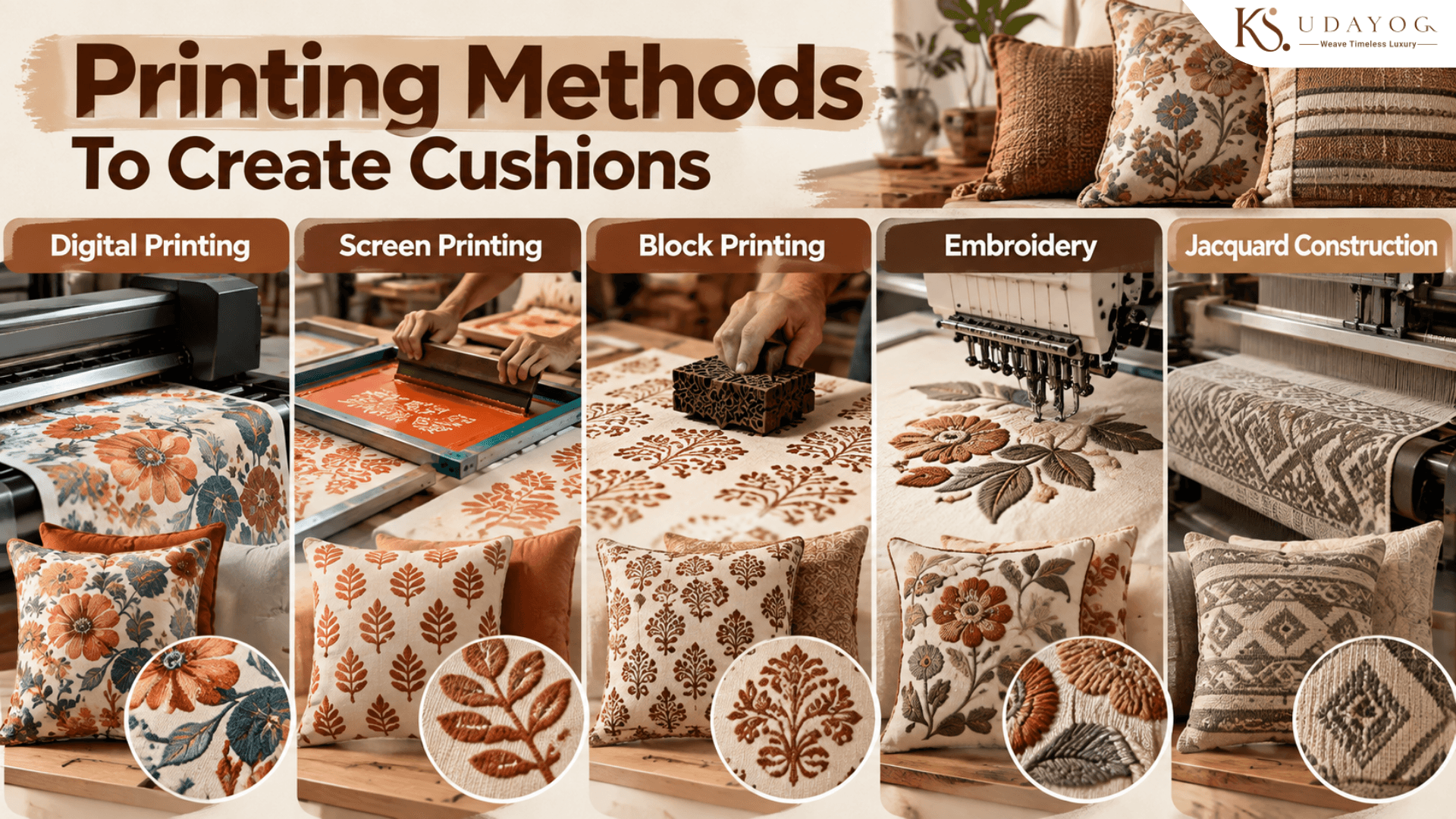
Your choice depends on the artwork, fabric, quantity, design complexity, and desired finish.
- Labels And Branding
If you are selling cushions under your own brand, mention branding requirements at the beginning. Discuss woven labels, printed labels, care labels, brand tags, packaging, barcode requirements, and carton markings.
A complete brief allows a manufacturer to provide a more meaningful quotation.
Step 2: Choose The Right Indian Manufacturing Region
India has several established textile and home-furnishing manufacturing clusters, and different regions have developed strengths across different textile categories.
For cushion sourcing, the manufacturing region can be relevant depending on the construction, material, printing method, and broader home-textile requirement.
- Panipat: Panipat is particularly relevant to home furnishings and textile products. For buyers looking for a manufacturer that can work across multiple home-textile categories, its industrial ecosystem can be useful.
- Jaipur: Jaipur is widely associated with printed textiles, block-printing traditions, artisan products, and decorative home furnishings.
- It can be relevant when the design direction depends heavily on traditional prints or handcrafted visual elements.
- Karur: Karur is another important Indian textile centre, particularly associated with woven and cotton home-textile products.
The important point is not to select a supplier only because of its city. Evaluate the actual factory, product capability, sampling process, quality controls, MOQ, and communication before placing an order.
Step 3: Shortlist A Cushion Supplier Using Practical Checks
Once you have identified potential suppliers, compare them using the same criteria. A cushion manufacturer should be able to answer basic commercial and production questions clearly.
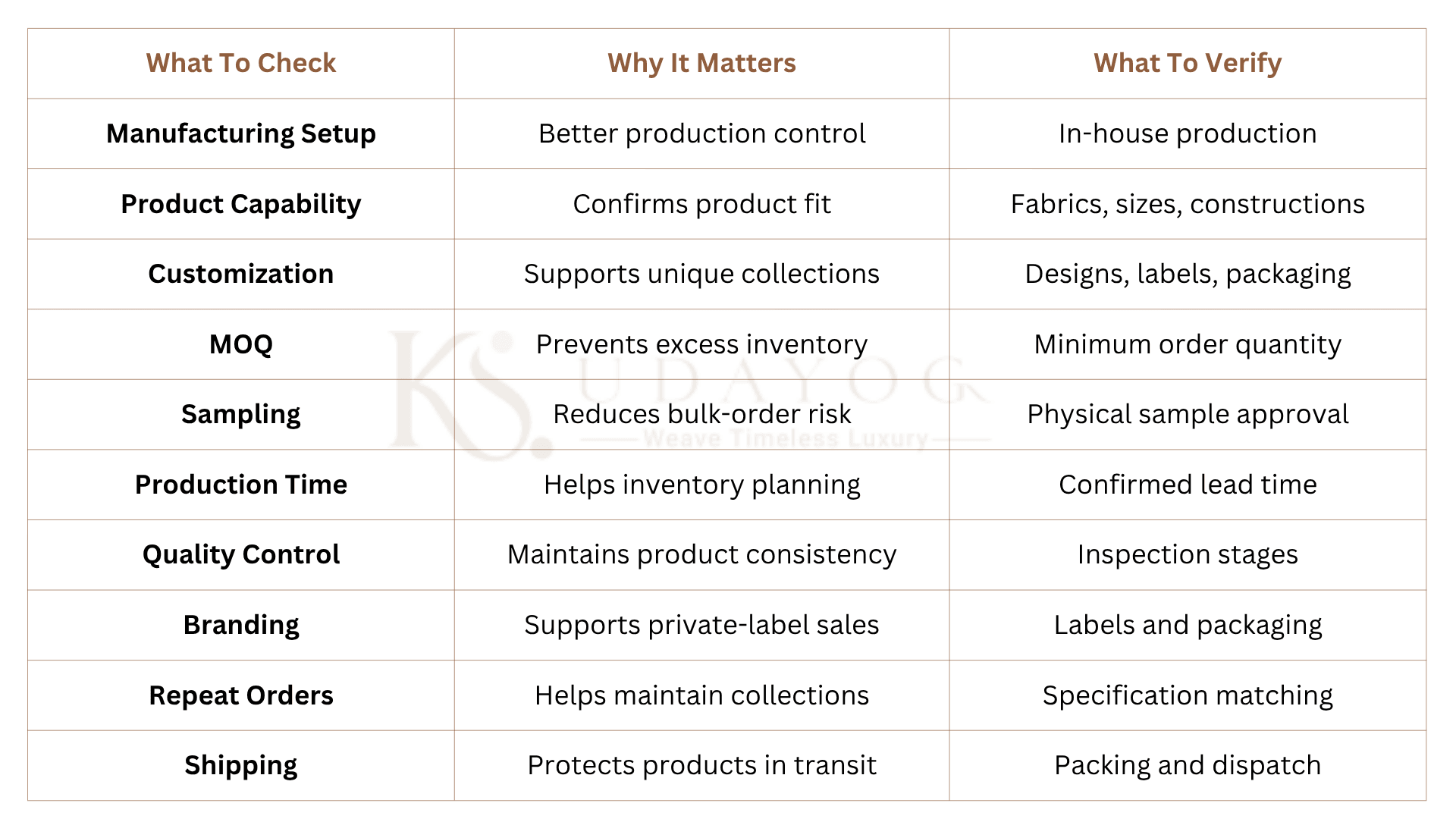
Do not compare suppliers only by their quoted price.
A lower quotation may not remain lower if you later encounter inconsistent dimensions, poor stitching, unsuitable fabric, incorrect filling, damaged packaging, or a requirement to remake part of the order.
Step 4: Understand MOQ Before Planning Your Bulk Cushion Order
MOQ means Minimum Order Quantity. It tells you the minimum quantity a manufacturer is prepared to produce under defined commercial conditions.
For custom cushion manufacturing, MOQ can vary depending on fabric, design, printing method, size, colour, customization, packaging, and production requirements.
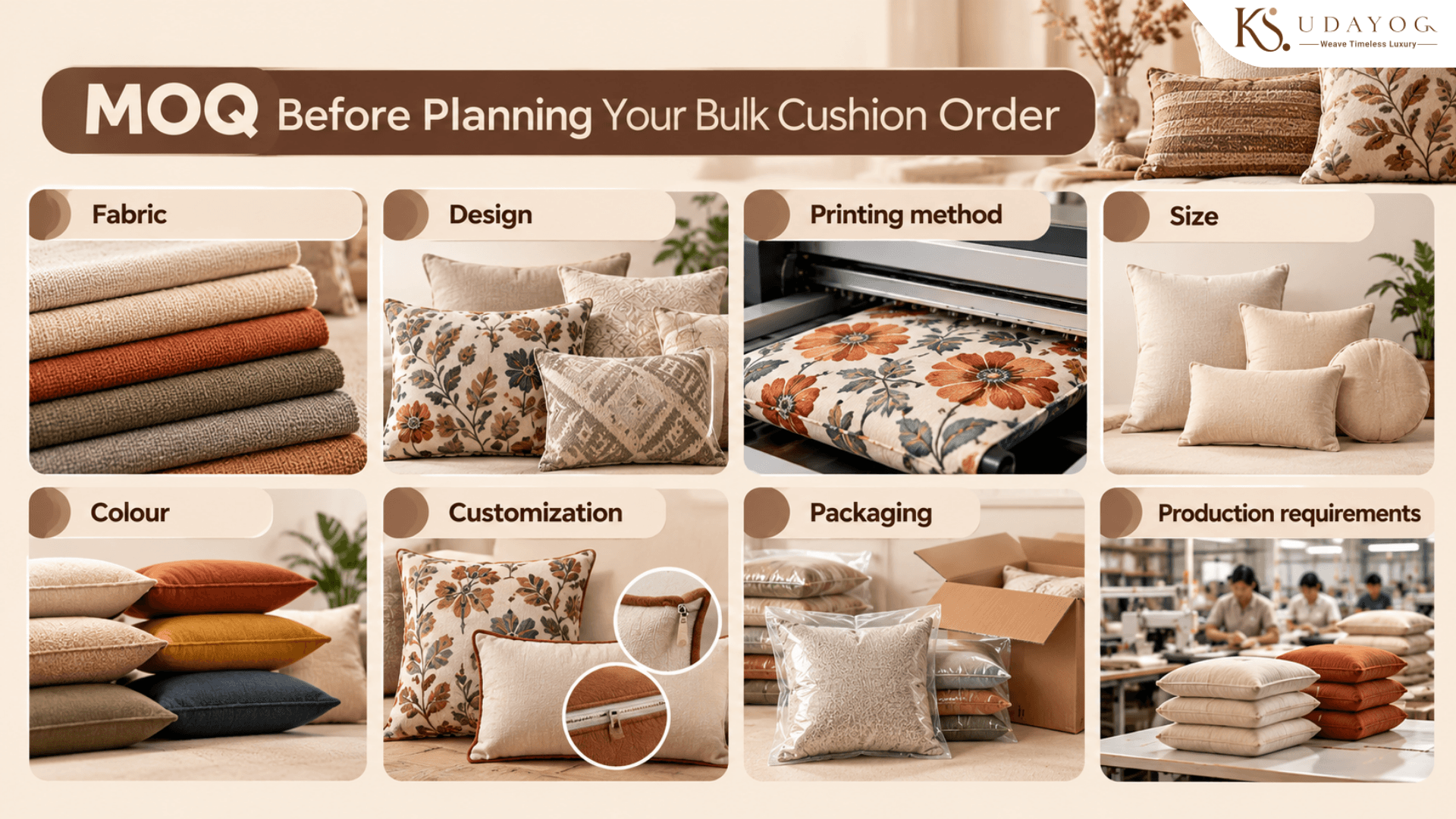
Some commercial custom runs may require hundreds of pieces per design or colourway, but there is no universal MOQ that applies to every manufacturer or cushion type.
Therefore, instead of assuming that every supplier will accept the same quantity, ask:
“What is your MOQ for this exact fabric, size, design, and construction?”
This gives you a much more useful answer.
For retailers, MOQ should also be considered against expected sales volume. Ordering too many designs in small quantities can increase procurement complexity, while ordering excessive quantities of an untested design can tie up working capital.
Step 5: Send A Proper Cushion Tech Pack
A tech pack does not need to be complicated.
For a cushion, it should communicate enough information for the manufacturer to understand exactly what you want to produce.
A basic cushion tech pack can include:
- Product Name: Decorative Cushion
- Finished Size: 16 × 16 inches
- Fabric: 300 GSM Velvet
- Front Design: Supplied artwork
- Back Fabric: Defined separately
- Filling: Fibre-filled
- Closure: Hidden zipper
- Label: Brand label required
- Packaging: Individual polybag or specified packaging
- Quantity: 500 pieces per design
- Colour: Approved colour reference
- Reference Image: Attached
For custom printed cushions, provide high-resolution artwork whenever possible.
For repeat production, retain the approved specifications and sample reference. This gives both the buyer and manufacturer a common reference point.
Step 6: Always Request A Physical Sample Before Bulk Cushion Production
A digital design can look correct on a screen and still produce a different physical result.
This is why sampling is one of the most important stages in sourcing wholesale cushions.
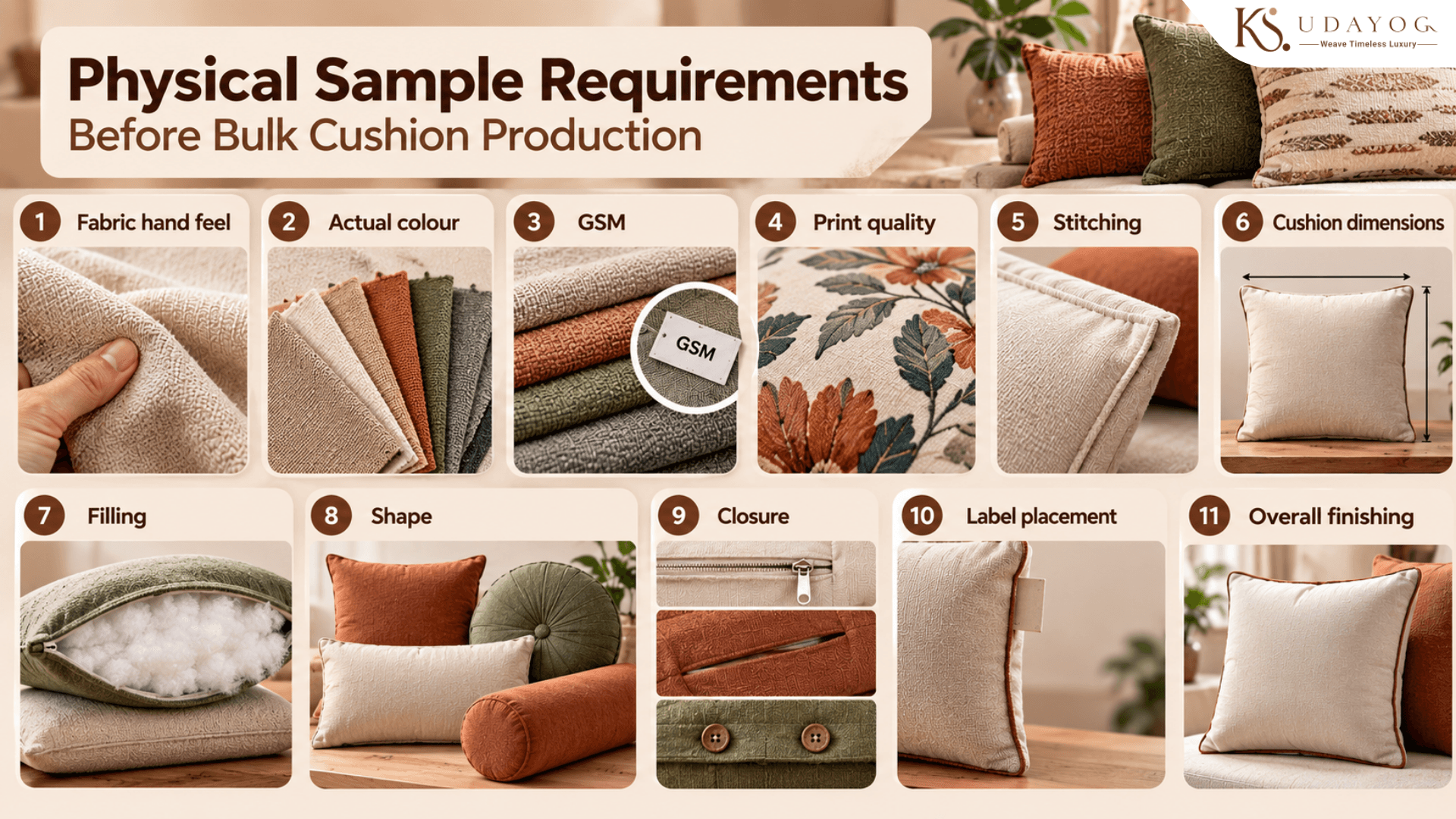
For custom cushions, do not approve production only from a digital artwork file if the physical characteristics matter to your collection.
If changes are required, communicate them before approving the final sample.
What Is A Golden Sample?
A golden sample is the approved physical reference that represents what the manufacturer should reproduce during bulk production. This becomes particularly useful when you plan repeat orders.
Compare Quotations Beyond The Per-Piece Price
A cushion quotation should be understood as more than a single number. Ask the supplier to clarify what the quoted price includes.
Also clarify whether the quotation covers packaging, transportation, taxes, or other applicable charges.
This helps you compare suppliers on a like-for-like basis.
Step 8: Check Quality Before The Full Production Run
Quality control should begin before the cushions reach the packing stage. For a bulk cushion order, retailers should consider checking the following.
- Check whether the fabric matches the approved sample in appearance, weight, texture, and construction.
- Measure finished cushions against the approved specifications.
- Look for uneven seams, loose threads, skipped stitches, weak corners, and inconsistent finishing.
- Check whether cushions have the expected filling type, volume, firmness, and shape.
- Compare colour, placement, sharpness, and repeatability against the approved artwork or sample.
- Open and close zippers or other closures to verify that they operate correctly.
- Check brand labels, care labels, tags, and placement requirements.
- Inspect whether the packaging protects the cushions during handling, storage, and transportation.
For larger commercial orders, buyers can also consider independent inspection services where appropriate. The inspection method should match the size, value, destination, and risk profile of the order.
Step 9: Discuss Payment Terms And Delivery Before Production
Never leave commercial terms until after manufacturing has started.
Before confirming the order, document:
- Total order quantity
- Unit price
- Sample approval
- Payment schedule
- Production timeline
- Packaging requirements
- Inspection arrangements
- Shipping terms
- Delivery location
- Required documentation
Payment structures vary by supplier and order, so buyers should agree on the exact terms in writing rather than relying on generic percentages found online.
For export orders, buyers may also need documentation such as commercial invoices, packing lists, bills of lading, and certificates of origin, depending on the shipment and destination requirements.
Step 10: Plan Packaging For Wholesale Cushion Orders
Packaging becomes especially important when ordering bulk cushions because products may pass through several handling points before reaching your store or warehouse.
Discuss:
- Individual packaging
- Carton quantity
- Carton dimensions
- Product labels
- SKU/barcode labels
- Outer carton markings
- Moisture protection where required
- Shipping configuration
If the cushions are intended for retail shelves, packaging should also match your presentation requirements.
A manufacturer who understands your final sales channel can help you plan the product accordingly.
Quick Answer: How Do You Source Cushions From A Wholesale Manufacturer?
To source cushions in bulk, first define your fabric, GSM, size, filling, construction, design, quantity, packaging, and labeling requirements.
Then shortlist cushion manufacturers based on their production capability, customization options, MOQ, sampling process, quality-control practices, and ability to repeat approved specifications.
Request samples and quotations, compare the physical products against your requirements, approve a final sample, and confirm production, inspection, packaging, payment, and delivery terms before placing the bulk order.
For Indian retailers, working directly with a cushion manufacturer can also provide greater control over product specifications and collection development than purchasing through multiple intermediaries.
Why Retailers Should Buy Cushions Directly From A Manufacturer
When a retailer sources cushions through multiple layers of suppliers, it can become difficult to understand where the product was made, how specifications are controlled, and whether the same design can be reproduced later.
Buying directly from a manufacturer gives you an opportunity to discuss the product at the production stage.
This becomes particularly important when you need:
- Multiple sizes within one collection
- Specific fabric weights
- Custom prints or patterns
- Different filling options
- Private-label packaging
- Branded labels
- Repeat production
- Large quantities
- Consistent specifications across batches
- Custom designs for your store or brand
For example, a retailer developing a 12-design cushion collection may need the same fabric appearance, filling density, dimensions, zipper construction, and finishing across every design. These requirements should be discussed before production rather than after the goods arrive.
The objective is not simply to find a cheap cushion supplier. It is to find a manufacturing partner capable of producing the product your customers expect at a commercially workable cost.
How KS Udayog Supports Bulk Cushion Sourcing
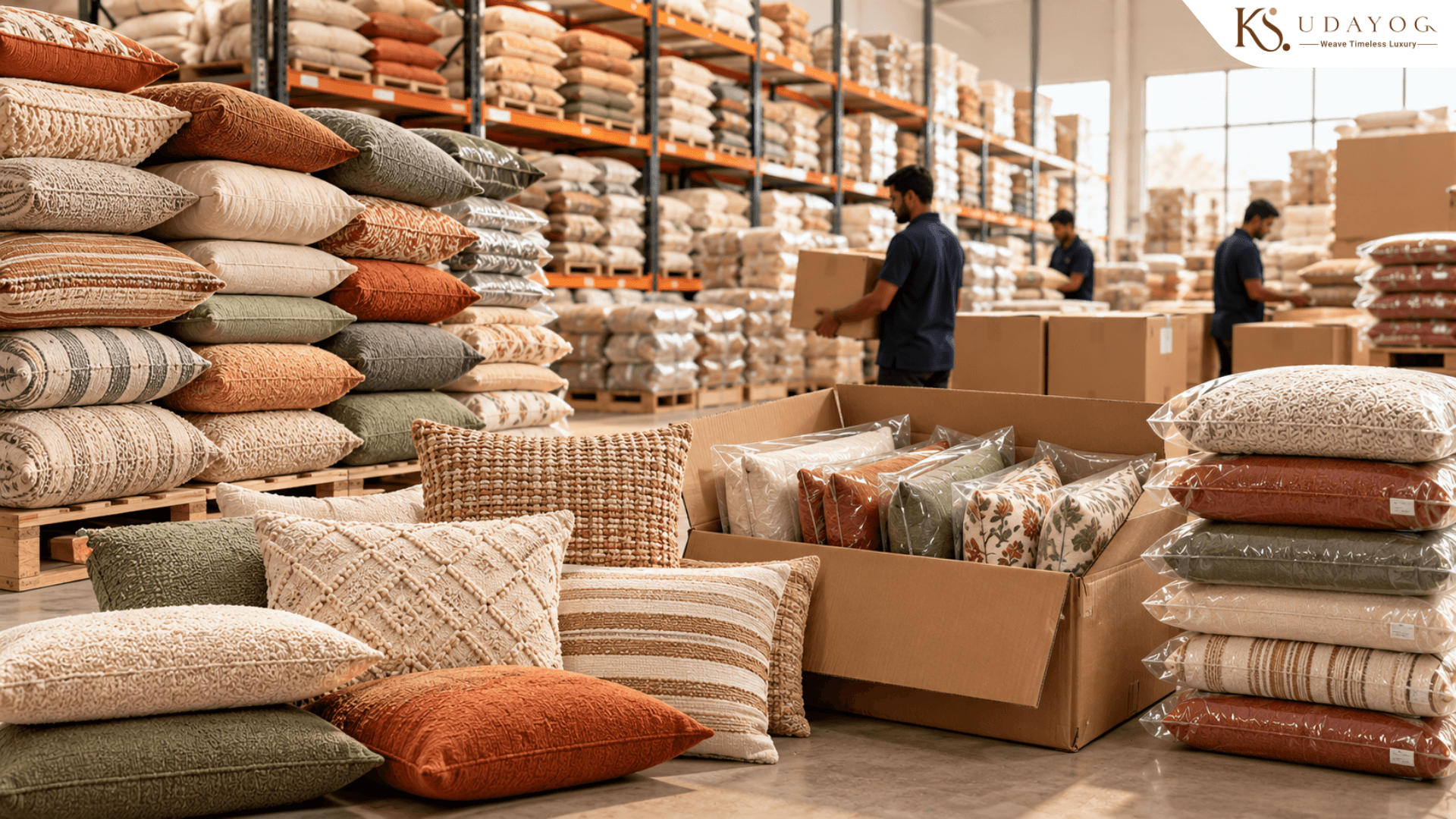
KS Udayog manufactures cushions alongside rugs, carpets, bath rugs, door mats, and throws, allowing businesses to source multiple home-textile categories from one manufacturing partner. Its website states that the company offers cushion customization across sizes, fabrics, fillings, and production requirements, with an in-house production facility and multi-stage inspection.
The company is based in Panipat, Haryana, and states that it has more than 10 years of experience, a multi-plant manufacturing setup, and vertically integrated production capabilities.
For retailers and brands, this can be relevant when developing coordinated collections rather than sourcing every home-textile category from a different supplier.
Wholesale Custom Cushions Vs Ready-Made Cushions: What Should Retailers Choose?
The right option depends on your business model.
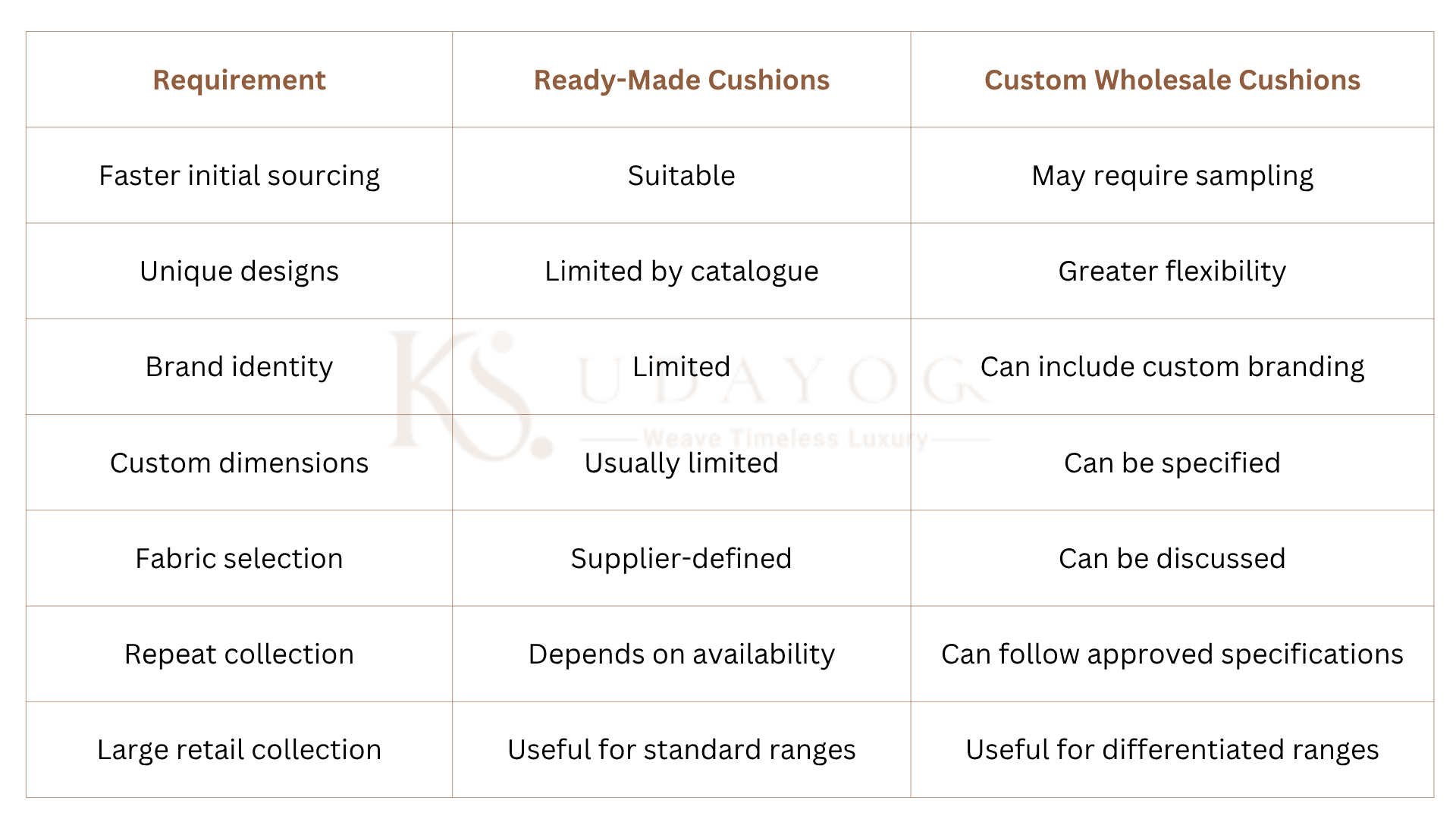
If your store competes mainly on price and needs standard products quickly, ready-made collections may be practical.
If you are building a distinctive home-furnishing range, custom manufacturing can provide greater control over the final product.
Final Thoughts
Sourcing wholesale cushions successfully requires more than finding a manufacturer with a competitive quotation. Retailers should define the product properly, evaluate the cushion supplier, approve a physical sample, document the final specifications, inspect bulk production, and confirm packaging and delivery requirements before the order leaves the factory.
For businesses building a differentiated home-furnishing collection, a capable wholesale cushion manufacturer can become more than a product vendor. It can support product development, customization, repeat production, and larger sourcing requirements.
If you are planning a new cushion collection or need bulk cushions for your retail, wholesale, hospitality, or home-furnishing business, discuss your requirements with a reliable wholesale cushion manufacturer in India and request a customized quotation.
Frequently Asked Questions (FAQs)
How Do I Find A Wholesale Cushion Manufacturer In India?
Look for manufacturers with relevant cushion production capabilities, customization options, clear MOQs, sampling facilities, quality-control processes, and experience handling commercial or bulk orders.
Can A Cushion Manufacturer Produce Private-Label Products?
Some manufacturers provide private-label manufacturing, including custom labels and packaging. Confirm whether the supplier supports your specific branding requirements before placing an order.
Can Retailers Buy Cushions Directly From Indian Manufacturers?
Yes, retailers can source cushions directly from Indian manufacturers for better product control, customization, and bulk purchasing. Direct sourcing can also simplify communication and repeat ordering.
How Can Retailers Estimate Cushion Quantities For A New Collection?
Estimate quantities using expected sales, available storage, collection size, and planned retail coverage. Start with practical quantities, then increase orders based on actual customer demand.
How Can Retailers Maintain The Same Cushion Quality Across Repeat Orders?
Keep an approved sample with detailed fabric, GSM, dimensions, filling, construction, and colour specifications. Share these references with the manufacturer whenever placing repeat orders for consistency.
How Far In Advance Should Retailers Place A Bulk Cushion Order?
Retailers should plan bulk cushion orders according to product complexity, sampling requirements, quantity, and production schedules. Custom collections generally need more planning than standard ready-made cushion orders.