Your best-selling carpet is only valuable if you can source it again without starting the entire buying process from scratch. For Indian retailers, wholesalers, and décor businesses, a carpet manufacturing relationship can matter when collections need new sizes, repeat production, custom designs, or larger quantities.
India’s carpet industry spans different manufacturing environments, from artisan-led handmade production around Bhadohi and Mirzapur to the industrial textile ecosystem of Panipat. That gives businesses access to different construction methods, product categories, and production approaches rather than relying on one type of supplier.
The Carpet Export Promotion Council (CEPC) reports that India’s carpet industry serves international markets and supports a broad network of manufacturers, exporters, weavers, and artisans.
But sourcing carpets from India should not be based on craftsmanship alone. Product specifications, samples, MOQ, quality control, customization, pricing, production capacity, and supplier reliability all matter when you are buying carpets from a wholesale manufacturer.
This guide looks at the practical business advantages of buying carpets from Indian manufacturers and what buyers should consider before placing a bulk order.
Why Should Retailers Source Carpets From India?
India offers buyers a broad manufacturing base covering traditional handmade carpets, contemporary designs, dhurries, hand-tufted products, hand-knotted carpets, and other floor coverings.
Current India Carpet Expo information highlights major carpet-producing hubs including Bhadohi, Mirzapur, Varanasi, Panipat, Jaipur, Bikaner, and Jammu & Kashmir.
This variety allows businesses to explore different product categories rather than depending on one construction or price segment.
For a buyer, the more important question is not simply “Are Indian carpets good?” but:
“Can an Indian carpet manufacturer produce the exact products, quantities, quality, and specifications my business needs?”
That is where the following advantages become relevant.
1. Access A Wide Range of Indian Carpet Styles
One major advantage of sourcing from Indian carpet manufacturers is product variety.
Depending on the manufacturer and production region, businesses can explore hand-knotted, hand-tufted, handwoven, flatweave carpets, dhurries, contemporary rugs, traditional carpets, geometric, floral, minimalist, textured, and custom-designed floor coverings.
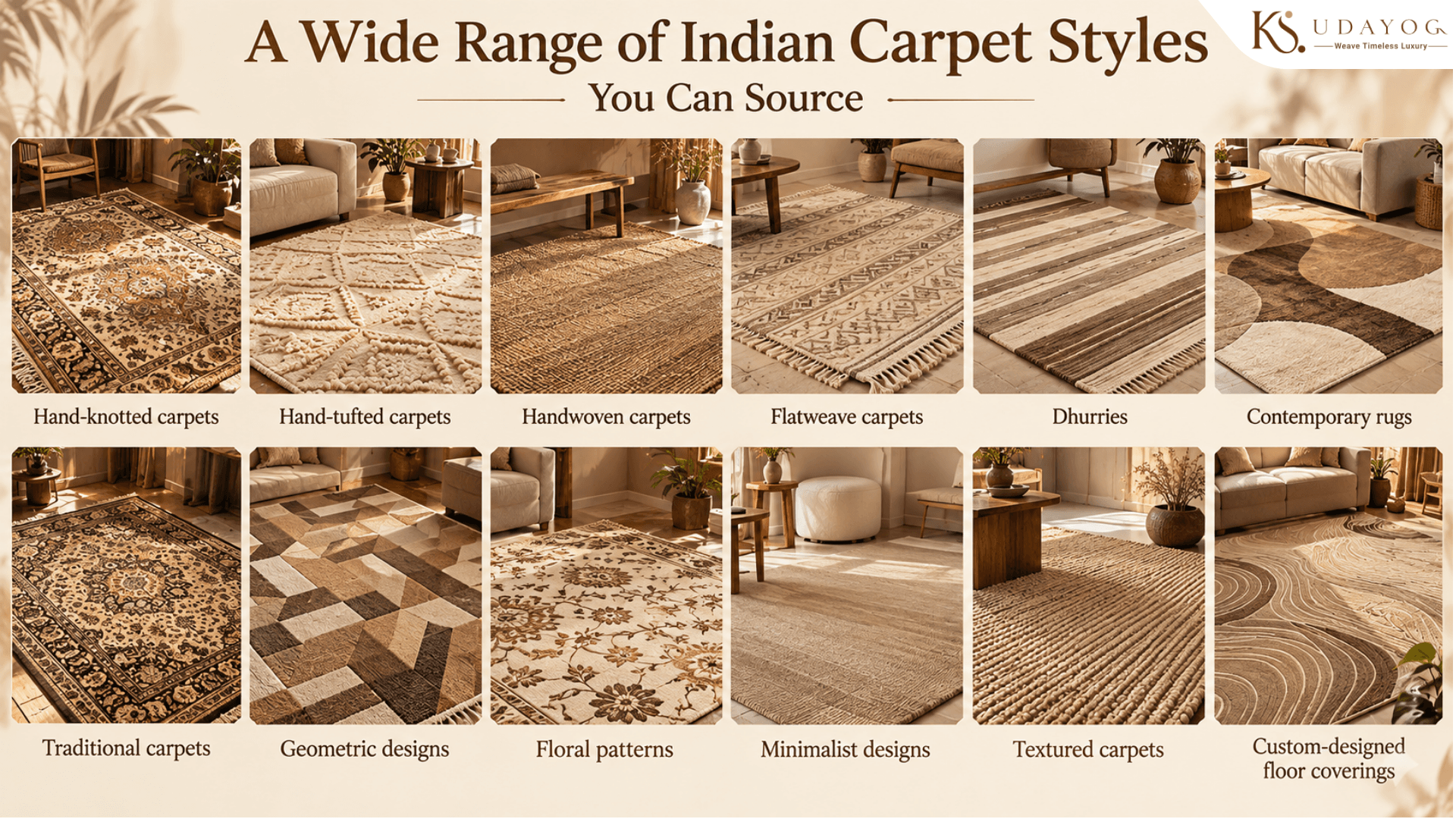
The India Carpet Expo currently showcases products ranging from traditional hand-knotted carpets to contemporary hand-tufted designs, dhurries, and other floor coverings.
For retailers, this variety can make it easier to build collections for different customer preferences instead of selling one narrow carpet style.
2. Source Different Carpet Materials
Indian carpet manufacturers work with a wide range of yarns and carpet materials, depending on the product and construction. Common options can include:
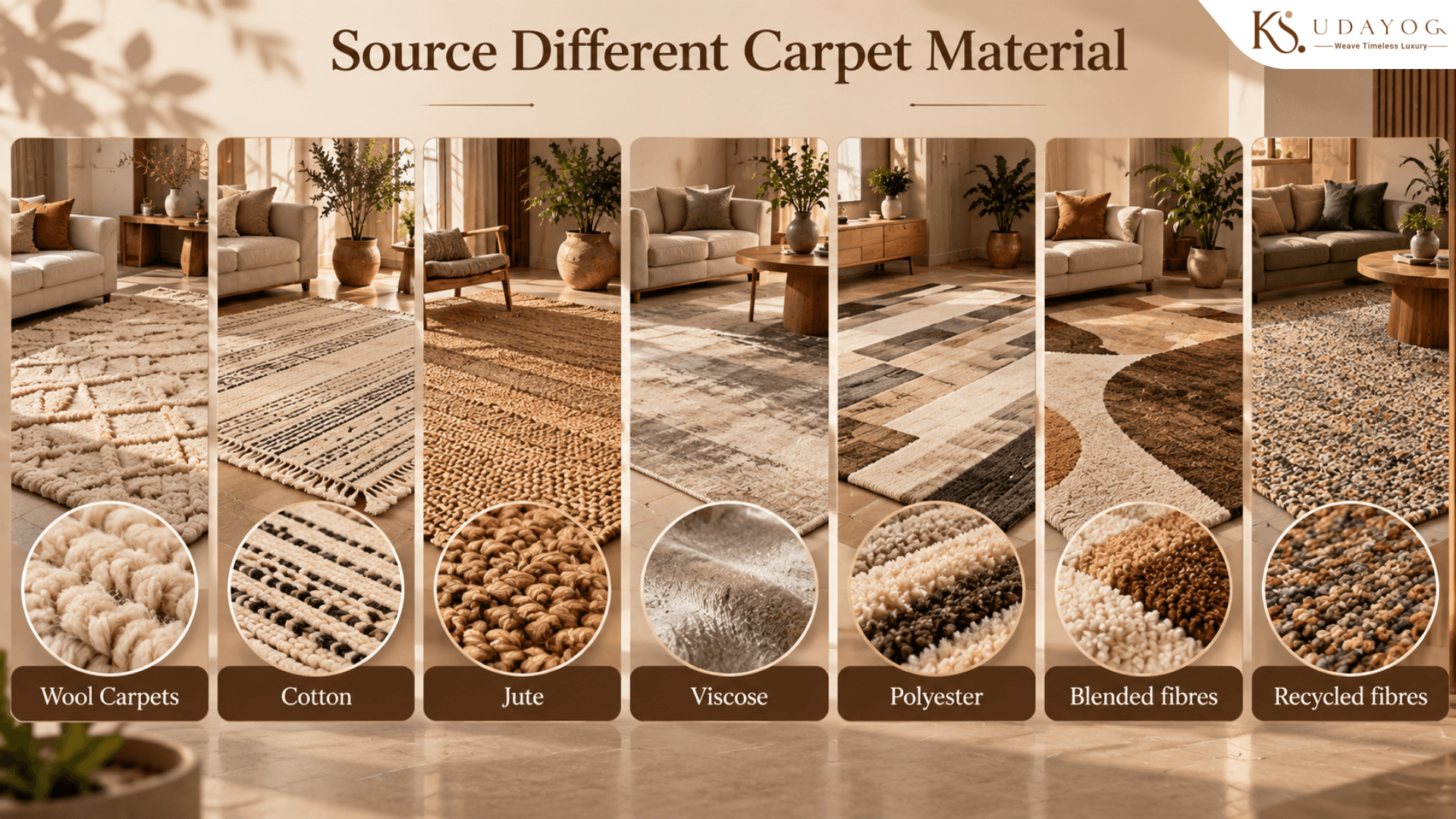
The exact availability, quality, and suitability vary by manufacturer, so buyers should request material specifications rather than relying only on product names.
India's handmade carpet industry uses diverse raw materials and can blend different yarns according to product requirements.
3. Get Greater Scope For Custom Carpet Designs
A standard catalog is useful when you want ready-to-order products, but businesses often need something more specific.
An Indian carpet manufacturer may be able to develop products around requirements such as:
- Custom dimensions
- Custom colours
- Specific patterns
- Material selection
- Pile requirements
- Border designs
- Construction type
- Logo integration
- Private labels
- Custom packaging
However, customization should always be confirmed with the individual supplier. Ask what can be modified, what MOQ applies, whether sampling charges are involved, and how long development will take.
4. Build Wholesale Carpet Collections For Different Price Segments
A business does not always need one carpet type for every customer. You may need an entry-level range, a mid-range collection, and a premium line.
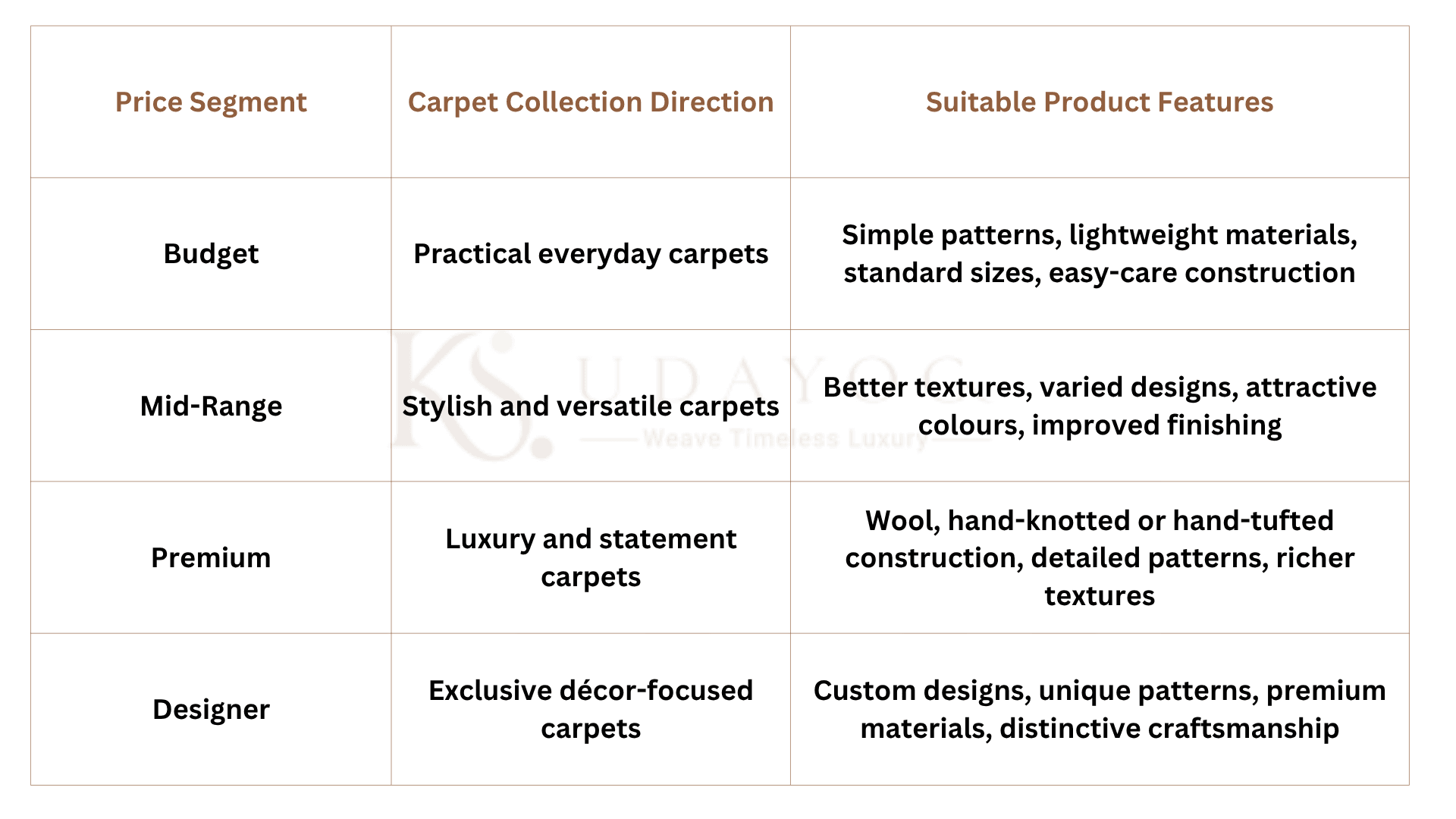
The benefit of working with a manufacturing market offering multiple constructions is the ability to explore different product positions within one sourcing strategy.
5. Explore Handmade Carpet Manufacturing
India is particularly recognised for its handmade carpet industry.
CEPC describes India as a major producer and exporter of handmade carpets and other floor coverings, with manufacturing and artisan networks across numerous states.
Handmade carpets can include:
- Hand-knotted carpets
- Hand-tufted carpets
- Handwoven carpets
- Dhurries
- Traditional woven floor coverings
For businesses selling premium or design-led collections, handmade construction can provide a product story based around craftsmanship and production technique.
However, handmade products can also have natural variations. Buyers should define acceptable tolerances for dimensions, colour, pattern, texture, and finishing before bulk production.
6. Buy Carpets From Established Manufacturing Clusters
India's carpet industry is spread across several manufacturing regions rather than being concentrated in one location. Different regions can offer different product strengths.
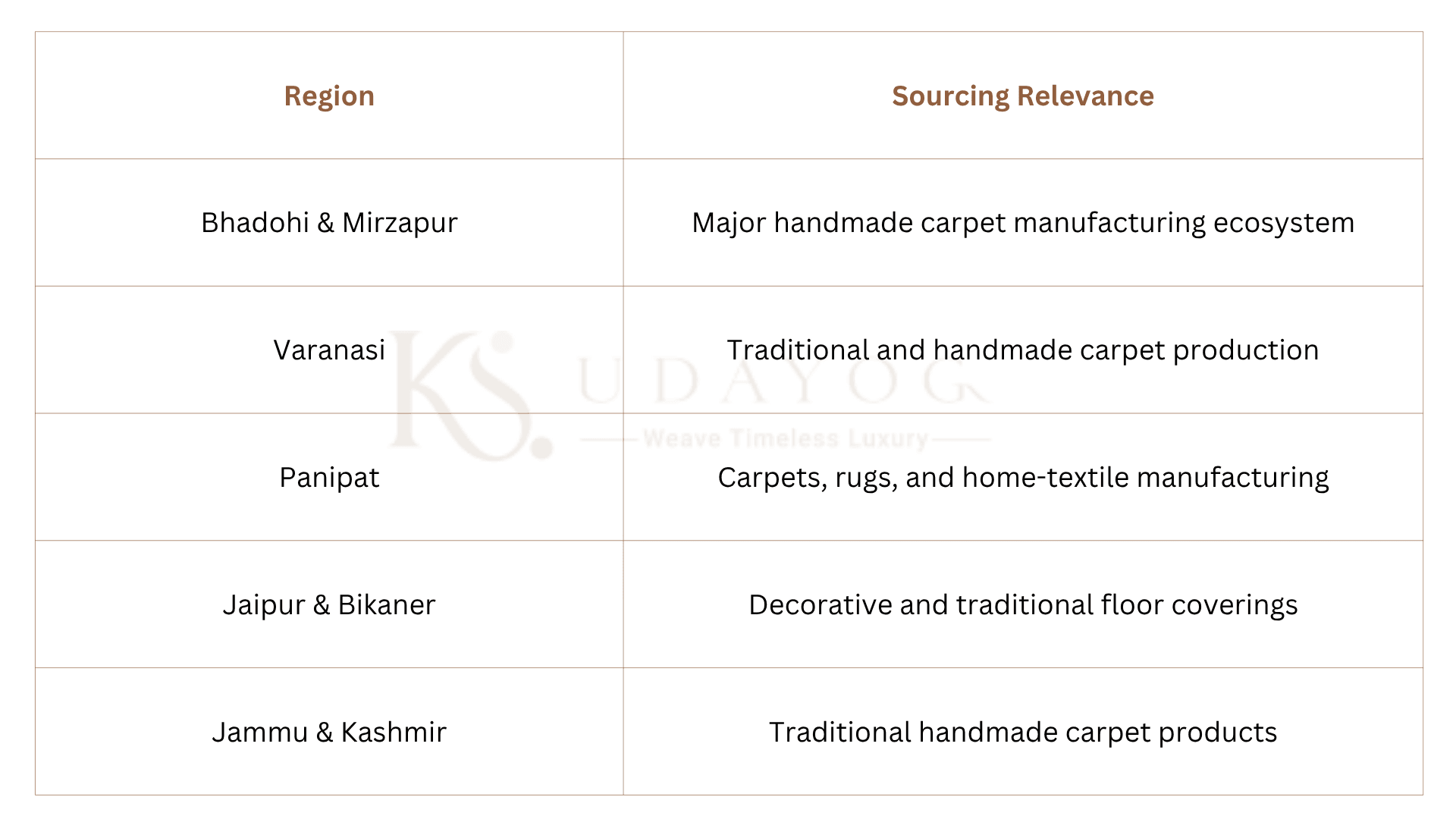
The location alone should not determine your supplier choice. Production capability, quality, samples, pricing, and commercial terms still need to be evaluated.
7. Benefit From India's Established Carpet Export Ecosystem
CEPC was established in 1982 under the Ministry of Textiles to promote exports of handmade carpets, rugs, floor coverings, and related products. It currently represents a large network of industry members and supports activities related to export promotion, quality assurance, trade events, and market development.
For an international buyer, an experienced carpet exporter in India may therefore be familiar with areas such as:
- Export documentation
- Product specifications
- Buyer communication
- Packaging requirements
- Shipment coordination
- International trade procedures
- Repeat-order management
Still, these capabilities should be verified with the specific exporter before placing an order.
8. Find Carpets For Multiple Business Applications
Indian carpets are not limited to one type of buyer. Different businesses can source according to their specific requirements.
- Retailers: Design variety, healthy margins, and reliable repeat-order opportunities
- Wholesalers: Flexible MOQs, competitive pricing, and scalable production capacity
- Interior Designers: Custom sizes, colours, patterns, and project-specific carpet solutions
- Hotels: Project quantities, durability standards, and required product specifications
- Home Décor Brands: Private labeling, exclusive designs, and branded collections
- Online Sellers: Protective packaging, repeat designs, and reliable product consistency
- Furniture Stores: Complementary colours, coordinated designs, and matching carpet collections
- Export Businesses: Export documentation, packaging standards, and dependable shipment capabilities
The important point is to match the supplier's capabilities with the business model rather than selecting a manufacturer solely because it has a large product catalog.
9. Develop Private-Label Carpet Collections
Businesses that want to build their own home décor brand may need more than standard wholesale products.
Depending on the manufacturer, private-label requirements can include brand labels, custom product names, exclusive designs, colourways, size variations, product tags, care labels, retail packaging, and carton specifications.
Before starting private-label production, confirm ownership and usage rights for custom designs, artwork, labels, and packaging.
10. Scale From Samples To Wholesale Carpet Orders
A reliable sourcing process should not jump directly from an online catalog to a large bulk order.
A better process is:
Start with your requirements, shortlist suitable suppliers, review samples, test quality, approve specifications, finalize pricing, place a pilot order, inspect production, proceed with bulk manufacturing, pack, dispatch, and reorder.
Each stage reduces a different type of risk.
For example, the sample checks product quality, the quotation confirms commercial terms, and the pilot order provides an opportunity to assess how the supplier handles actual production before larger quantities are committed.
11. Compare Indian Carpet Manufacturers On More Than Price
The cheapest quotation is not automatically the most economical option.
A supplier comparison should include:
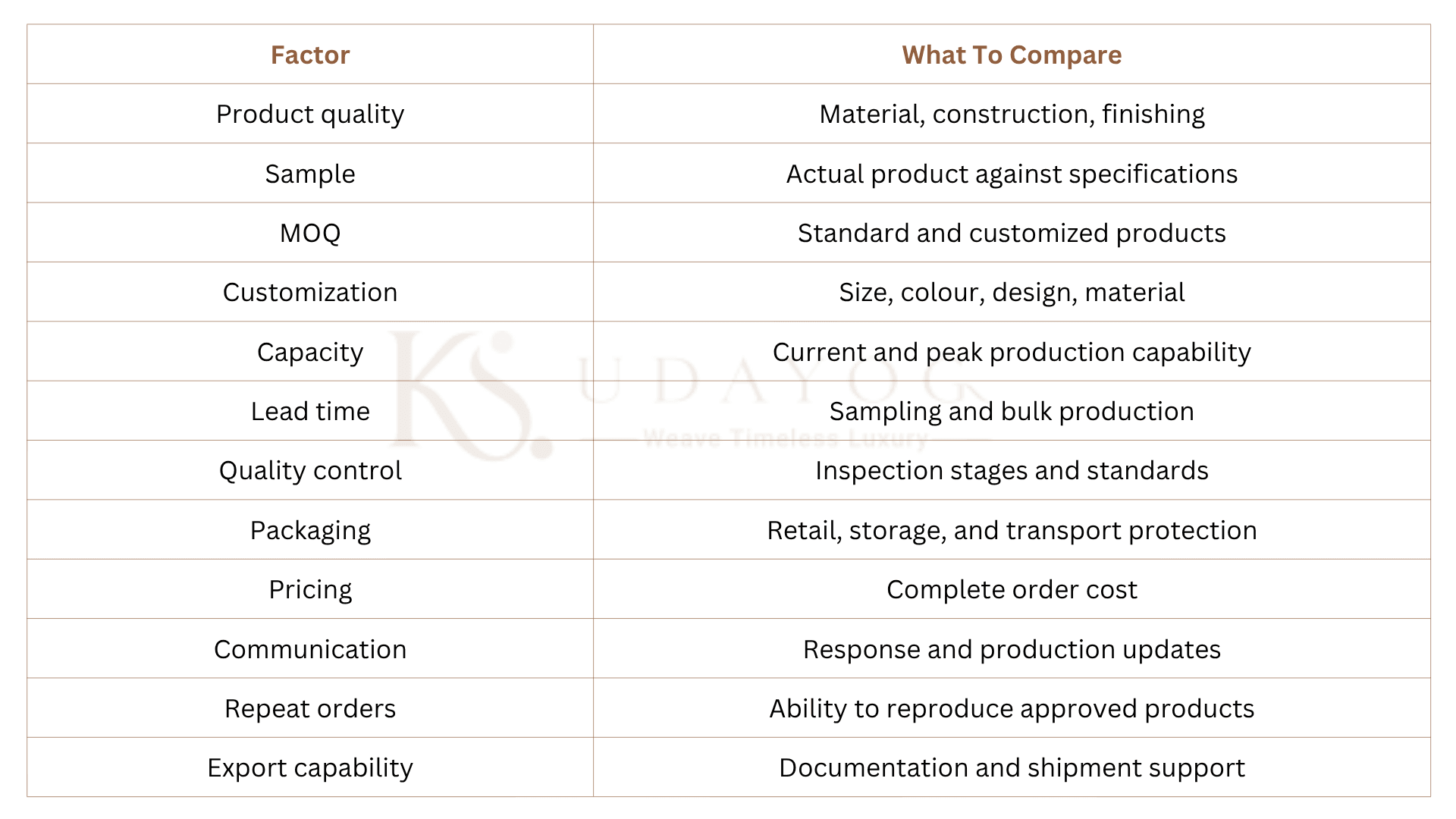
This approach helps buyers compare total sourcing value rather than simply comparing one number on a quotation.
12. Compare The Complete Cost of Wholesale Carpets
Suppose a retailer needs 500 carpets. The following is an illustrative example only, not a market quotation.
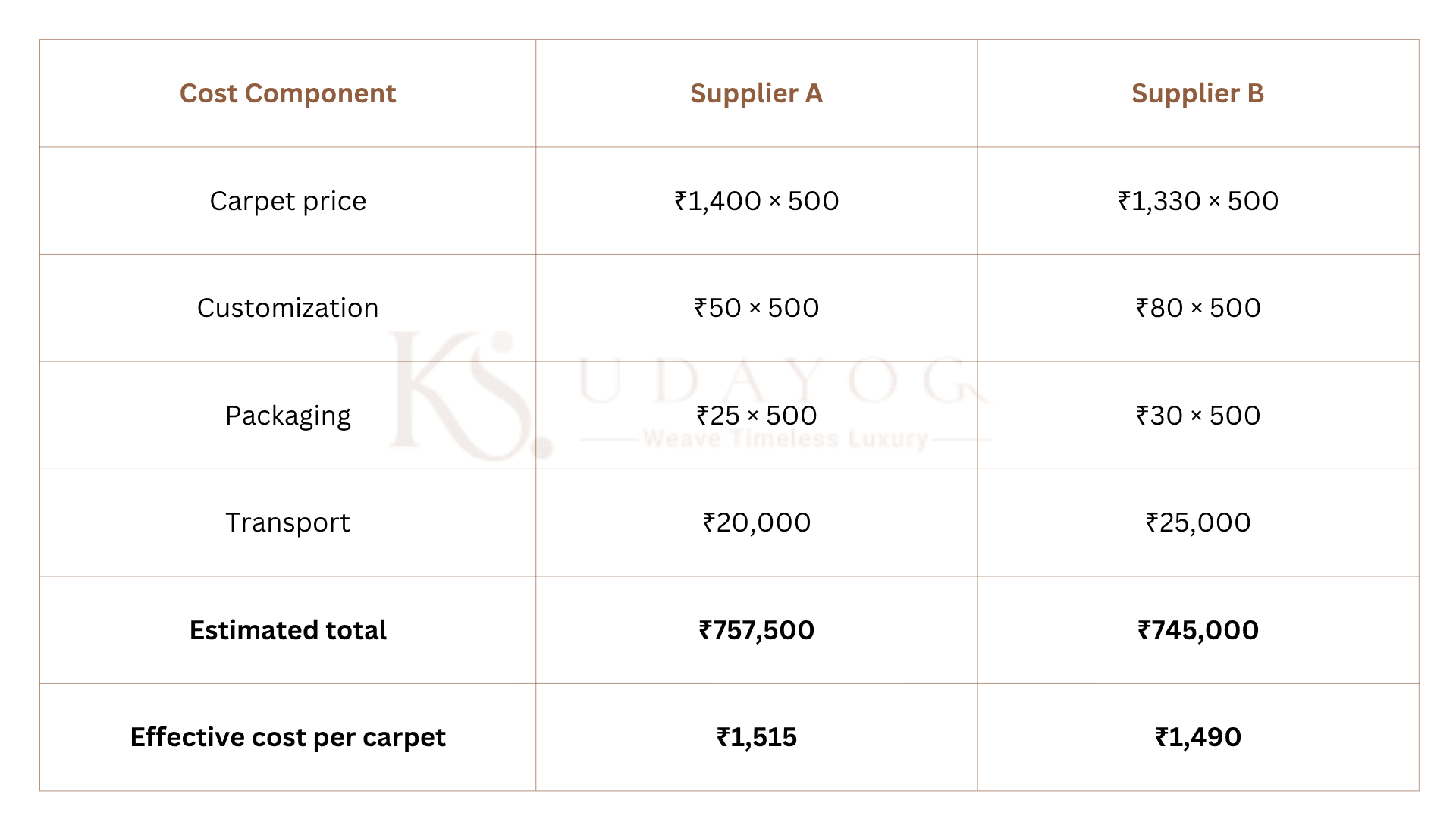
Supplier B has the lower overall cost in this example even though its customization and packaging charges are higher in some areas.
For imported orders, the buyer may also need to consider freight, insurance, duties, customs clearance, local transportation, and other applicable charges when calculating the final landed cost.
13. Access A Broad Carpet Design Vocabulary
Indian carpets can serve both traditional and contemporary retail collections.
This gives businesses room to explore collections featuring Persian-inspired patterns, geometric designs, botanical motifs, abstract artwork, minimalist neutrals, vintage patterns, contemporary textures, stripes, solid textures, and artisan-inspired styles.
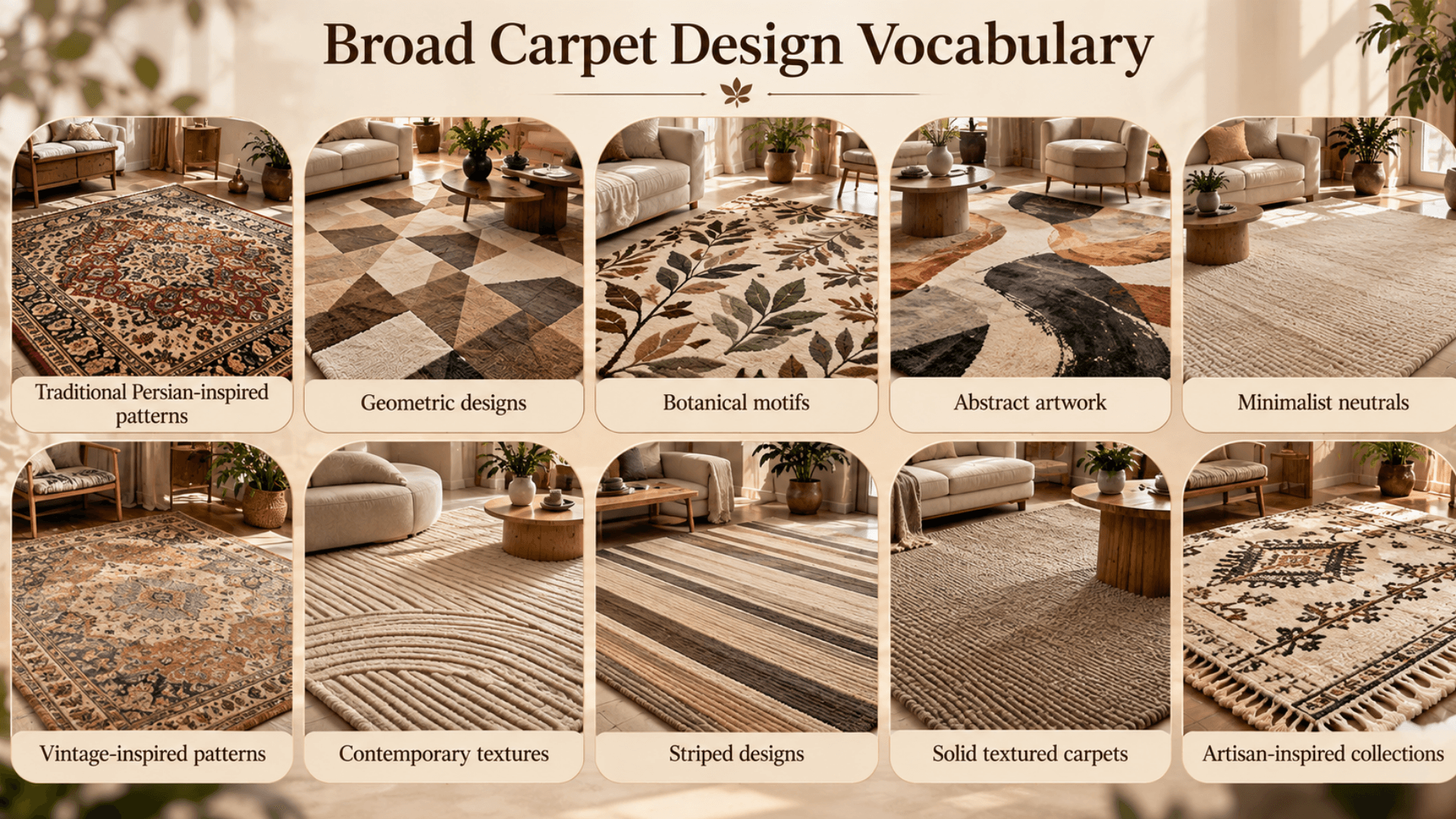
For retailers, this variety can help create collections for different room styles and customer preferences.
Indian Carpet Manufacturer Vs Carpet Trading Supplier
Both manufacturers and trading suppliers can serve legitimate business needs. The right choice depends on your requirements.
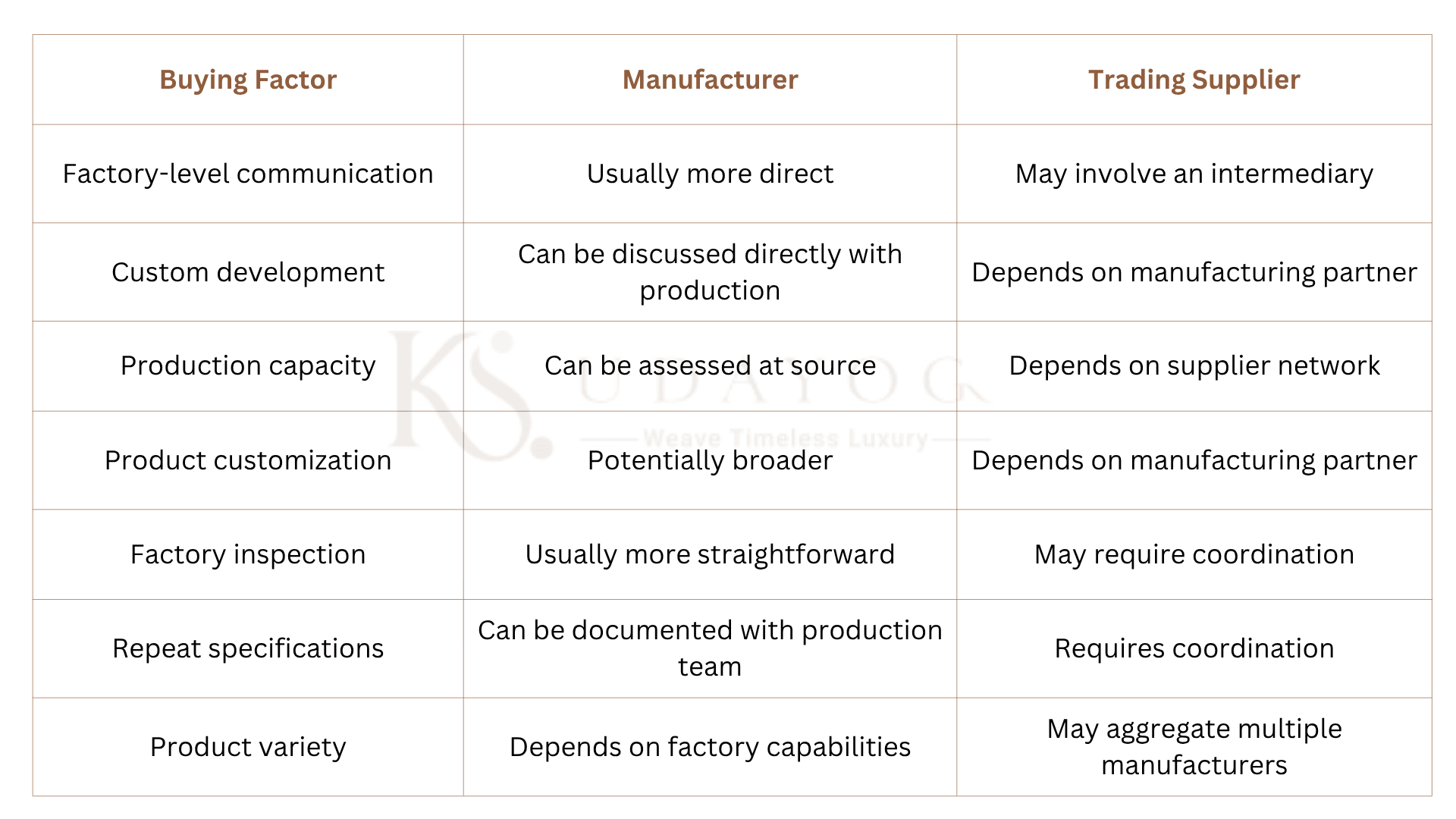
Do not assume that every company calling itself a manufacturer performs every production stage in-house. Ask specific questions about manufacturing, outsourcing, production facilities, and quality control.
When Should Your Business Buy Carpets From An Indian Manufacturer?
Direct sourcing from India may be worth exploring when your business needs:
- Wholesale carpet quantities
- Custom sizes
- Custom colours
- Exclusive designs
- Handmade carpets
- Multiple carpet materials
- Private-label products
- Repeat production
- Retail-ready packaging
- Different price segments
- Long-term supplier relationships
The decision becomes stronger when the manufacturer's actual capabilities match your requirements.
Which Businesses Can Source Indian Carpets?
Indian carpet sourcing can be relevant for several business models.
- Retail Stores: Diverse collections, fresh designs, and reliable repeat-order options
- Wholesale Distributors: Bulk quantities, competitive pricing, and dependable procurement
- Home Décor Brands: Private-label solutions and exclusive custom collections
- Interior Designers: Bespoke sizes, colours, patterns, and project-specific designs
- Hotels: Project quantities, durability requirements, and defined specifications
- Furniture Retailers: Complementary rugs, carpets, and coordinated collections
- Online Home Décor Stores: Branded products, retail packaging, and consistent designs
- Export Businesses: Manufacturing capacity, export documentation, and shipment capabilities
The most suitable supplier will depend on your product category, target customers, order quantity, budget, and market requirements.
Wrap Up
Buying Indian carpets can give businesses access to a broad manufacturing ecosystem, diverse carpet constructions, different materials, design flexibility, and established export networks. India's carpet industry includes major production centres and a wide range of manufacturers and exporters, particularly within the handmade carpet segment.
A supplier offering custom sizes is useful when your collection requires flexibility. An exporter with established documentation processes can matter for international orders. And a carpet manufacturer with reliable repeat production becomes valuable when a particular design starts selling well.
The sourcing decision should therefore go beyond the question of whether Indian carpets are attractive or competitively priced.
To source Indian carpets for your business, you can contact an experienced Indian carpet manufacturer to develop quality collections and custom designs.
Frequently Asked Questions (FAQs)
Why Should Businesses Buy Carpets From Indian Manufacturers?
Indian manufacturers offer access to diverse carpet constructions, materials, designs, customization options, and established manufacturing networks, particularly across major handmade carpet-producing regions.
Are Indian Carpets Suitable For Wholesale Businesses?
Yes, Indian carpet manufacturers can serve wholesale requirements across different product types, materials, price segments, quantities, and design categories, depending on individual supplier capabilities.
How Can I Find A Carpet Manufacturer In India?
Shortlist manufacturers through industry networks, trade exhibitions, manufacturer directories, sourcing platforms, and referrals, then verify their production capabilities through samples and supplier discussions.
Can Indian Carpet Manufacturers Make Custom Designs?
Yes, many manufacturers offer customization, including sizes, colours, patterns, materials, construction, and finishing. Custom capabilities and MOQs should be confirmed with each supplier.
What Is The MOQ For Wholesale Carpets From India?
MOQ varies by carpet manufacturer, material, construction, design, customization, and production requirements. Standard products may have different minimums from fully customized carpets.
Is It Better To Buy Carpets Directly From A Manufacturer?
Direct manufacturer sourcing can provide greater visibility into production and customization, but buyers should compare the manufacturer's actual capabilities, pricing, quality, capacity, and commercial terms before deciding.
What Should I Ask An Indian Carpet Exporter Before Ordering?
You can ask about product specifications, samples, MOQ, customization, production capacity, lead time, quality inspection, packaging, export documentation, payment terms, and repeat-order capabilities.