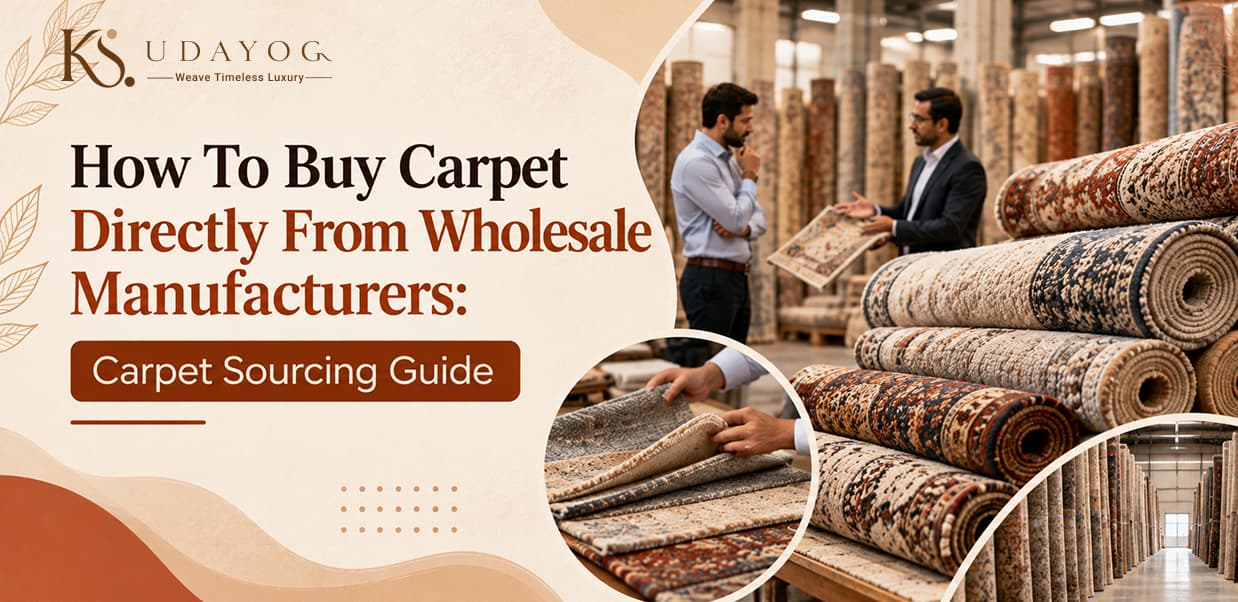
If you are buying carpets for resale or a large project, the carpet exporter sending you the quotation may not be the person actually making the carpet. That extra layer can make it harder to understand where the product comes from, how much room there is for customization, and what you are really paying for.
Going directly to a wholesale carpet manufacturer changes the conversation. Instead of discussing only price and quantity, you can talk directly about construction, fibers, patterns, dimensions, production capacity, quality standards, packaging, lead times, and the details that matter to your particular order.
But finding a trusted carpet manufacturing factory is only the beginning. This guide explains how to source carpets directly from wholesale manufacturers and what to check at each point so your bulk purchase meets the quality, budget, and delivery expectations you started with.
What Does Buying Carpet Directly From A Wholesale Carpet Manufacturer Mean?
Buying carpet directly means purchasing from the company that manufactures the carpet rather than going through several layers of distributors or resellers.
This approach can be useful for buyers who need larger quantities, specific specifications, repeat orders, or customized products.
Direct sourcing may allow you to discuss requirements with the production team, understand manufacturing capabilities, request samples, and negotiate order details based on volume.
However, direct purchasing does not automatically mean every manufacturer will offer the right quality or lowest total cost. You still need to evaluate the supplier carefully.
Carpet Sourcing From Wholesale Manufacturers: Tip To Buy Carpet
One wrong decision at the sourcing stage can affect an entire carpet shipment, not just a single piece. Buyers need to look beyond catalogs and quotations to understand the manufacturer’s capabilities, product specifications, quality controls, and order terms. These tips will help you source wholesale carpets with fewer surprises along the way.
Step 1: Define Your Carpet Requirements
Before contacting manufacturers, establish exactly what you need.
A clear requirement makes it easier for suppliers to recommend suitable products and prepare accurate quotations.
Consider:
- Carpet type
- Material or fiber
- Construction method
- Color
- Pattern
- Dimensions
- Pile height
- Required quantity
- Intended application
- Expected foot traffic
- Budget range
- Customization requirements
- Delivery destination
- Required delivery date
For example, "I need carpets for a hotel" gives a manufacturer limited information.
A specification such as 1,000 square yards of medium-pile carpet for hotel corridors, with a specific color range and delivery within 8 weeks gives the supplier a much clearer starting point.
Step 2: Decide What Type of Carpet You Need
Carpet is available in many constructions and materials, so determine which type fits your application before comparing suppliers.
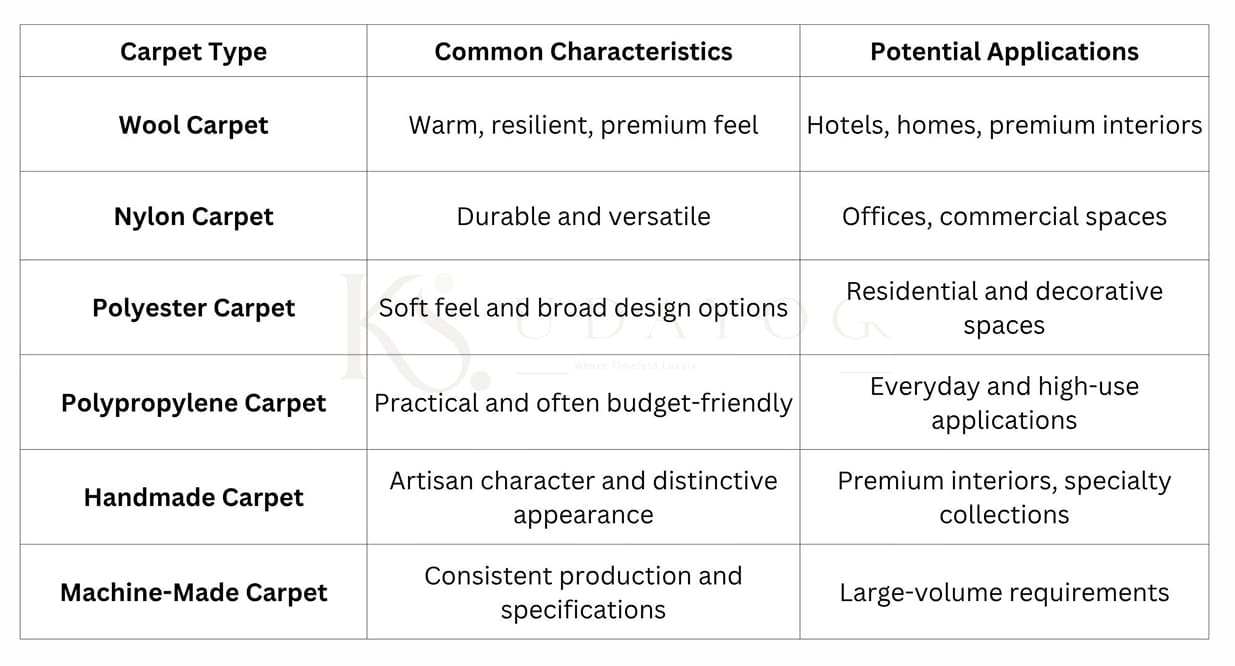
The best material depends on traffic, appearance, maintenance expectations, budget, and intended use.
Step 3: Find Wholesale Carpet Manufacturers
Once your requirements are clear, begin identifying manufacturers that can supply the products you need.
You can evaluate potential suppliers through:
- Manufacturer websites
- Trade directories
- Industry exhibitions
- B2B marketplaces
- Industry recommendations
- Export-focused suppliers
- Direct manufacturer inquiries
Do not shortlist suppliers based only on attractive product photographs.
Look for evidence of actual manufacturing capabilities, product range, production capacity, quality procedures, customization options, and experience with wholesale orders.
If you are sourcing internationally, also check whether the manufacturer regularly handles export orders and understands the documentation and packaging requirements involved.
Step 4: Verify The Manufacturer Before Requesting A Large Order
A supplier may describe itself as a manufacturer, but you should understand what it actually produces.
- Review Material Expertise: Look for manufacturers experienced with the carpet materials and fiber types suitable for your collection.
- Compare Construction Methods: Confirm whether their manufacturing methods match the carpet styles and specifications you want.
- Check Available Sizes: Make sure the manufacturer can produce your required dimensions without unnecessary limitations or compromises.
- Assess Production Capacity: Choose a manufacturer capable of handling your order volume within your required production schedule.
- Understand Minimum Order Quantities: Review MOQ requirements carefully, especially when ordering multiple designs, colors, or customized carpet specifications.
- Explore Customization Options: Ask whether the manufacturer can develop carpets around your preferred colors, patterns, sizes, or finishes.
- Request Physical Samples: A physical sample lets you evaluate the actual carpet before committing to larger quantities.
- Review Quality Procedures: Understand how carpets are inspected for dimensions, construction, color, finishing, and other agreed specifications.
- Consider Repeat-Order Support: Prioritize manufacturers capable of reproducing approved designs and specifications for future wholesale requirements.
- Check Market Experience: A supplier experienced with similar markets may better understand quality expectations, packaging, and commercial requirements.
Clear answers can help you distinguish between a manufacturer and a supplier that may simply be sourcing products from elsewhere.
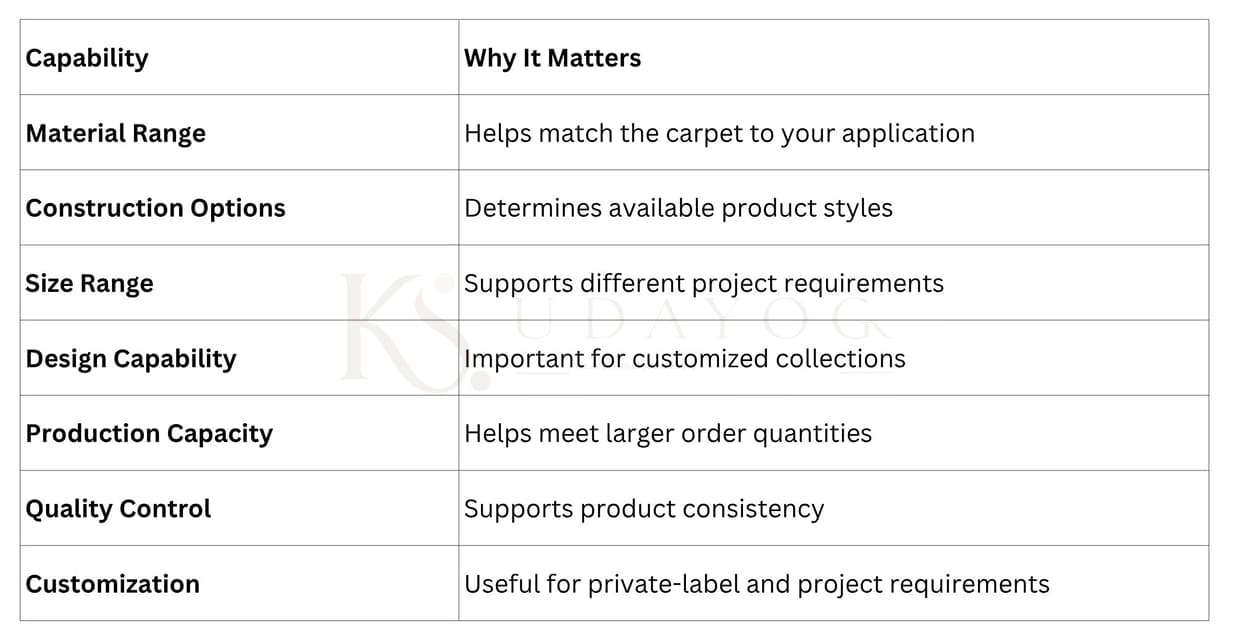
Step 5: Compare Manufacturing Capabilities
Not every manufacturer can produce every type of carpet.
One supplier may specialize in handmade carpets, while another may focus on machine-made production. Some may offer extensive customization, while others work primarily with existing designs.
Compare capabilities based on your actual requirements.
Step 6: Request Product Samples
Never rely entirely on photographs when sourcing carpets in bulk.
Request a physical sample before committing to a substantial order whenever possible.
Examine:
- Color
- Texture
- Pile
- Density
- Material
- Dimensions
- Edge finishing
- Backing
- Pattern clarity
- Overall workmanship
A sample gives you a much better understanding of the actual product.
If the order involves customization, keep the approved sample and written specifications as references for the production order.
Step 7: Confirm Carpet Specifications
Once you have selected a suitable product, document the specifications clearly.
Your specification sheet can include:
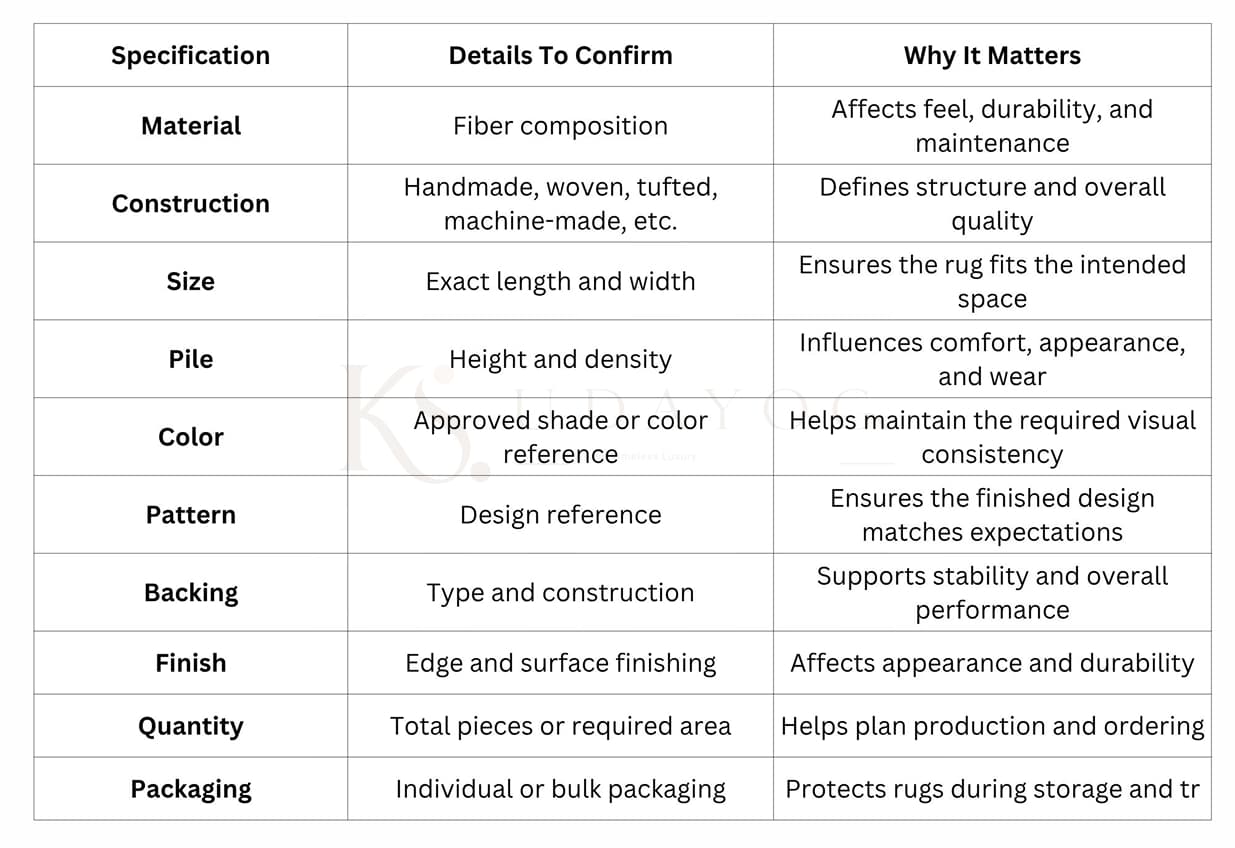
Clear specifications reduce misunderstandings between the buyer and manufacturer.
Step 8: Understand MOQ of Carpet
MOQ stands for Minimum Order Quantity.
Manufacturers may set different MOQs depending on the product, design, material, color, customization, or production method.
For example, a manufacturer might allow mixed designs within one order but require a separate minimum quantity for customized production.
Ask:
- Is the MOQ per order?
- Is it per design?
- Is it per color?
- Can different products be combined?
- Does customization increase the MOQ?
- Are larger quantities eligible for different pricing?
Understanding MOQ before finalizing your collection can help you avoid ordering more inventory than your business can reasonably handle.
Step 9: Compare Wholesale Quotes Properly
Do not compare quotations by unit price alone.
Two carpets with similar photographs can have very different specifications.
When comparing quotes, check:
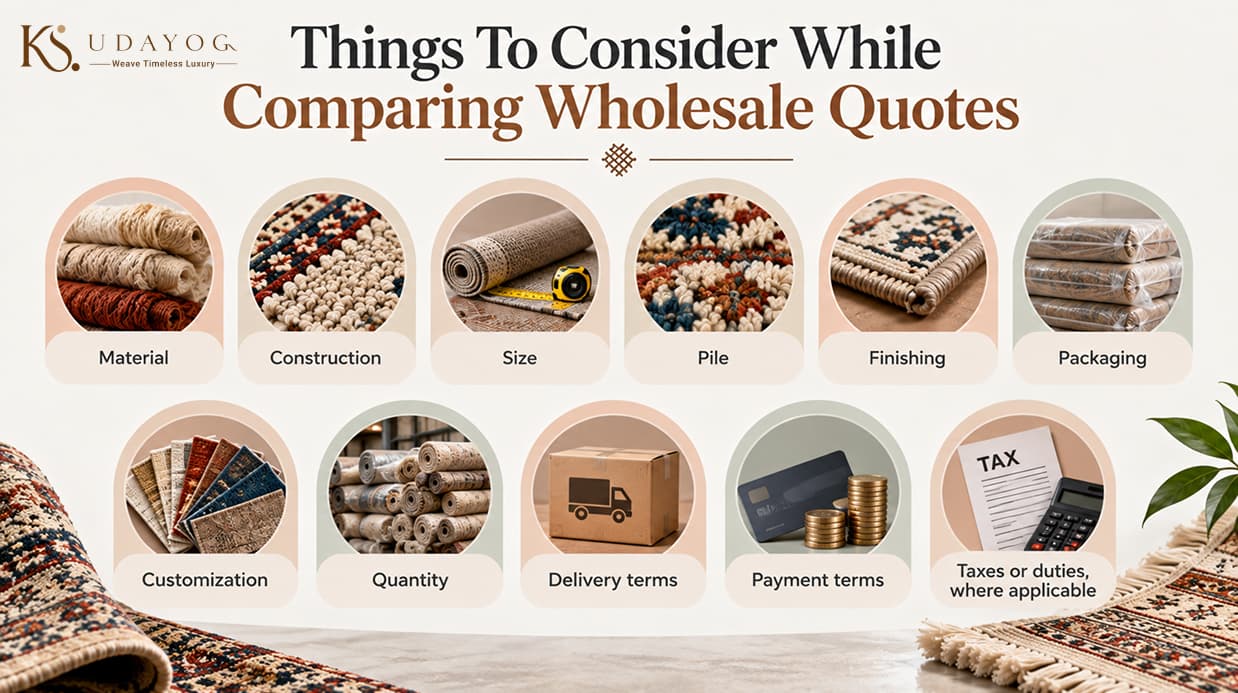
You must check material, construction, size, pile, finishing, packaging, customization, quantity, delivery terms, payment terms, and applicable taxes or duties. A lower initial quotation may not represent better value if it excludes important costs or covers a different specification.
Step 10: Calculate Your Total Sourcing Cost
The purchase price is only one part of your actual cost.
For an imported or large wholesale order, consider:
Product Cost + Packaging + Freight + Insurance, If Applicable + Duties/Taxes, If Applicable + Local Delivery = Estimated Landed Cost
The exact components will vary depending on the sourcing arrangement and destination.
Knowing the estimated landed cost helps retailers calculate margins and helps project buyers stay within budget.
Step 11: Discuss Customization
Direct carpet manufacturer sourcing can be particularly useful when you need products that differ from standard catalog offerings.
Depending on the carpet manufacturer's capabilities, you may be able to customize:
- Size
- Color
- Pattern
- Material
- Shape
- Pile specifications
- Finishing
- Labels
- Packaging
Customization can help retailers create exclusive collections and allow interior or hospitality buyers to match specific design requirements.
However, customized production may involve higher MOQs, additional sampling, longer lead times, and different pricing.
Discuss these details before approving production.
Step 12: Check Quality-Control Procedures
Before placing a bulk order, understand how the manufacturer checks finished carpets.
A useful quality-control process may review:
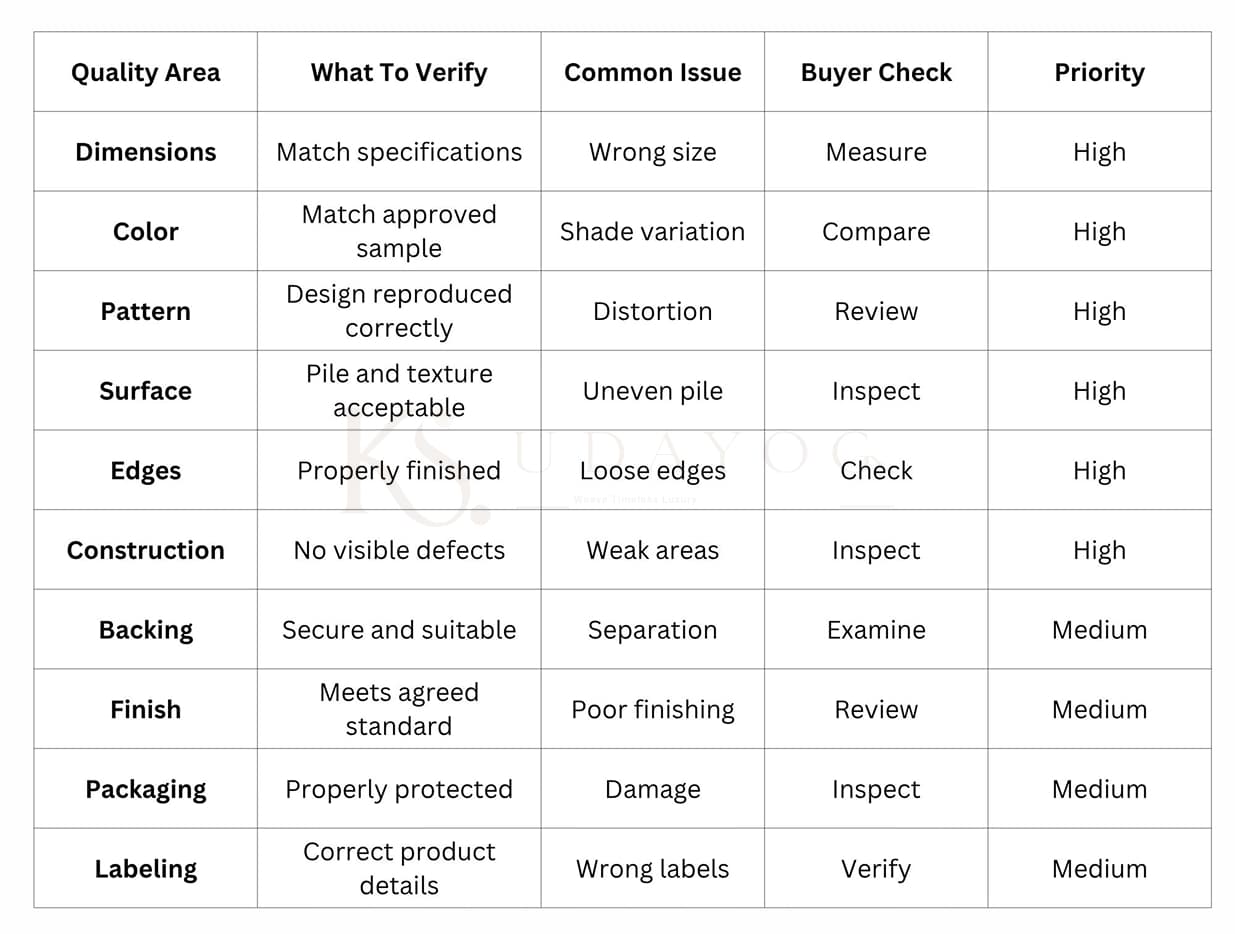
For large orders, agree in advance on the specifications that will be checked before shipment.
Step 13: Confirm Production Capacity And Lead Time
A manufacturer may offer the right carpet but still be unsuitable if it cannot produce your required quantity within your timeline.
Ask about:
- Current production schedule
- Estimated manufacturing period
- Sample approval time
- Production start date
- Order completion date
- Packaging period
- Dispatch schedule
If you are planning seasonal sales, store launches, hotel openings, or interior projects, build enough time into the purchasing schedule for production and transportation.
Step 14: Agree On Packaging And Delivery
Carpets can require careful packaging because they may be exposed to handling, moisture, compression, and transportation conditions.
Discuss how the products will be packed and whether your requirements include specific labeling or packaging standards.
Also confirm:
- Shipping method
- Delivery location
- Dispatch timeline
- Packaging format
- Documentation
- Tracking arrangements
- Responsibility for transportation
- Applicable shipping costs
The exact terms depend on whether you are purchasing domestically or internationally.
Step 15: Approve The Final Carpet Order
Once the product, price, specifications, quantity, and timeline are agreed upon, review the complete order before production begins.
Your purchase confirmation should clearly identify the product, material, construction, dimensions, quantity, color, design, approved sample, price, MOQ, customization, packaging, delivery terms, production timeline, and payment terms.
Do not assume that details discussed informally will automatically appear in production instructions.
Written confirmation gives both parties a clear reference.
Step 16: Inspect The Bulk Order
The sourcing process does not end when production is completed.
Before accepting a large shipment, inspect the products according to the agreed specifications where possible.
For larger orders, buyers can check a suitable sample of the shipment for:
- Size accuracy
- Color consistency
- Construction
- Surface quality
- Edge finishing
- Packaging condition
- Visible defects
If the carpet wholesale order is being inspected before shipment, clarify the inspection arrangement with the manufacturer in advance.
How To Choose Between Carpet Manufacturers?
If several manufacturers meet your basic requirements, compare them using a structured approach. When comparing carpet manufacturers, look beyond the quotation. The right supplier should match your product requirements, order volume, quality expectations, timeline, and future sourcing needs.
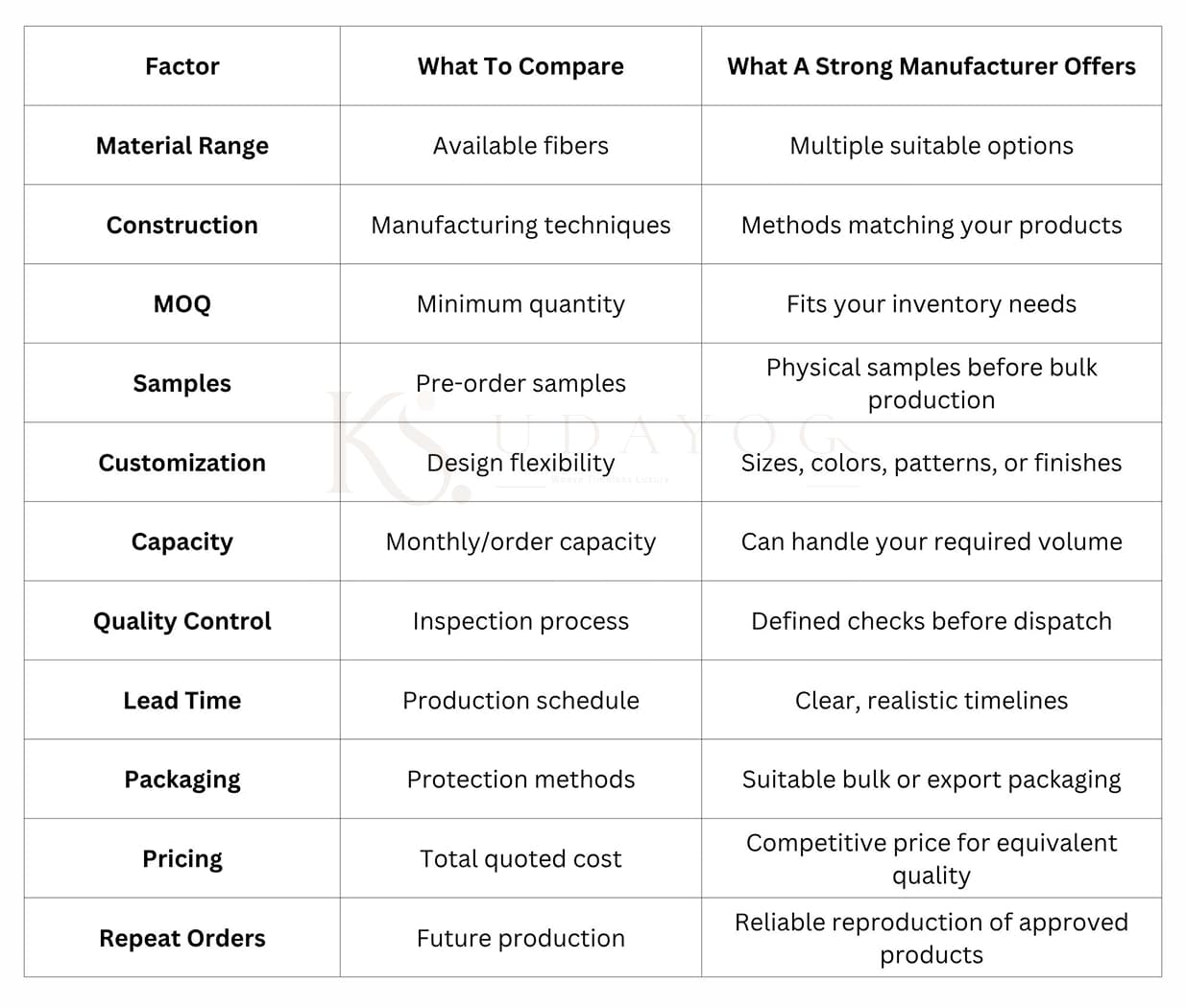
This type of comparison makes it easier to evaluate the complete offer rather than focusing on price alone.
Common Mistakes When Buying Carpet Directly From Manufacturers
Direct sourcing can be beneficial, but avoid these common mistakes:
1. Choosing The Lowest Quote
A low price does not necessarily mean better value. Compare the complete specifications before making a decision.
2. Skipping The Sample
Photographs cannot show every aspect of texture, pile, construction, or color.
3. Ignoring MOQ
A supplier may offer attractive pricing but require more inventory than you actually need.
4. Not Confirming Specifications
Verbal agreements can lead to misunderstandings. Record important requirements in writing.
5. Underestimating Lead Time
Production and delivery can take longer than expected, particularly for customized or large orders.
6. Failing To Check Repeat-Order Capability
A supplier may produce an excellent first order but struggle to reproduce the same specifications later.
7. Comparing Products That Are Not Equivalent
Always compare material, construction, dimensions, pile, finishing, and other specifications before comparing prices.
Why Buy Carpet Directly From Wholesale Carpet Providers?
Direct sourcing can provide several advantages when you are purchasing at scale.
- Greater Specification Control: You can discuss product requirements directly with the manufacturer.
- Customization Opportunities: Some manufacturers can create products according to specific designs, sizes, colors, or finishing requirements.
- Bulk Purchasing: Direct relationships can make larger and repeat orders easier to manage.
- Better Product Understanding: You can ask questions about materials, construction, production, and quality procedures directly.
- Long-Term Supply Potential: A suitable manufacturer can become a repeat supplier as your collection or project requirements grow.
These benefits depend on the manufacturer's capabilities and the quality of the working relationship, so supplier evaluation remains important.
Final Advice
If you are buying carpet directly from a wholesale manufacturer, this approach works best when the sourcing process is treated as a complete evaluation rather than a simple price comparison.
Start with clear requirements, identify manufacturers that can meet them, compare their capabilities, request samples, confirm specifications, evaluate MOQ and pricing, and establish realistic production and delivery timelines.
Before placing the final order, make sure the approved product, quantity, quality expectations, customization, packaging, and commercial terms are clearly documented. This creates a stronger foundation for the current purchase and makes future reordering easier.
Planning a new carpet collection for your store or project? Compare carpet manufacturers and suppliers based on product quality, customization, pricing, and supply capabilities before choosing the best carpet sourcing partner.
Frequently Asked Questions (FAQs)
Is It Cheaper To Buy Carpet Directly From A Manufacturer?
Direct purchasing can offer competitive wholesale pricing, particularly for larger quantities, but the final value depends on product specifications, MOQ, shipping, packaging, and other sourcing costs.
What Should I Ask A Wholesale Carpet Manufacturer?
Ask about materials, construction methods, sizes, MOQ, samples, customization, quality control, production capacity, lead time, packaging, pricing, and repeat-order capabilities.
Should I Order A Sample Before Buying Carpet In Bulk?
Yes. A physical sample allows you to evaluate the actual color, texture, pile, construction, dimensions, and finishing before committing to a larger quantity.
How Do I Compare Wholesale Carpet Prices?
Compare equivalent specifications rather than unit prices alone. Review material, construction, dimensions, pile, finishing, packaging, customization, quantity, delivery, and other applicable costs.
How Long Does Wholesale Carpet Production Take?
Lead time varies according to product type, quantity, customization, manufacturer capacity, and current production schedule. Always request a realistic timeline before confirming an order.
Can I Buy Handmade And Machine-Made Carpets From The Same Manufacturer?
Some manufacturers offer multiple construction methods, while others specialize in specific categories. Confirm the supplier's actual manufacturing capabilities before placing an order.