For a retailer or wholesaler, a throw is not just another home-furnishing product. It is inventory that has to sell at the expected margin. The wrong throw manufacturing partner can create problems long after the purchase order is signed, particularly when the finished goods fail to match the product approved during sampling.
A dependable throw blanket supplier should be able to translate your requirements into repeatable bulk production rather than treating every order as a one-off project. That distinction becomes especially important when you are building a product range, serving multiple retail channels, or planning recurring purchases.
The right throw manufacturer can be identified through a more deliberate sourcing process. This guide covers how to assess throw manufacturers, what to verify before ordering, how to compare suppliers, and how to choose a partner capable of supporting long-term wholesale requirements.
What Should You Look For In A Throw Manufacturer?
A reliable throw manufacturer should offer more than a broad catalog of throws. Their production capabilities, material options, quality standards, minimum order quantities, customization services, and order-handling capacity should align with your purchasing requirements.
Your evaluation should focus on whether the manufacturer can produce the exact type of throw you want at the required quantity and quality level. This approach helps you compare suppliers based on actual suitability rather than marketing claims or price alone.
1. Start With Your Throw Requirements
A clear product requirement makes supplier comparison much easier. Before approaching manufacturers, decide what kind of throws you want and how you intend to sell or use them.
Your initial requirements should cover throw material, dimensions, weight or thickness, weave or construction, pattern, colors, texture, seasonal requirements, quantity, packaging, labeling, customization, and target price range.
For example, a retailer looking for lightweight decorative throws for summer collections will have different requirements from a hospitality buyer seeking durable blankets for frequent use.
2. Check The Manufacturer's Product Range
The product range can tell you whether a manufacturer has experience working with different throw styles and customer requirements.
Depending on their capabilities, you may find:

A manufacturer with experience across relevant categories can be useful when you plan to expand your collection later.
3. Examine Material Options
Material selection affects the throw's feel, appearance, durability, care requirements, and price.
Ask the throw blanket manufacturer which fibers they work with and whether they can provide the material specifications for each product.
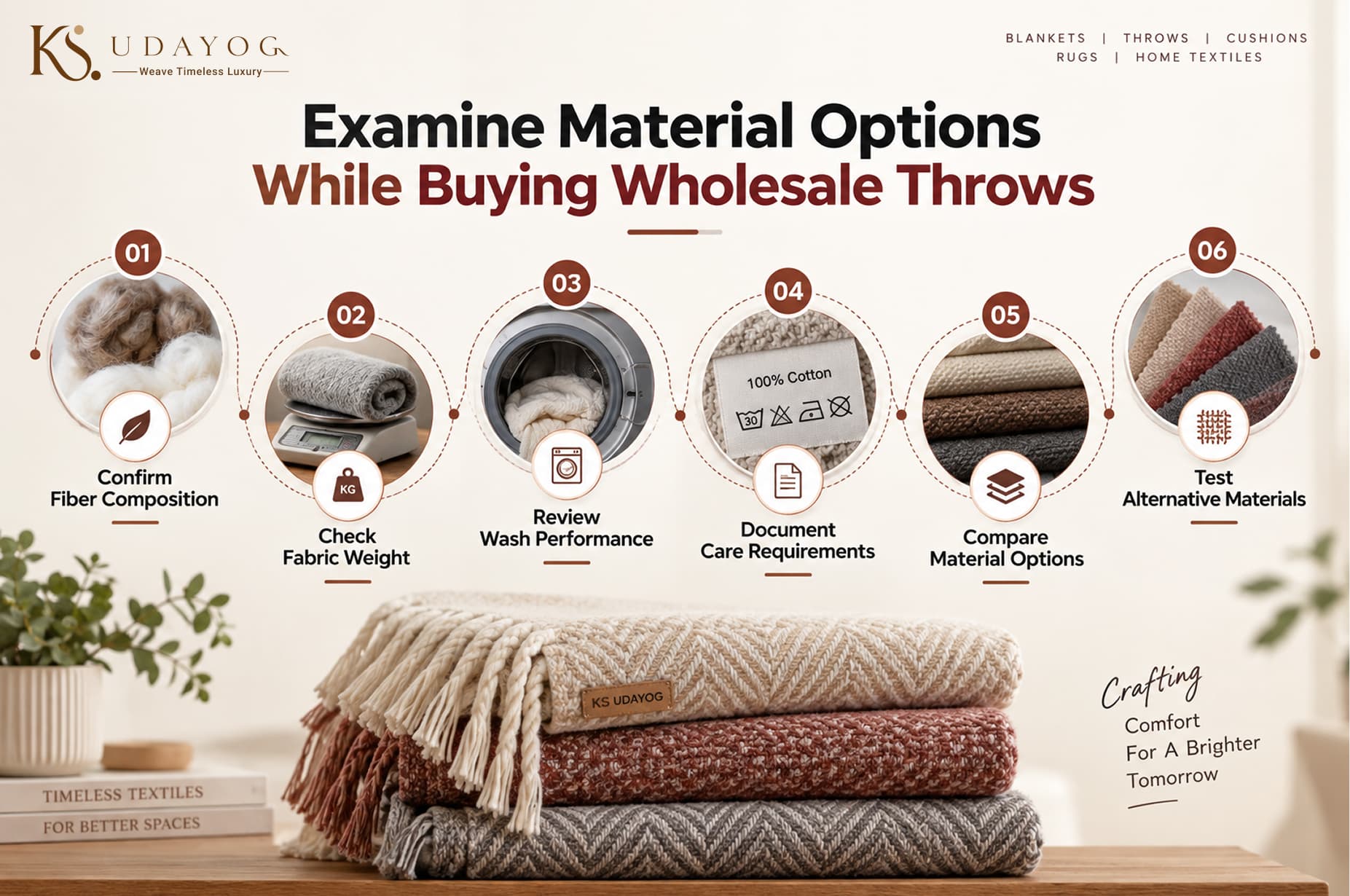
- Confirm Fiber Composition: Verify the exact fiber or blend used and ensure it matches your product specifications.
- Check Fabric Weight: Compare GSM or fabric weight to achieve the required warmth, thickness, and overall feel.
- Review Wash Performance: Test shrinkage, color retention, softness, and shape after washing before approving bulk production.
- Document Care Requirements: Confirm washing, drying, ironing, and maintenance instructions for accurate product labeling.
- Compare Material Options: Review available fibers and blends to select the best option for your target market.
- Test Alternative Materials: Check whether approved designs can be produced using different materials without compromising appearance or construction.
A clear understanding of materials also helps you create accurate product descriptions for your customers.
4. Request Physical Samples
A sample is one of the most valuable tools for evaluating a throw manufacturer. Product photographs can show colors and patterns, but they cannot fully communicate softness, thickness, texture, stitching, or finishing.
Inspect the sample for:
- Actual dimensions
- Material and texture
- Weight
- Color accuracy
- Pattern quality
- Stitching
- Edge finishing
- Fabric density
- Surface appearance
- Overall construction
A throw sample approval should happen before bulk production whenever possible. Keep the approved sample or documented specification as a reference for the final order.
5. Evaluate Throw Manufacturing Quality
Manufacturing quality should be assessed across the complete throw rather than through appearance alone.
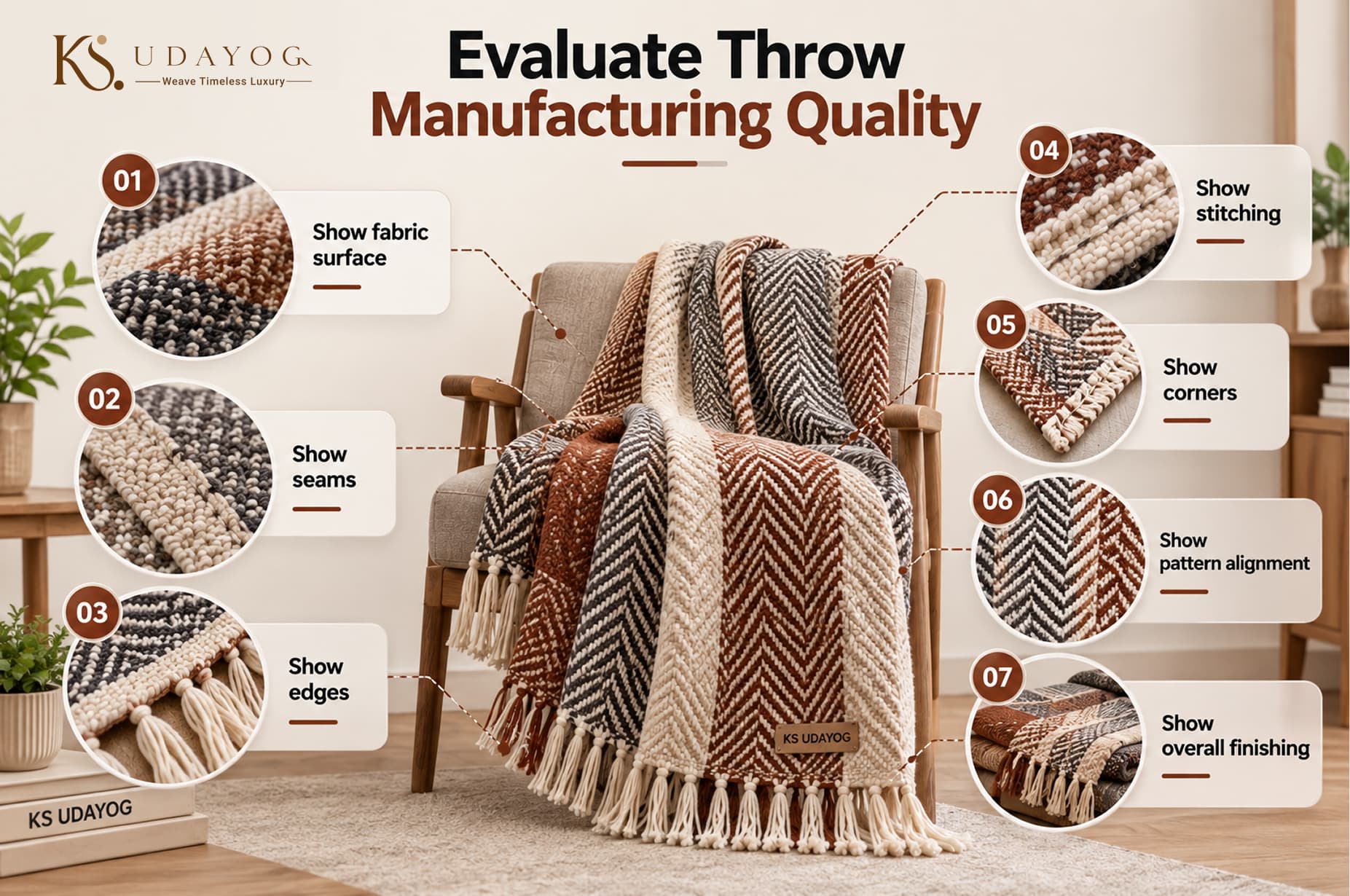
Look closely at the fabric surface, seams, edges, stitching, corners, pattern alignment, and overall finishing. For woven or patterned throws, check whether the design appears clear and properly reproduced.
A good throw blanket manufacturer should also have defined quality checks during production and before dispatch. Ask what defects they inspect and how they handle products that do not meet the agreed standard.
6. Compare Customization Capabilities
Customization can be important when you want your throw collection to have a distinct appearance or carry your own branding.
Depending on the manufacturer, customization may include:
- Custom dimensions
- Colors
- Patterns
- Materials
- Weaves
- Borders
- Labels
- Hang tags
- Packaging
- Private labeling
Not every manufacturer will offer the same level of customization. Ask which changes are possible, what minimum quantities apply, and whether development or sampling charges are involved.
7. Understand MOQ Before Ordering
MOQ, or Minimum Order Quantity, is the smallest quantity a manufacturer accepts for a particular product or production requirement.
MOQ may vary depending on:
- Existing versus custom designs
- Material
- Color
- Size
- Manufacturing method
- Packaging
- Private labeling
A manufacturer may allow a smaller quantity for an existing throw but require a larger production run for a customized design.
Your ideal supplier should have an MOQ that fits your inventory plan. An attractive product is not commercially useful if the minimum order is significantly higher than what you can realistically sell.
8. Compare Wholesale Pricing of Throw Properly
Price comparison becomes meaningful only when manufacturers are quoting the same specifications.
A lower price could result from differences in material, dimensions, construction, packaging, customization, or finishing. Ask each supplier to quote against the same product requirements.
Consider these cost components:
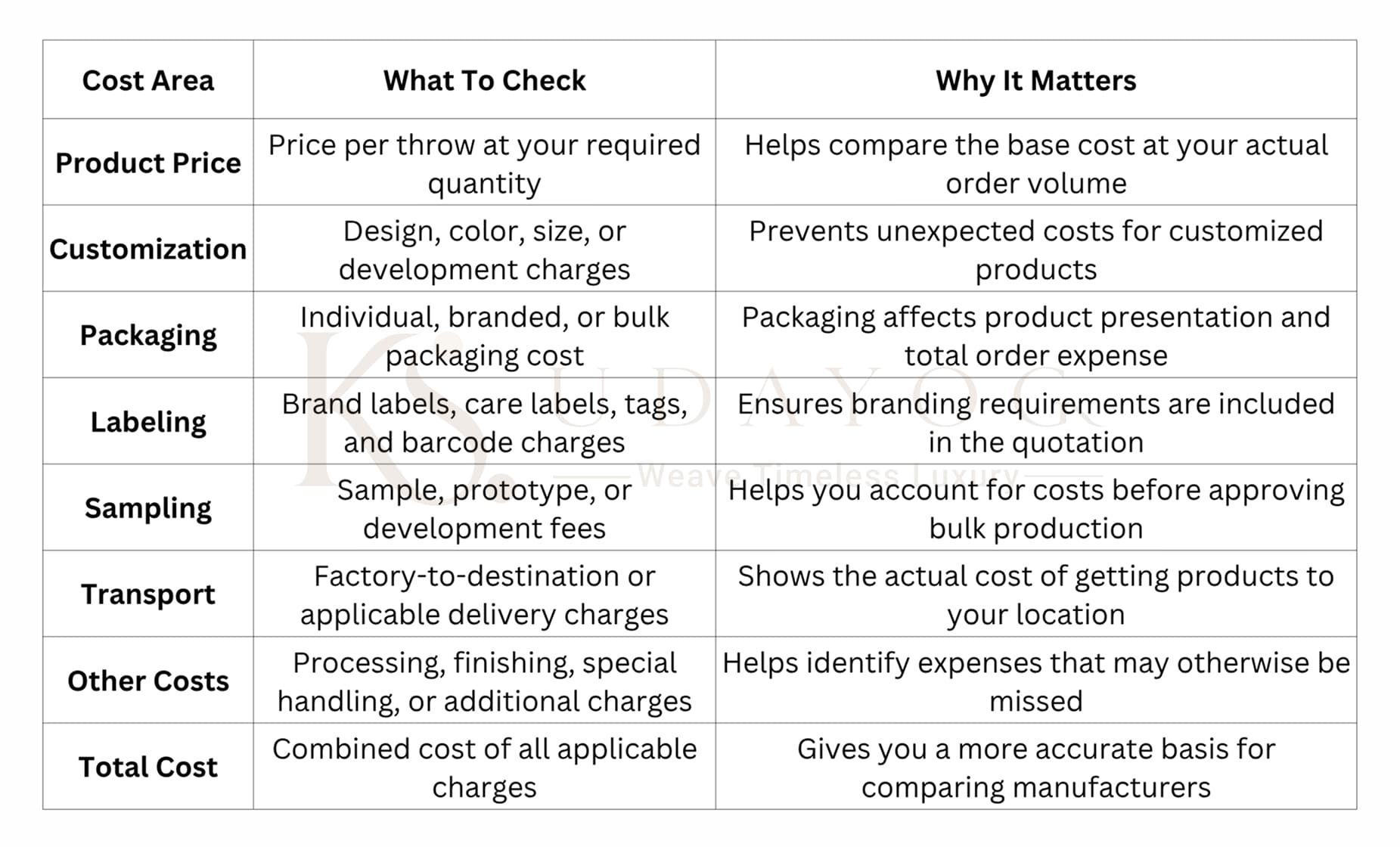
The goal is to compare the complete throw blanket purchasing cost, not simply the advertised price per piece.
9. Check Production Capacity
Production capacity matters when you are placing large orders or planning seasonal collections. A manufacturer should be able to meet your required quantity without compromising quality or extending the agreed timeline.
- Match Capacity To Quantity: Compare the manufacturer's available production capacity with your required order volume before finalizing the supplier.
- Check Monthly Output: Review typical production volumes to determine whether the manufacturer can handle your regular and peak requirements.
- Plan Seasonal Orders Early: Share expected seasonal demand in advance so production slots can be reserved before busy periods.
- Test With A Trial Order: Start with a manageable quantity to assess whether the manufacturer can maintain quality and meet delivery commitments.
- Assess Scaling Ability: Confirm that production can increase when your sales grow without causing major changes in quality or lead time.
- Verify Repeat-Order Support: Choose a manufacturer capable of reproducing approved throws when you need additional inventory.
- Confirm Production Timeline: Get a clear manufacturing schedule covering sampling, bulk production, finishing, inspection, and packaging.
A supplier may be suitable for a small trial order but struggle with a significantly larger requirement. Your manufacturer's capacity should therefore match both present and expected demand.
10. Review Lead Times
Lead time includes the time required to prepare, manufacture, finish, inspect, and package your order.
Custom throws generally require more planning than standard products because additional development or approvals may be involved.
Ask for separate timelines for:
- Sample development
- Sample approval
- Bulk production
- Quality inspection
- Packaging
- Dispatch
A realistic timeline is more useful than a vague promise of fast delivery.
11. Examine Packaging And Labeling
Packaging should protect the throws from dust, moisture, compression, and handling damage during transportation and storage.
Discuss your preferred packaging before finalizing the order.
Requirements may include:
- Individual polybags
- Branded packaging
- Care labels
- Product labels
- Barcodes
- Hang tags
- Carton packing
- Carton markings
- Quantity per carton
Your packaging requirements can also affect the final product cost and shipping volume, so they should be included in the quotation.
12. Check Quality Control Procedures
Check Quality Control Procedures
A reliable manufacturer should inspect throws at different production stages instead of identifying defects only after the order is completed. A defined quality-control process helps catch problems early and keeps the finished products closer to the approved sample.
- Set Product Standards: Define the approved material, dimensions, construction, appearance, and finishing requirements before production begins.
- Establish Tolerances: Agree on acceptable variations for dimensions, weight, color, and other measurable specifications.
- Approve Quality Benchmarks: Use a physical sample or documented specification as the reference for bulk production.
- Inspect During Production: Encourage stage-wise checks so defects can be identified before the entire order is completed.
- Review Finished Products: Conduct a final inspection to confirm the completed throws meet the agreed standards before packing.
- Document Defects: Record recurring issues, rejected pieces, and corrective actions to improve production quality across future orders.
- Verify Corrective Measures: Confirm that identified production problems are resolved before approving the remaining batch for dispatch.
For bulk orders, establish acceptable tolerances before production begins. This gives both the buyer and manufacturer a clear reference for deciding whether the finished products meet the agreed requirements.
13. Ask About Repeat Orders
Repeat-order capability is particularly important for retailers and brands.
Suppose a throw becomes one of your best-selling products. You will want the next production batch to remain as close as reasonably possible to the approved version.
Ask the manufacturer whether they can maintain records of:
- Product specifications
- Approved samples
- Color references
- Dimensions
- Materials
- Construction details
- Packaging requirements
A manufacturer capable of supporting repeat production can become more valuable as your collection grows.
14. Assess Communication And Responsiveness
Communication can have a major impact on bulk-order management.
Pay attention to how clearly the manufacturer answers questions about samples, specifications, MOQ, pricing, customization, production schedules, and quality checks.
Clear communication during the quotation stage can also indicate how easily you may be able to coordinate future orders.
A supplier that responds quickly but gives unclear answers is not necessarily a better choice than one that provides detailed, accurate information.
15. Ask About Private Label Support
Private labeling allows retailers and brands to sell throws under their own branding rather than the manufacturer's name.
If private labeling is part of your plan, discuss:
- Brand labels
- Care labels
- Hang tags
- Packaging
- Product inserts
- Barcodes
- Carton markings
- Branding placement
The manufacturer should understand your branding requirements before production starts. Samples of branded packaging or labels should also be approved where necessary.
16. Compare Throw Manufacturers Using A Supplier Scorecard
A supplier scorecard can make your decision more objective when several manufacturers appear suitable.
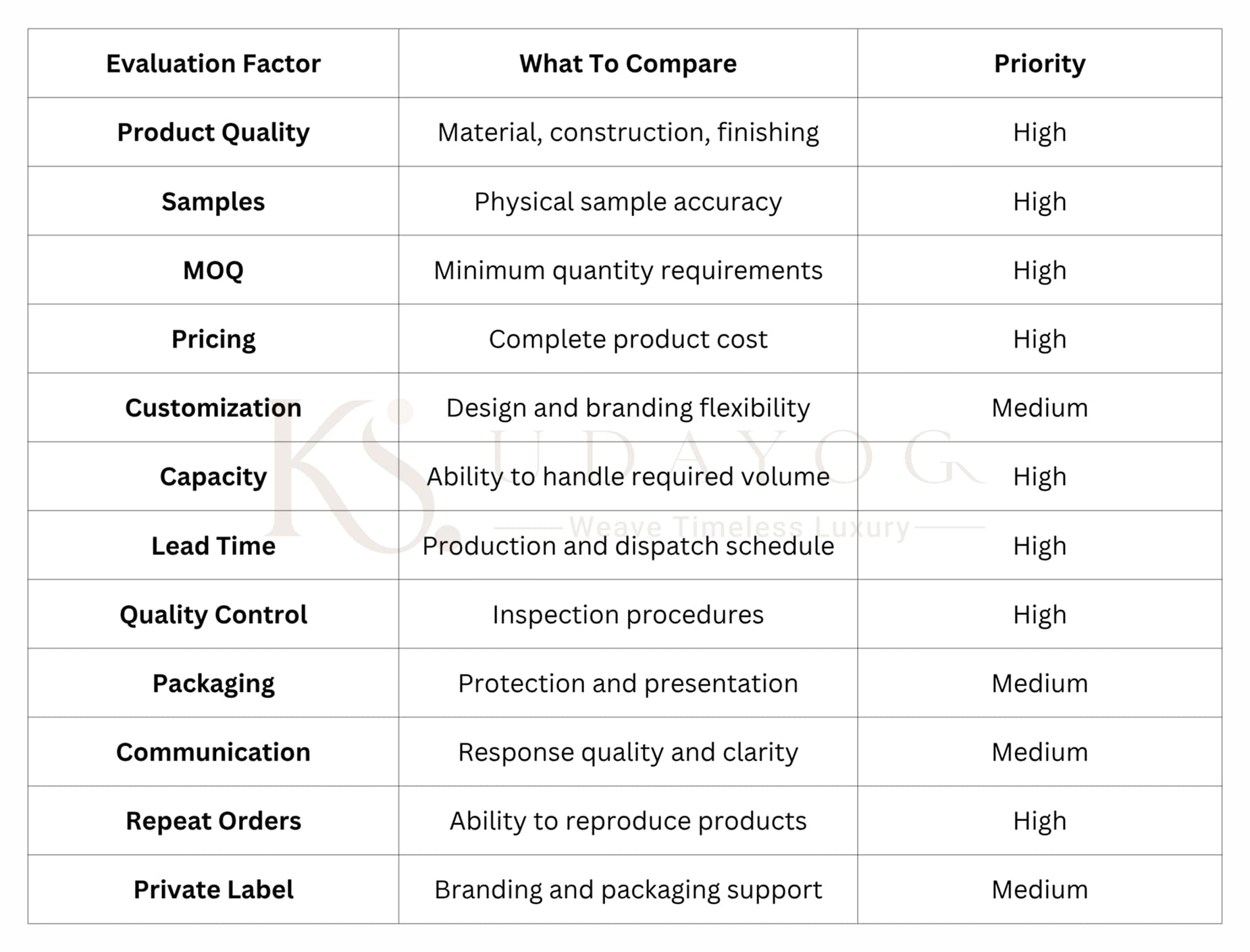
You can score each manufacturer against these factors and compare the results before making your final decision.
Wholesale Throws Vs Bulk Throws: What Is The Difference?
The terms wholesale throws and bulk throws are often used interchangeably, but the buying intent can differ.
Wholesale throws generally refer to products purchased at wholesale quantities or pricing for resale. Bulk throws simply emphasize purchasing a larger quantity, whether for resale, hospitality, events, furnishing projects, or another application.
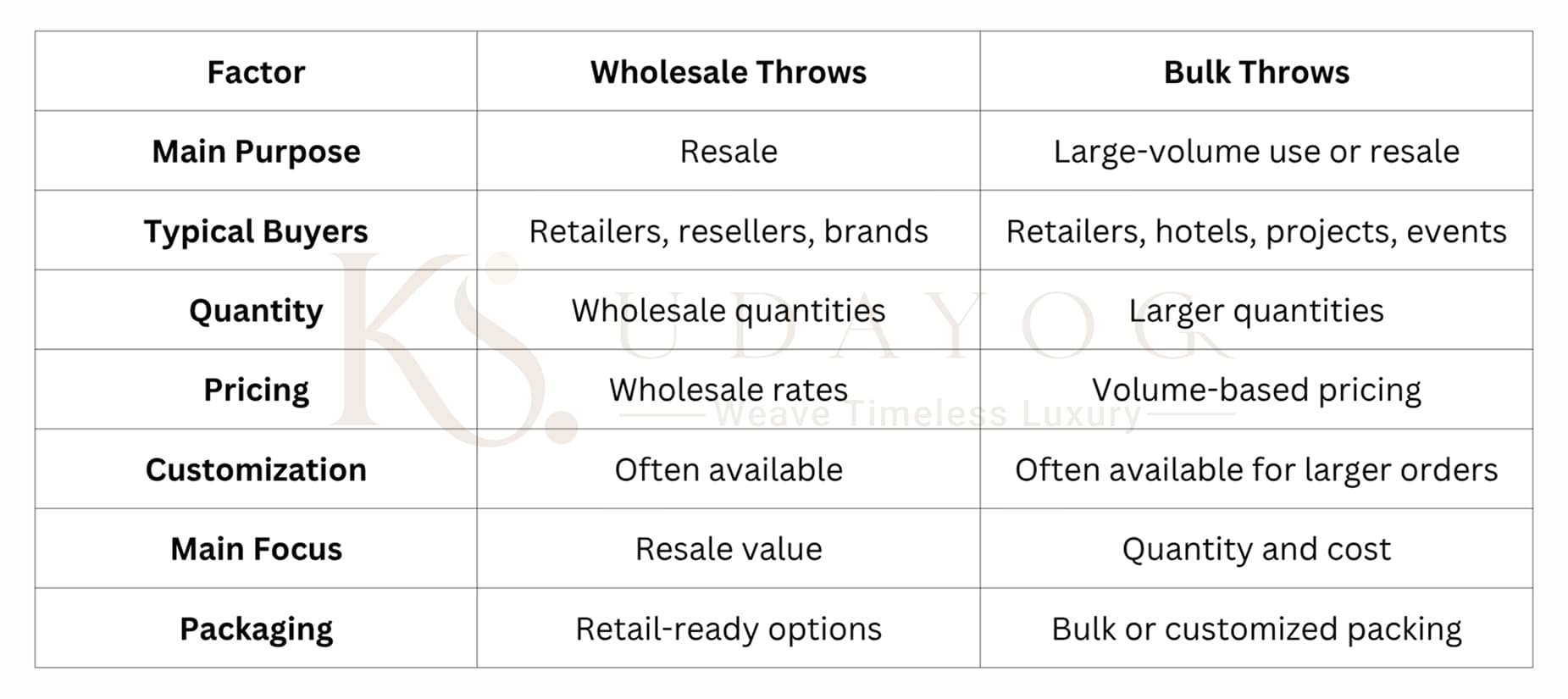
The important consideration is not the terminology but the order requirements. Quantity, product specifications, customization, pricing, packaging, and delivery expectations should be clearly established with the manufacturer.
Questions You Must Ask A Throw Manufacturer Before Placing A Bulk Order
A few targeted questions can reveal whether a supplier is suitable for your requirements.
- Can you manufacture the exact throw specification I need? The answer should cover material, dimensions, construction, design, and finishing.
- What is your MOQ for standard and customized throws? Different products may have different minimum quantities.
- Can I approve a physical sample before bulk production? A sample provides an important reference for quality and specifications.
- What customization options do you offer? Ask specifically about materials, sizes, colors, patterns, labels, and packaging.
- What is your production lead time? Request a realistic timeline rather than a general estimate.
- How do you conduct quality inspections? The manufacturer should be able to explain the checks performed before dispatch.
- Can you support repeat orders? This matters when you expect to reorder successful designs.
- What packaging options are available? Confirm whether the packaging meets your storage, retail, or shipping requirements.
Red Flags To Watch For When Choosing A Throw Supplier
Some warning signs deserve additional attention before you place a large order.
- No Physical Samples
A supplier unwilling or unable to provide a suitable sample can make product evaluation difficult.
- Unclear Pricing
A quotation without clear details about quantity, specifications, packaging, customization, or other charges makes comparison difficult.
- Vague Production Timelines
Unclear lead times can create inventory planning problems, particularly for seasonal collections.
- Limited Product Information
A manufacturer should be able to explain the materials, construction, dimensions, and finishing of the products they supply.
- No Defined Quality Process
The absence of a clear inspection process can increase the risk of receiving products that differ from your approved requirements.
- Unrealistic Promises
Extremely low prices, unusually short timelines, or broad claims without supporting details should be evaluated carefully.
How To Place Your First Bulk Throw Order?
Your first order does not need to be complicated if the process is organized properly. Here’s the complete process to place your bulk order.
Step 1: Define Your Requirements
Finalize the throw size, material, design, colors, quantity, intended use, and packaging requirements before approaching manufacturers.
Step 2: Shortlist Manufacturers
Compare manufacturers based on product range, production capacity, MOQ, customization options, quality standards, pricing, and previous bulk-order experience.
Step 3: Request Samples
Order physical samples to check fabric quality, stitching, dimensions, color accuracy, softness, finishing, and overall product appearance.
Step 4: Confirm Specifications
Share the approved sample and finalize every production detail, including measurements, materials, GSM, colors, patterns, labels, and packaging.
Step 5: Compare Complete Costs
Review the unit price along with customization, packaging, shipping, and other applicable charges to understand your actual order cost.
Step 6: Confirm MOQ And Timeline
Agree on the minimum order quantity, production schedule, dispatch date, payment terms, and expected delivery timeline before placing the order.
Step 7: Approve The Final Order
Review the quotation, specifications, sample reference, quantity, and commercial terms before giving written approval for production.
Step 8: Inspect Before Dispatch
Request pre-shipment quality checks or inspection reports to verify that the finished throws match the approved specifications.
Step 9: Arrange Delivery
Confirm packaging, shipping method, documentation, and delivery details so the completed order reaches your required destination safely.
Why The Right Throw Manufacturer Matters
The throw manufacturer you choose becomes an important part of your supply chain. Product quality, availability, customization, pricing, lead times, and repeat production can all influence how easily you manage your throw collection.
A supplier that matches your requirements from the beginning can make future orders easier to plan. More importantly, a careful selection process helps you avoid choosing a manufacturer based solely on a low quotation.
Final Thoughts
The selection of a throw manufacturer in India for wholesale or bulk orders requires a balanced evaluation of quality, materials, pricing, MOQ, customization, production capacity, lead time, packaging, and repeat-order support. Physical samples and clearly documented specifications should form the foundation of the purchasing process.
The best supplier is not necessarily the one with the lowest price or the largest catalog. A stronger choice is a manufacturer that can deliver the right product, quantity, quality, and service requirements while supporting your purchasing needs as your demand grows.
If you are planning your next bulk order, you can connect with a reliable throw manufacturer to discuss your product requirements and sourcing needs.
Frequently Asked Questions (FAQs)
How Do I Find A Reliable Throw Manufacturer?
Start by comparing manufacturers based on product quality, samples, material options, MOQ, customization, production capacity, quality control, lead time, and repeat-order capabilities.
What Is The MOQ For Wholesale Throws?
MOQ varies by manufacturer and product requirements. Custom designs, special materials, private labeling, and specific colors may require higher quantities than standard products.
Can I Customize Throws For My Brand?
Many manufacturers offer customization options such as colors, sizes, patterns, labels, packaging, and materials. Confirm available options and applicable minimum quantities before ordering.
Should I Request A Sample Before Buying Bulk Throws?
Yes, a physical sample allows you to evaluate material, dimensions, texture, color, construction, stitching, and finishing before committing to a larger production order.
How Should I Compare Throw Manufacturer Prices?
Compare quotations using identical product specifications and include customization, packaging, labeling, transport, sampling, and other applicable costs instead of comparing unit prices alone.
How Long Does Bulk Throw Production Take?
Production time depends on quantity, material, design, customization, manufacturing capacity, and seasonal demand. Ask the manufacturer for a timeline covering sampling, production, inspection, packaging, and dispatch.
Can A Throw Manufacturer Handle Repeat Orders?
Many manufacturers support repeat orders, but buyers should confirm whether approved specifications, samples, colors, materials, and packaging details can be retained for future production.
What Should I Check In A Bulk Throw Order?
Check the material, dimensions, color, pattern, texture, stitching, edges, finishing, quantity, packaging, labels, and overall appearance against the approved sample and specifications.