The biggest difference between handmade and machine-made carpets may not be visible from across the room. It becomes clearer when you examine the construction, feel the materials, look at the reverse side, and consider how the carpet fits your budget and expected use.
Handmade luxurious carpets can offer distinctive character and long-term durability, while machine-made carpets provide a more uniform product that can be produced at greater speed and generally at a lower price. Neither choice is automatically right for everyone; the better fit depends on what you expect from the carpet.
The real difference comes from how the carpet is manufactured, which carpet material is right and used, how it will be used, and how much you are prepared to invest. Understanding these factors makes it easier to choose a carpet that fits your space rather than choosing based only on appearance.
This guide breaks down the handmade-versus-machine-made decision so you can understand what you are paying for, where each option works best, and which carpet is likely to suit your needs better.
Handmade Vs Machine-Made Carpets: What Is The Difference?
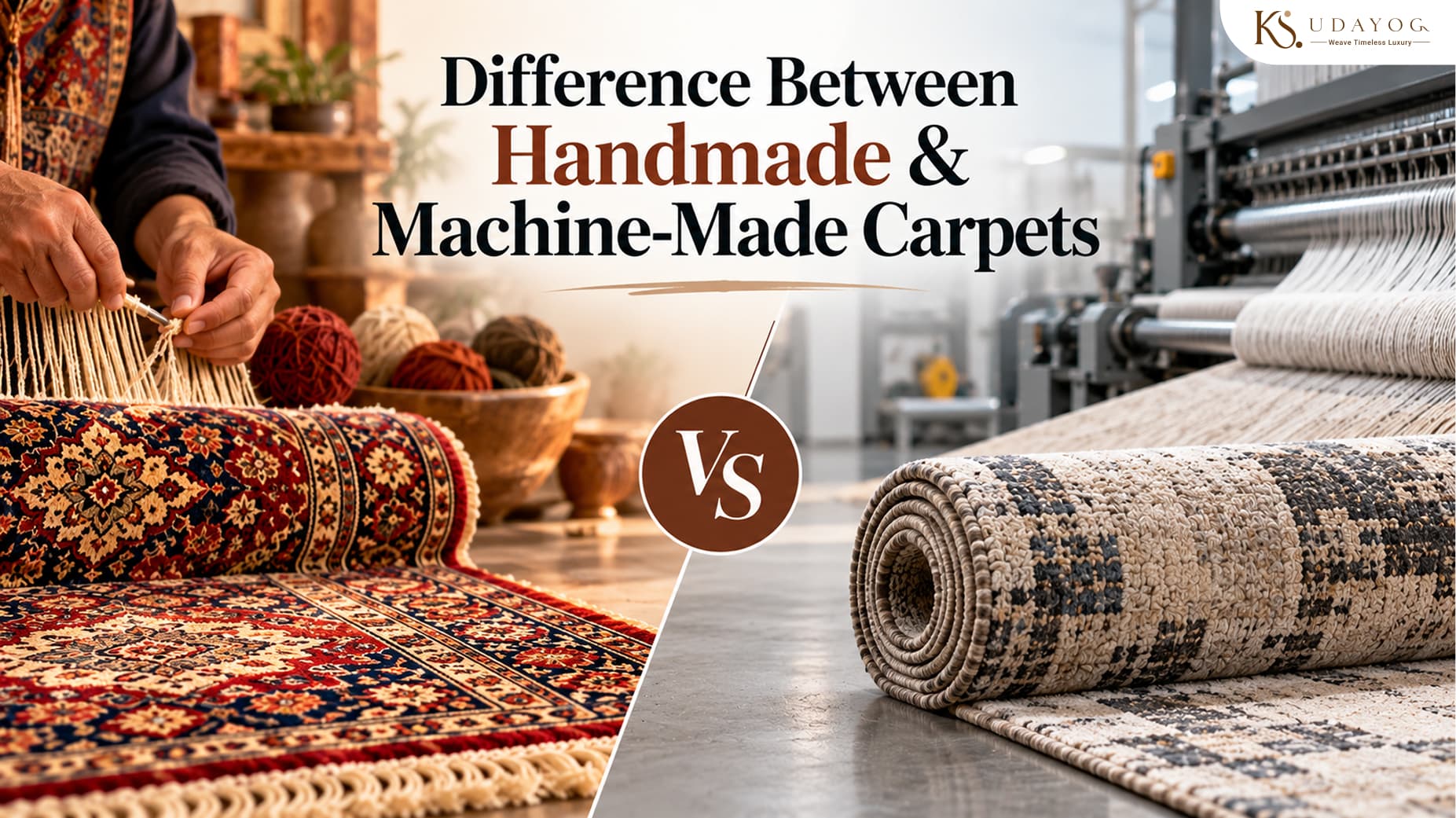
The biggest difference is the carpet manufacturing method.
A handmade carpet is produced using substantial manual craftsmanship. Depending on the construction, artisans may hand-knot, hand-weave, or hand-tuft yarn to create the carpet. Hand-knotted carpets, for example, are built knot by knot on a loom, making the construction closely connected to the design itself.
Machine-made carpets are produced using powered looms or automated manufacturing systems. The process allows manufacturers to reproduce the same pattern, dimensions, colors, and construction across larger quantities with greater uniformity.
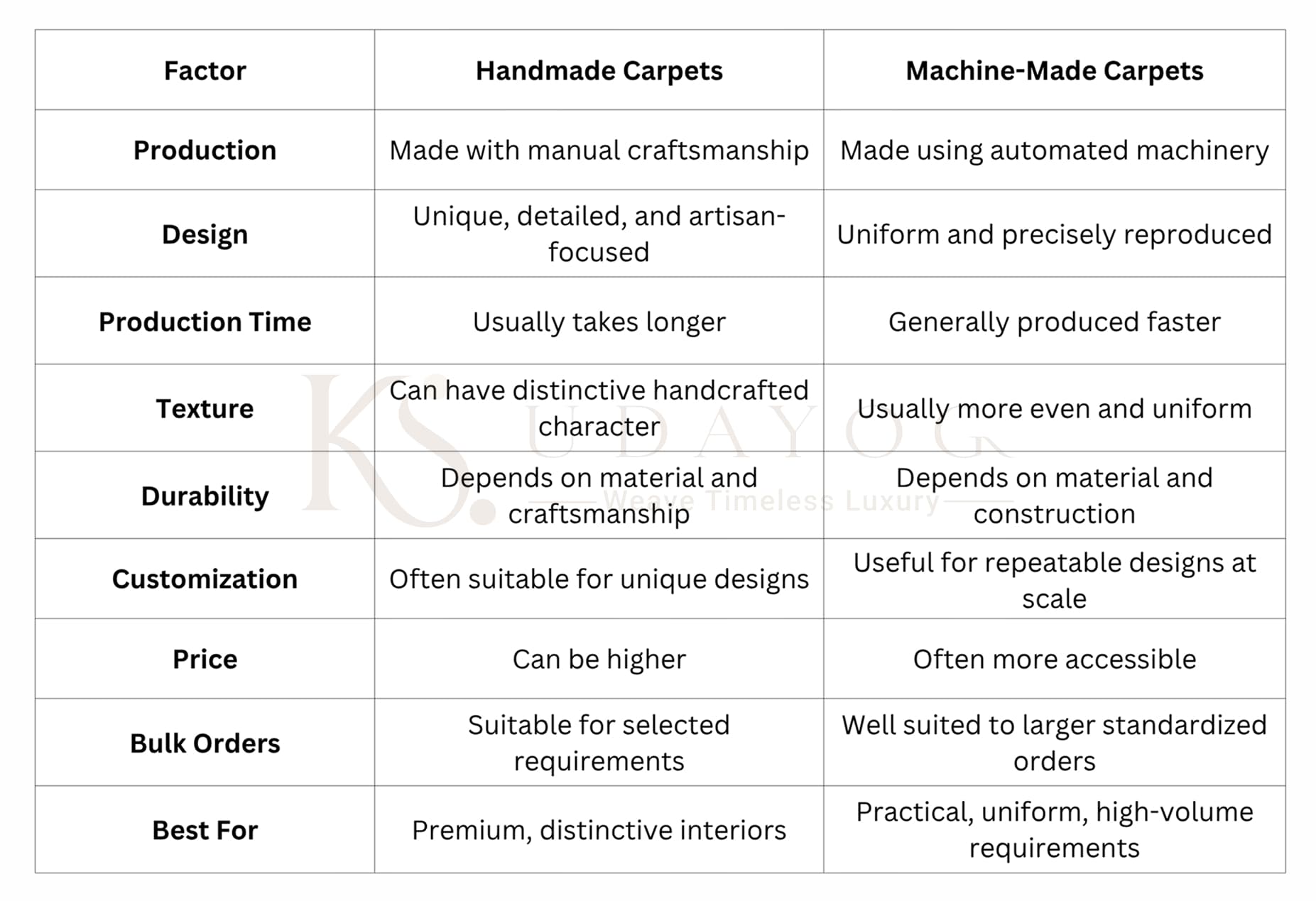
This difference affects more than production time. It can influence the carpet's texture, appearance, customization possibilities, production volume, pricing, and the type of buyer it suits.
1. Understanding Carpet Construction Methods
Handmade carpets can be produced through different techniques, so the term does not describe only one construction method.
- Hand-Knotted Carpets
In hand-knotting, artisans tie individual knots around the warp threads. The pile is built gradually as the design develops across the loom. Knot density, yarn quality, design complexity, and craftsmanship can all influence the finished carpet.
- Hand-Tufted Carpets
Hand-tufted carpets are made by pushing or punching yarn through a prepared backing using a handheld tufting tool. The pile is then finished, trimmed, and secured with backing materials.
- Hand-Woven Carpets
Hand-woven carpets are created by interlacing yarn manually on a loom. Flatweaves such as certain dhurries and kilims are examples of constructions that can be produced using this approach.
Therefore, when someone says a carpet is "handmade," it is worth asking which handmade technique was used. Hand-knotted, hand-tufted, and hand-woven carpets should not automatically be treated as identical products.
On the other hand, machine-made carpets use powered equipment to create the carpet structure at a larger production scale.
The carpet manufacturing system can reproduce patterns, dimensions, and construction with a high degree of uniformity. Depending on the carpet, carpet exporters and manufacturers may use materials such as polyester, polypropylene, nylon, wool blends, or other fibers suited to the intended product.
The major advantage is repeatability. If a retailer needs hundreds of carpets in the same design and size, machine production can make that requirement easier to fulfil.
The Carpet Export Promotion Council also notes construction differences between handmade and machine-made carpets, including differences in knots, edges, backs, materials, touch, and manufacturing processes.
2. Comparing Handmade And Machine Production
Handmade carpets generally require more time to produce because a significant portion of the construction depends on manual work. The production period can vary considerably depending on the carpet's size, design complexity, construction technique, and level of detail.
In contrast, machine-made carpets can be produced much faster, particularly when the same design needs to be manufactured in larger quantities. Automated production makes it easier to reproduce standardized products without requiring the same amount of manual labor for every individual piece.
3. Exploring Carpet Design And Patterns
Handmade carpets can have a distinctive visual character because the design develops through manual craftsmanship. Small variations in knotting, yarn placement, or tension can create subtle differences that make individual pieces feel less uniform.
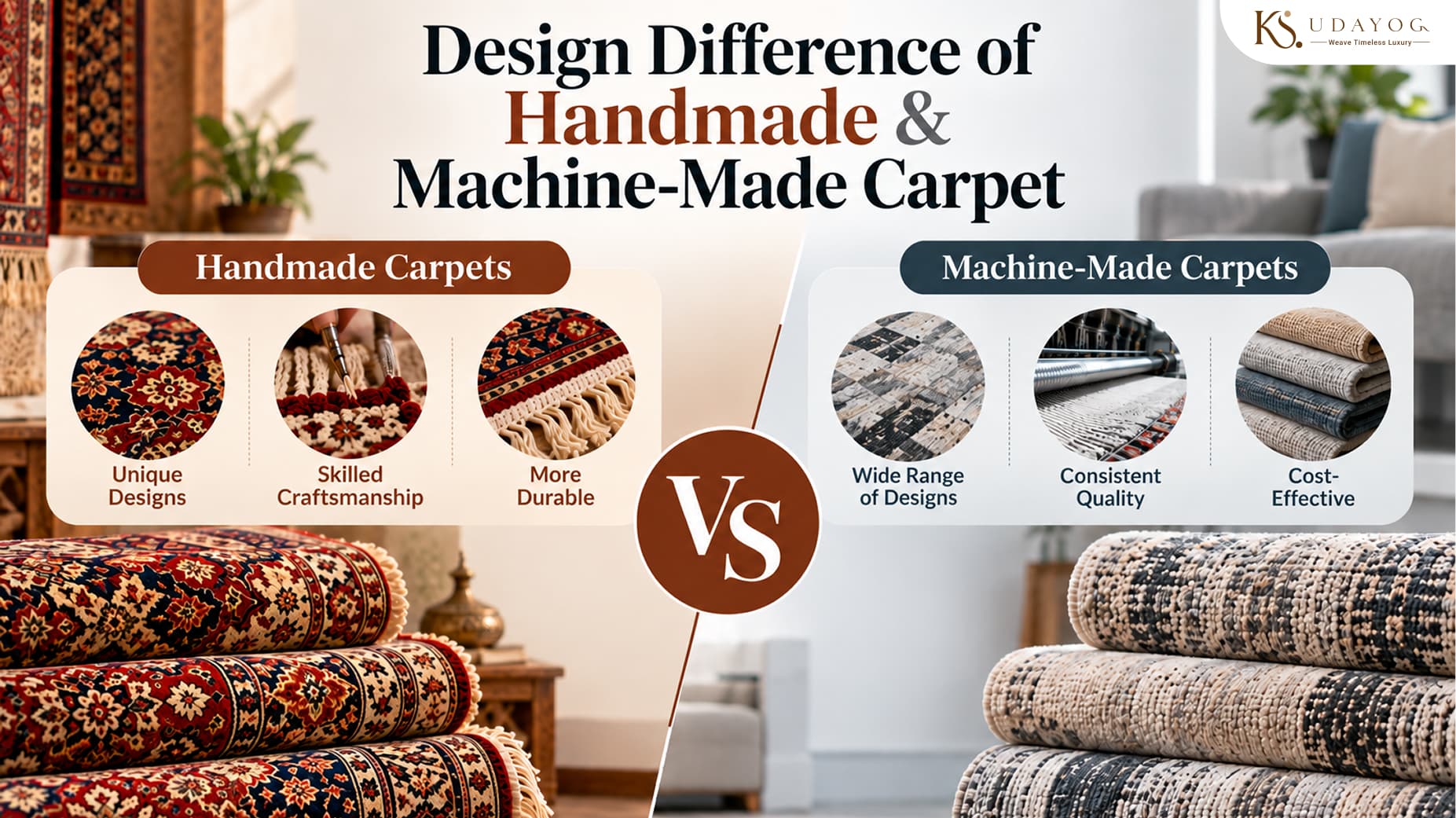
By comparison, machine-made carpets are designed for precise reproduction. Patterns, borders, motifs, and color placements can be replicated across multiple carpets with considerable consistency. This makes them particularly useful when a buyer needs matching pieces for several rooms or a larger commercial project.
4. Comparing Carpet Uniformity And Consistency
Handmade carpets may show slight variations in construction, particularly when they are hand-knotted or handwoven. These differences can occur because the work is performed manually and can vary slightly from one section to another.
Machine-made carpets, meanwhile, are generally more uniform. Automated equipment maintains the same programmed specifications throughout production, making consistent dimensions, patterns, and construction easier to achieve. The Carpet Export Promotion Council also identifies uniformity as one of the useful characteristics when distinguishing machine-made construction from handmade carpets.
5. Understanding Carpet Materials And Fibers
Handmade carpets are often associated with materials such as wool, silk, and cotton, although the actual material selection depends on the manufacturer and the specific construction.
On the other hand, machine-made carpets can use a broad range of fibers, including polyester, polypropylene, nylon, wool blends, and other materials. Therefore, it is better not to assume that the manufacturing method automatically determines the material.
The fiber itself can have a major influence on softness, appearance, durability, cleaning requirements, and overall suitability.
6. Comparing Carpet Texture And Comfort
Handmade carpets can offer a distinctive texture because their construction involves manual manipulation of yarn and fibers. Depending on the material and technique, the surface may have subtle variations that contribute to its individual character.
In comparison, machine-made carpets generally provide a more controlled and uniform surface. However, this does not mean they are necessarily less comfortable. Pile height, density, fiber type, and finishing can all influence how a machine-made carpet feels underfoot.
7. Evaluating Handmade And Machine Durability
There is no universal answer.
A well-made handmade carpet can provide excellent long-term durability, particularly when it uses appropriate materials and a strong construction. However, not every handmade carpet has the same performance.
The same applies to machine-made carpets. A machine-made carpet designed for everyday use can perform well when its fiber, pile, backing, density, and construction are appropriate for the environment.
Instead of asking only "Is it handmade?", ask:
- What fiber is used?
- How is the carpet constructed?
- How dense is the pile?
- How strong is the backing?
- Where will it be used?
- How much foot traffic will it receive?
- How will it be cleaned?
- Can damaged areas be repaired?
For example, a decorative handmade carpet placed in a lightly used formal room has very different requirements from a machine-made carpet placed in a busy family area.
8. Comparing Carpet Customization And Flexibility
Handmade production can provide flexibility for buyers seeking distinctive sizes, patterns, colors, or design details, depending on the manufacturer's capabilities.
On the other hand, machine-made production is particularly useful when a buyer needs the same customized specification reproduced across a larger quantity. Once the design is programmed and approved, manufacturers can reproduce it with greater consistency.
The better choice depends on the type of customization you need.
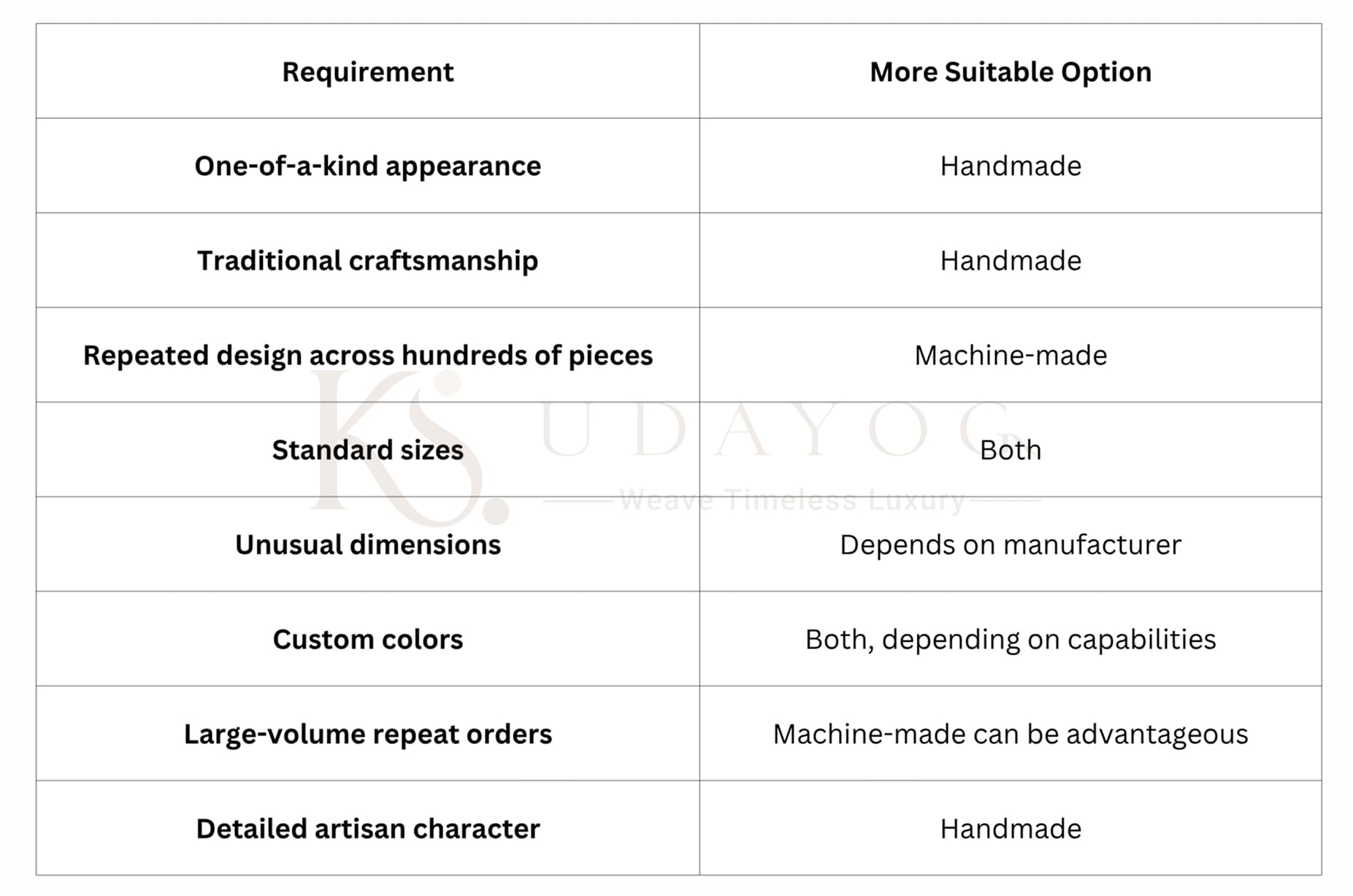
For commercial buyers, always ask the manufacturer about actual customization capabilities instead of assuming one production method automatically provides more flexibility.
9. Understanding Handmade And Machine Pricing
Handmade carpets can command a higher price because of the labor, craftsmanship, production time, material selection, and design complexity involved.
In contrast, machine-made carpets can benefit from automation and larger-scale production, which can make standardized designs more accessible to buyers.
However, price should always be compared against the complete specification. A handmade wool carpet and a machine-made synthetic carpet are different products, so comparing only their prices can give you the wrong impression about value.
10. Comparing Availability And Repeat Ordering
Handmade carpets may require more production time, especially when a buyer requests a particular design, size, or customization.
By comparison, machine-made carpets can be easier to reproduce when the same specification needs to be ordered repeatedly. This can be an important advantage for retailers, hospitality businesses, interior projects, and other buyers that require matching products over time.
11. Understanding Carpet Maintenance And Care
The maintenance needs of a handmade carpet depend heavily on its fiber and construction. Delicate materials or intricate constructions may require more careful cleaning and handling.
Machine-made carpets can also have different maintenance requirements depending on their fiber, pile, backing, and finishing. Some may be designed for practical everyday use, while others may require specialized care.
Therefore, the better question is not simply "Which carpet is easier to maintain?" but "Which carpet's maintenance requirements fit my lifestyle and intended use?"
12. Comparing Carpet Repairs And Longevity
Some handmade carpets can be repaired or restored by skilled professionals, depending on their construction and the extent of the damage. This can be useful when the buyer intends to keep the carpet for many years.
Machine-made carpets, on the other hand, may be more practical to replace when significant damage occurs, depending on their construction and price. For a buyer who prefers easy replacement rather than long-term restoration, this can actually be an advantage.
Handmade Carpet or Machine-Made Carpet: Which Is Better For Retailers And Wholesale Buyers?
The decision becomes different when buying carpets in bulk. A retailer may care more about:
- MOQ
- Wholesale pricing
- Repeatability
- Production capacity
- Standard sizing
- Design consistency
- Lead time
- Packaging
- Private labeling
- Replacement availability
Machine-made carpets can be useful when a retailer needs a large quantity of identical or closely matched products.
Handmade carpets may be more suitable when the retailer's customers specifically value artisan craftsmanship, natural materials, traditional designs, or distinctive products.
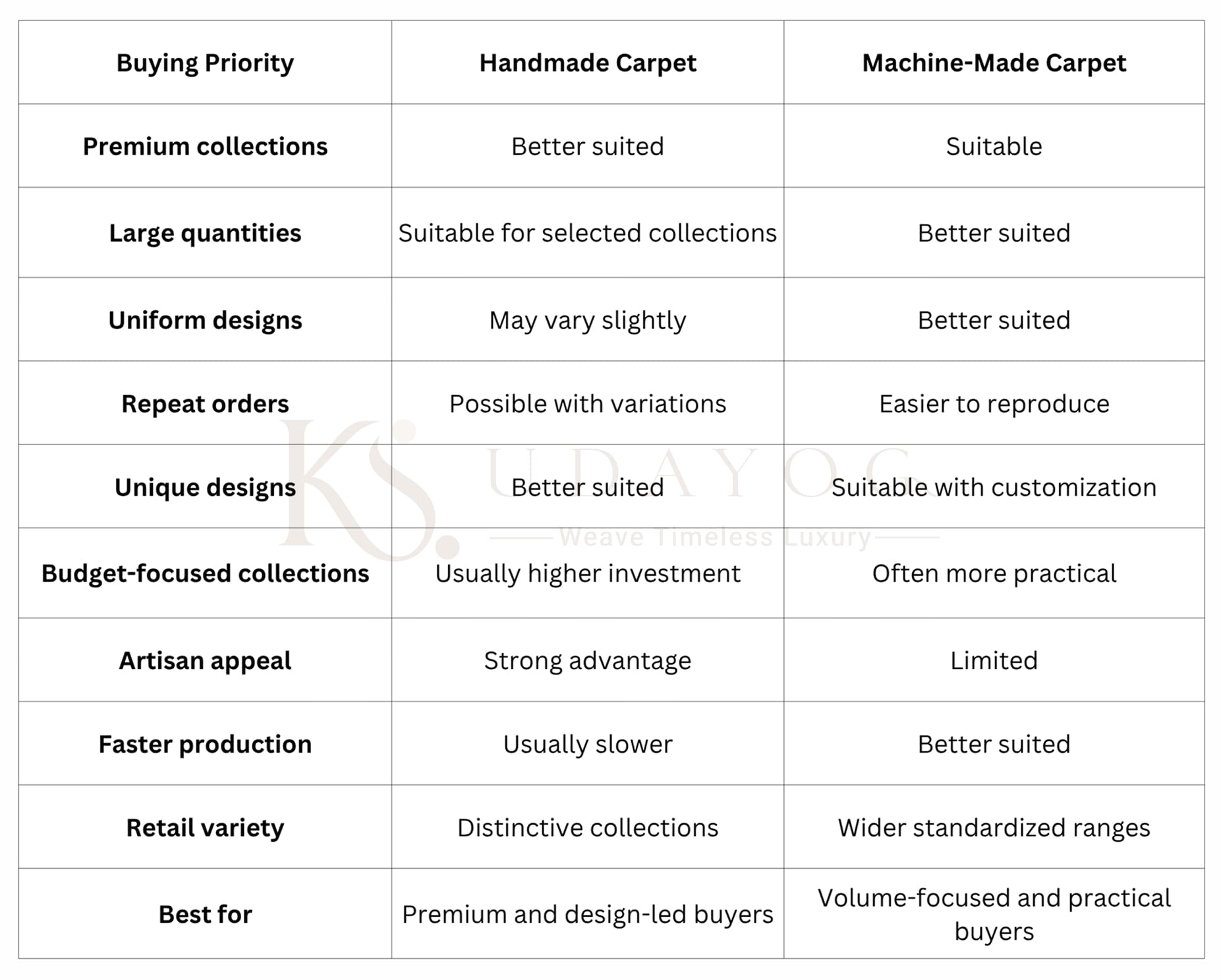
For bulk orders, the best approach is to compare the manufacturer's actual production capability rather than choosing a carpet category first.
Handmade Vs Machine-Made: Which Offers Better Value?
Value is not the same as the lowest price.
A ₹5,000 carpet that needs frequent replacement may not provide better value than a ₹12,000 carpet that performs well for substantially longer. At the same time, paying a premium for handmade craftsmanship may not make sense if you need an inexpensive carpet for temporary use.
Think about value using this simple formula:
Value = Performance + Suitability + Lifespan + Appearance + Maintenance − Total Cost
For a formal room where design and craftsmanship matter, handmade may offer stronger value.
For a rental property where affordability and easy replacement matter, machine-made may be the more sensible choice.
For a retailer, the better option may depend on customer demand, selling price, margin, MOQ, production capacity, and repeat-order requirements.
Final Verdict
Handmade carpets are generally worth considering when craftsmanship, individuality, intricate design, customization, and premium positioning are your main priorities.
Machine-made carpets can be the better choice when uniformity, scalable production, standardized designs, practical pricing, and larger quantities matter more.
The smartest choice is therefore not about deciding that one category is superior. It is about matching the carpet's construction, material, quality, price, and expected performance with the way you plan to use it.
If you are buying for a home, think about the room and your lifestyle. If you are sourcing for a store or business, consider your customers, order volume, margins, repeatability, and supplier capabilities before choosing. You can connect with a reliable carpet manufacturer and supplier to discuss your requirements and sourcing needs.
Frequently Asked Questions (FAQs)
Are Handmade Carpets Better Than Machine-Made Carpets?
Handmade carpets can offer greater individuality and craftsmanship, while machine-made carpets provide uniformity and scalable production. The better option depends on your budget, usage, design preferences, and required quantity.
Which Lasts Longer, Handmade Or Machine-Made Carpets?
Neither production method alone determines lifespan. Fiber quality, construction, pile density, workmanship, maintenance, and traffic levels all influence how long a carpet performs.
Are Machine-Made Carpets Good For High-Traffic Areas?
They can be a practical choice for high-traffic spaces when the carpet has suitable fiber, construction, pile, and backing for frequent use.
Why Are Handmade Carpets More Expensive?
Depending on their construction, handmade carpets can involve substantial manual labor, specialized craftsmanship, longer production periods, detailed designs, and higher-value materials.
How Can I Tell Whether A Carpet Is Handmade or Machine-Made?
Inspect the reverse, edges, construction, pattern regularity, and finishing. For important or expensive purchases, ask the seller or manufacturer to clearly state the construction method and provide product specifications.
Should I Buy A Sample Before Ordering Carpets In Bulk?
Yes. A physical sample lets you verify material, color, dimensions, texture, pile, backing, finishing, and workmanship before committing to a larger order.
What Is More Important: Carpet Material or Manufacturing Method?
Both matter. Manufacturing method affects construction and production characteristics, while material influences feel, durability, appearance, cleaning requirements, and suitability for different applications.