
The real cost of a rug quality problem often appears after the shipment has already left the factory. Replacements, rejected orders, customer complaints, repackaging, and delayed deliveries can quickly turn a small manufacturing defect into a larger business expense.
For B2B buyers, inspecting rugs before dispatch is therefore an important part of order control. Each batch should be reviewed against agreed specifications, including dimensions, materials, colors, construction, finishing, labeling, and packaging requirements.
A systematic inspection while buying wholesale rugs helps B2B buyers catch issues while they can still be corrected at the rug manufacturing facility. This checklist explains what to examine before approving a rug shipment for dispatch.

Why Should B2B Buyers Inspect Rugs Before Shipment?
A bulk rug order can contain dozens, hundreds, or even thousands of pieces, making small production variations more significant. A minor issue that may seem unimportant on one rug can become a major concern when it appears across an entire shipment.
Pre-shipment inspection gives buyers an opportunity to verify that the finished products match what was agreed upon before dispatch. It can also help identify defects that may be difficult or costly to resolve once the rugs have already been shipped.
For B2B buyers, the inspection should focus on both individual rug quality and batch-level consistency.
Rug Quality Inspection Checklist: Essential Pre-Shipment Checks For B2B Buyers
Use the following checklist to review your rug order before approving shipment:
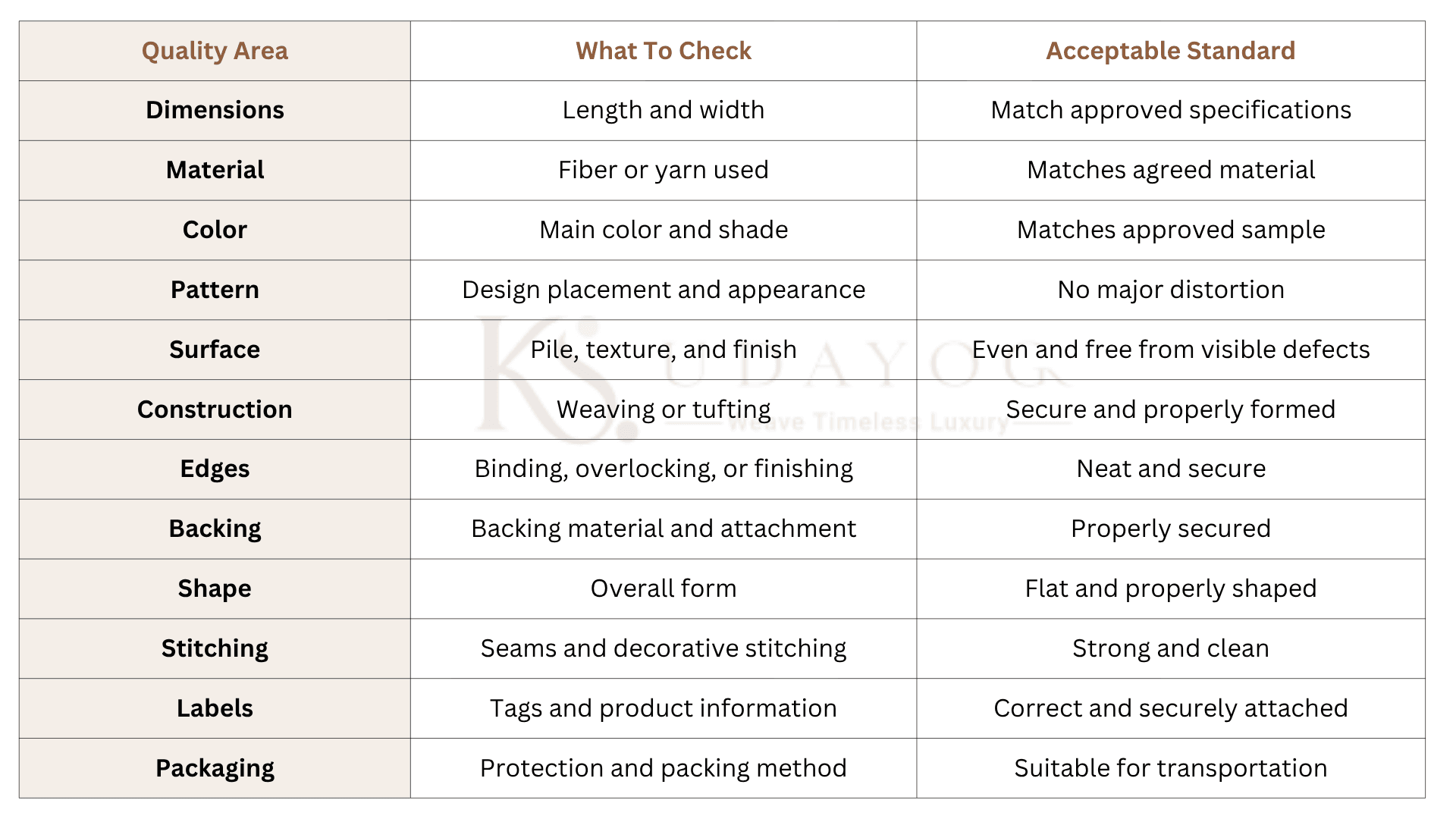
This checklist provides a starting point, but the exact inspection criteria should always reflect the product specifications agreed with the manufacturer.
1. Verify Rug Dimensions
Start by measuring the finished rug against the approved dimensions.
Check the length, width, and, where relevant, thickness or pile height. Do not assume that all pieces in a bulk order will have identical measurements simply because they were produced from the same specification.
For example, if the approved size is 5 × 8 feet, measure the finished rug to confirm it falls within the agreed dimensional tolerance. If your order includes 4 × 6 feet, 5 × 8 feet, and 8 × 10 feet rugs, inspect samples from each size instead of checking only one size from the entire shipment.
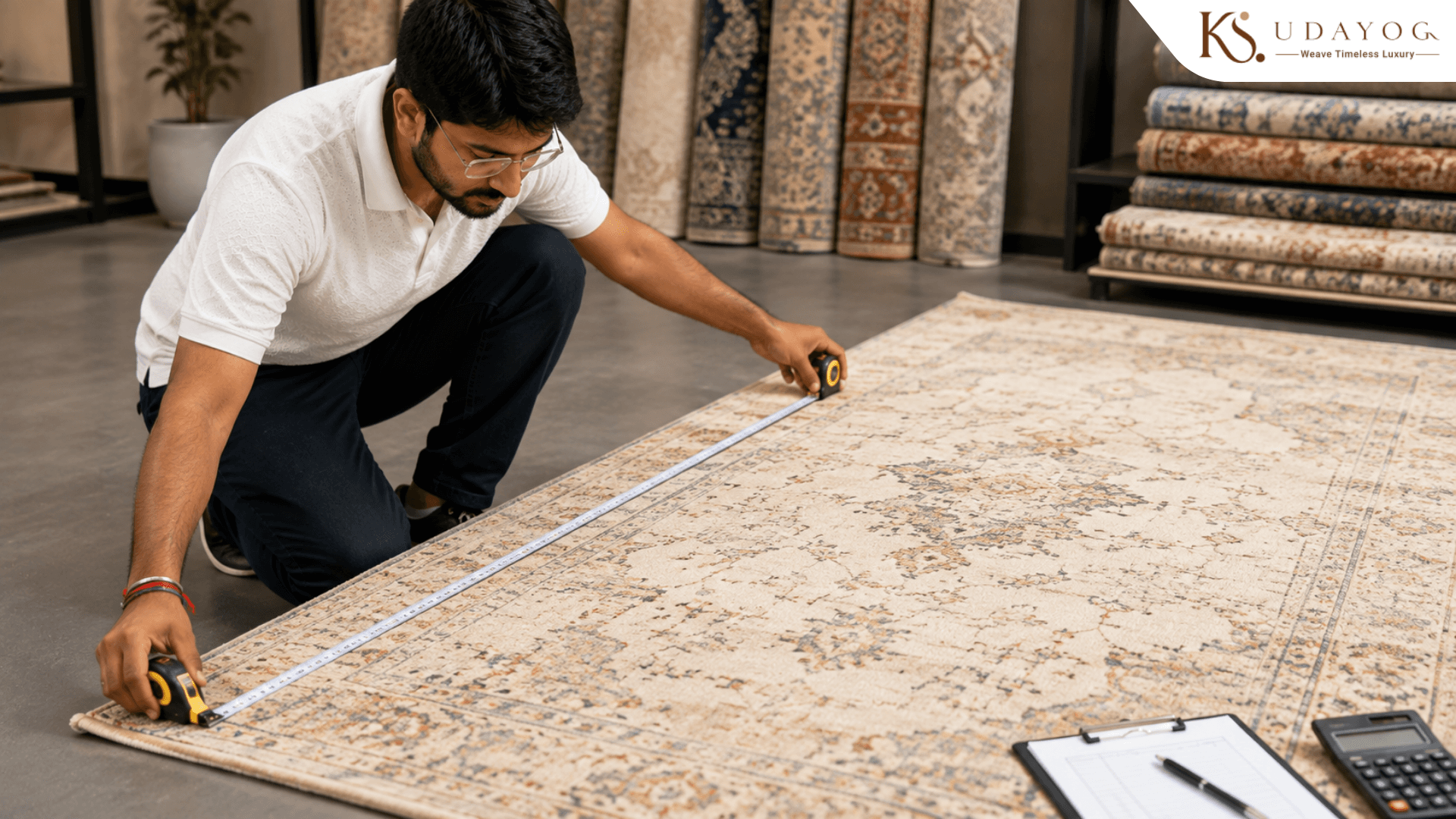
For rugs sold in standard sizes, dimensional accuracy is particularly important because retailers may organize their inventory around specific size categories.
If the order includes multiple sizes, inspect each size separately rather than checking only one representative piece.
2. Check The Rug Material
Confirm that the material used in production matches what was agreed during ordering.
For example, if you approved a wool rug, the finished product should not contain a different primary fiber without prior approval. For blended materials, verify that the agreed composition has been followed.
Material affects the rug's texture, appearance, durability, maintenance requirements, and selling price, so this is an important pre-shipment check.
3. Compare Color With The Approved Sample
Color differences can become noticeable when rugs are displayed together in a showroom or retail environment.
Compare the finished rugs with the approved sample, reference swatch, or agreed color specification. Check the main background color, secondary colors, borders, and other prominent elements.

Also look for uneven dyeing, visible shade variation, or areas that appear noticeably different from the approved reference.
For large orders, inspect rugs from different parts of the production batch rather than checking only products taken from the same stack.
4. Examine The Pattern And Design
The pattern should correspond to the approved design.
Check whether geometric shapes, borders, motifs, stripes, or other design elements are properly formed and positioned. Look for distortion, missing details, incorrect proportions, or noticeable inconsistencies.
This is especially important for patterned rugs because even a small design deviation can become obvious when the product is placed on a large floor area.
5. Inspect The Rug Surface
Run your hands across the surface and visually inspect the rug under suitable lighting.
Depending on the rug construction, check for uneven pile, bald or thin areas, loose fibers, visible knots, unwanted lumps, surface irregularities, excessive shedding, foreign material, and stains or marks.

The surface should reflect the quality level agreed during product development or sampling.
6. Check Construction Quality
Look closely at how the rug has been constructed.
For handmade rugs, examine the weaving, knotting, or tufting for visible structural problems. For machine-made rugs, check whether the construction appears uniform across the product.
Pay particular attention to areas where the construction looks loose, uneven, incomplete, or weaker than the surrounding sections.
A visually attractive surface does not necessarily indicate strong construction, so this check should be performed separately.
7. Inspect The Edges And Corners
Edges experience regular handling during manufacturing, packaging, transportation, and installation, so they deserve close attention.
Check whether binding, overlocking, stitching, fringes, or other edge treatments are securely finished. Corners should also lie properly without excessive curling, loose threads, or unfinished sections.
Poor edge finishing can affect both appearance and long-term usability.
8. Examine The Backing
Turn the rug over and inspect the entire backing.
Look for separation, cracks, loose areas, uneven application, or other visible defects. If the product has a specific backing material or treatment, verify that it matches the approved specification.
For rugs that require added stability, the backing should also be checked for proper attachment and coverage.
Do not inspect only the front surface; problems on the back can affect how the rug performs after installation.
9. Check Rug Shape And Flatness
Place the rug on a clean, flat surface and examine its overall shape.
Look for:
- Uneven corners
- Excessive curling
- Wavy edges
- Buckling
- Distortion
- Poorly formed borders
A rug may meet its length and width measurements but still have a shape problem that affects how it sits on the floor.
10. Examine Stitching And Decorative Details
If the rug includes stitching, embroidery, appliqué, piping, tassels, fringes, or other decorative elements, inspect these details individually.
Check whether the decorative components are properly attached and positioned. Look for loose threads, missing sections, uneven stitching, or details that differ from the approved design.
For customized collections, these finishing details can have a major impact on how closely the final product matches the approved sample.
11. Check For Visible Defects on Rugs
Conduct a general visual inspection under adequate lighting.
Look for stains, discoloration, broken fibers, holes, loose threads, marks, manufacturing residue, or other defects that could affect the product's appearance.
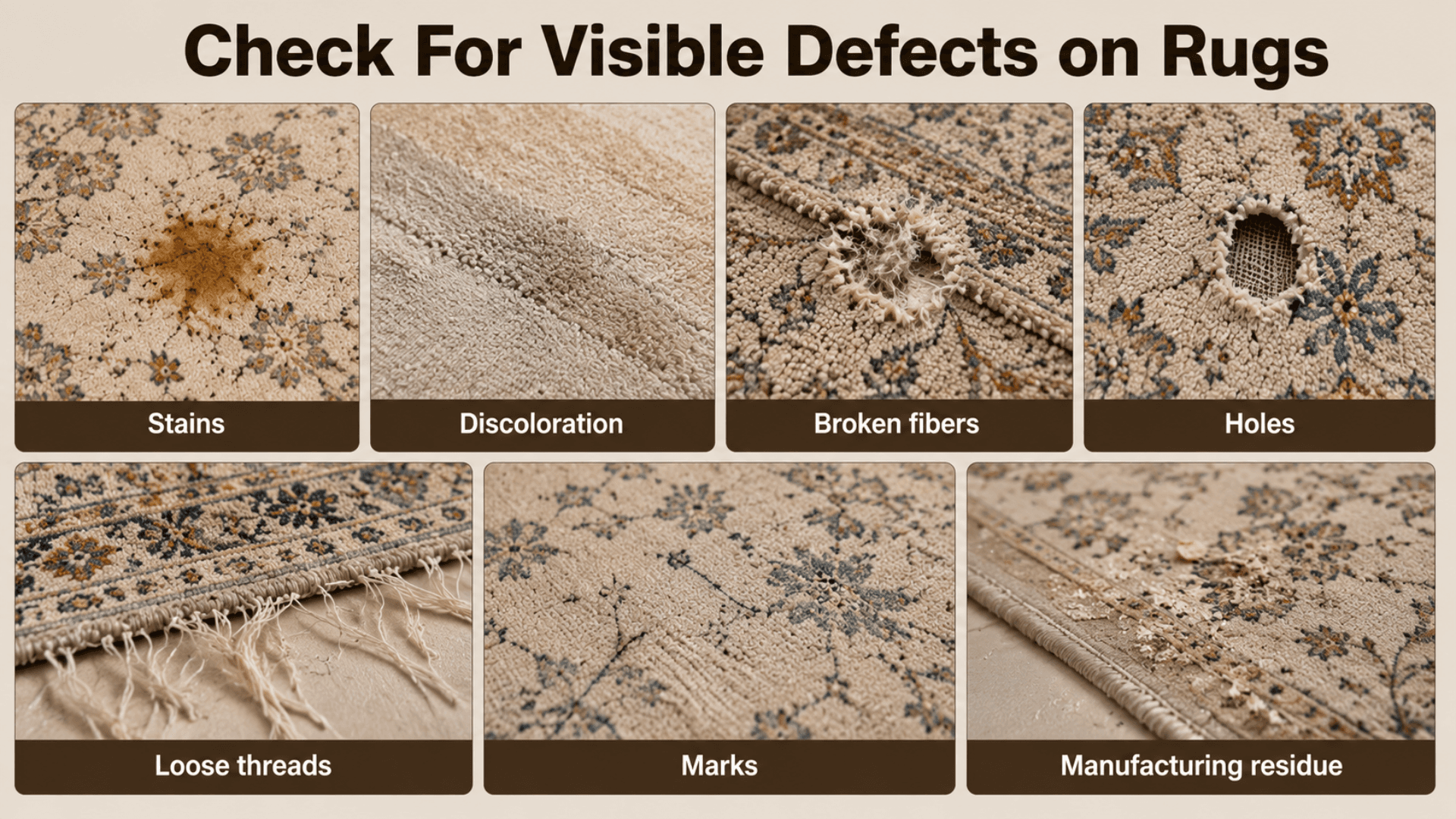
It is useful to inspect the rug from different angles because some surface irregularities may not be visible under a single viewing position.
12. Verify Product Labels And Identification
Before shipment, confirm that product labels and identification details are correct.
Depending on the order, this may include:
- Product name
- Size
- Material information
- Color or design code
- SKU
- Batch information
- Care information
- Buyer-specific labeling
Incorrect labeling can create inventory and fulfillment problems even when the physical rugs themselves meet the required quality standards.
13. Review Packaging Quality
The final product check should extend to packaging.
Confirm that rugs are packed according to the agreed method and adequately protected for transportation. Packaging should help prevent dust, moisture, staining, compression damage, and handling-related problems.
For retail orders, also verify whether individual packaging, barcode labels, inserts, or other requirements have been followed.
A high-quality rug can still arrive in poor condition if it is inadequately packaged.
How To Conduct A Pre-Shipment Rug Inspection?
A structured inspection is more useful than randomly looking at a few rugs. B2B buyers can follow this simple process:
Step 1: Review The Approved Specifications
Keep the purchase order, technical specifications, approved sample, size chart, color references, and customization details available during inspection.
These documents become the reference point for judging the finished products.
Step 2: Select Rugs From Different Parts of The Batch
Do not inspect only the easiest products to access.
Select pieces from different cartons, stacks, designs, colors, or production batches where applicable. This provides a better indication of overall order quality.
Step 3: Inspect Appearance And Construction
Check the front, back, edges, corners, surface, stitching, pattern, and finishing of the selected rugs.
Record any defects rather than relying on memory.
Step 4: Measure Representative Products
Measure the relevant dimensions and compare them against the agreed specifications.
If a particular size or design shows variation, increase the number of pieces inspected from that group.
Step 5: Compare Against The Approved Sample
Place the finished product beside the approved sample whenever possible.
Compare color, texture, pattern, dimensions, finishing, and overall appearance.
Step 6: Record And Classify Defects
Separate minor cosmetic issues from defects that could affect usability, appearance, or resale value.
A clear defect record makes discussions with the manufacturer much easier.
Step 7: Approve, Hold, Or Request Corrections
After inspection, decide whether the shipment meets the agreed standard.
If significant issues are found, communicate them before dispatch and request corrective action or clarification.
What Is An Acceptable Rug Defect?
There is no universal defect threshold that applies to every rug order. Acceptability depends on the product type, manufacturing method, agreed quality level, and buyer's specifications.
For example, handmade rugs may naturally show minor variations that reflect their production method. However, major color differences, structural problems, incorrect dimensions, damaged edges, or defects that affect usability may require correction.
The important point is to establish quality expectations before production begins, rather than trying to decide what is acceptable only after the bulk order is finished.
Handmade Rug Inspection Vs Machine-Made Rug Inspection
The main difference is that handmade rugs should be inspected for craftsmanship and acceptable natural variations, while machine-made rugs should be checked more closely for uniformity and production accuracy.
Handmade rugs may show slight differences in knots, texture, or pattern because of their production method, whereas machine-made rugs are generally expected to have more uniform construction and design.
For B2B buyers, the inspection criteria should therefore match the manufacturing method. With handmade rugs, focus on workmanship, knotting or weaving, finishing, and whether variations remain within the agreed standard.
With machine-made rugs, pay closer attention to consistent dimensions, pattern reproduction, pile, edges, and overall construction across the batch.
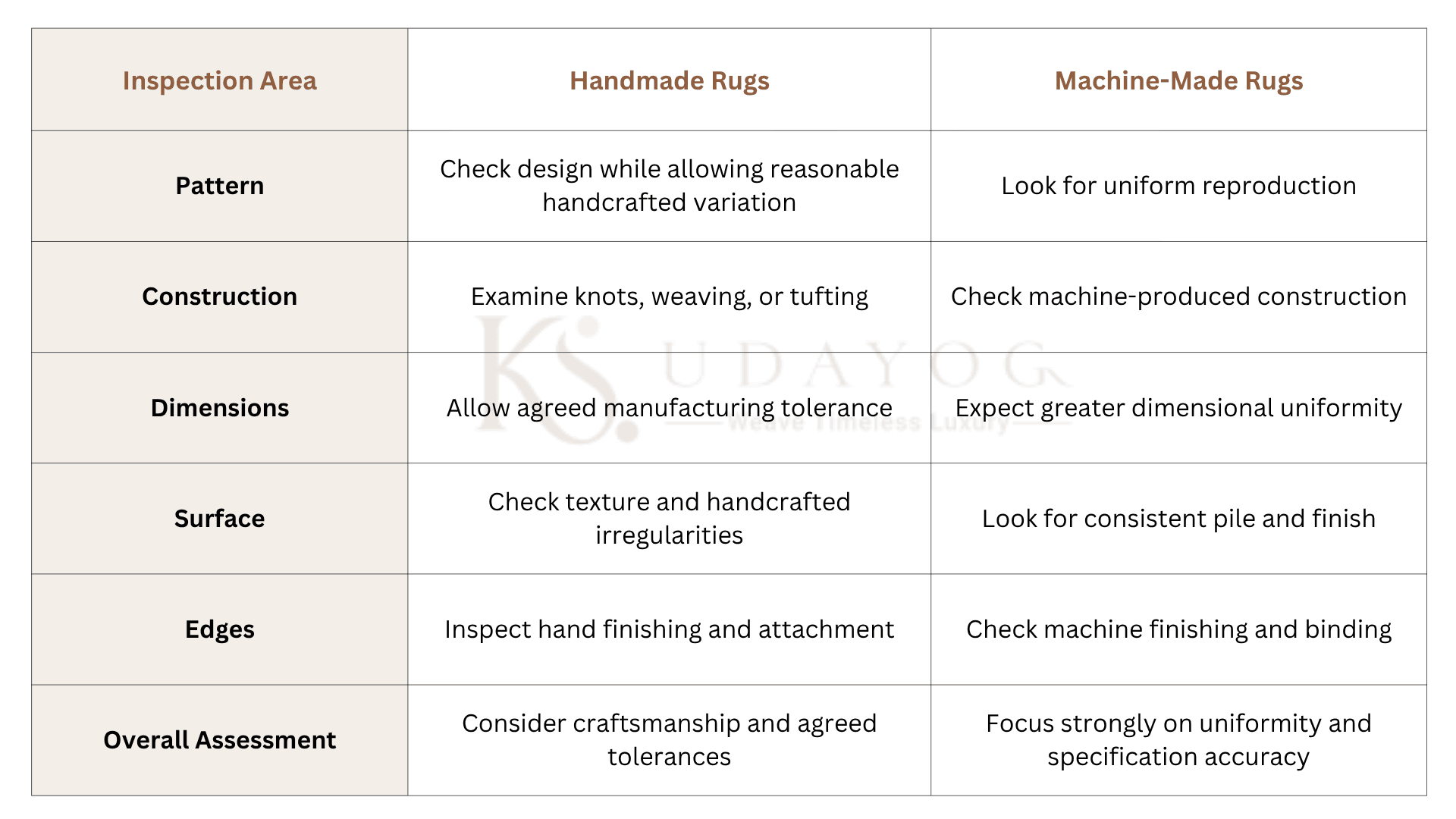
The key is not to judge every rug by exactly the same visual standard. Inspection should reflect the manufacturing method and the quality level agreed with the supplier.
What Should You Do If Rugs Fail Inspection?
If the rugs do not meet the agreed specifications, document the issue before shipment.
Take photographs or videos where possible and identify the affected product, batch, quantity, and specific problem. Then compare the issue with the original purchase specifications or approved sample.
Depending on the severity, you may request rework, replacement, sorting of defective pieces, a revised shipment, or another mutually agreed solution.
Avoid relying on informal descriptions such as “the quality is not right.” Specific observations such as incorrect dimensions, shade variation, loose edges, or damaged backing provide a much clearer basis for resolution.
Pre-Shipment Rug Quality Checklist For B2B Buyers
Before approving your shipment, ask yourself:
- Does the rug match the approved dimensions?
- Is the material what was originally specified?
- Does the color match the approved sample?
- Is the pattern reproduced correctly?
- Is the surface free from unacceptable defects?
- Is the construction secure?
- Are the edges and corners properly finished?
- Is the backing properly attached?
- Does the rug sit correctly when placed flat?
- Are decorative details properly finished?
- Are labels and product details correct?
- Is the packaging suitable for transportation?
- Does the overall batch meet the agreed quality standard?
If the answer is yes across these checks, you have a much stronger basis for approving the order for shipment.
Final Thoughts
Pre-shipment inspection is one of the most practical ways for B2B rug buyers to protect the quality of a bulk order before it leaves the manufacturer. Instead of checking only the rug's appearance, review the complete product, from dimensions, material, and construction to surface, edges, backing, finishing, labeling, and packaging.
The most reliable approach is to inspect against clear specifications and an approved sample, check products from different parts of the order, document defects, and resolve significant issues before dispatch. A well-defined rug quality checklist gives buyers a repeatable process for evaluating every shipment and maintaining the standard their customers expect.
Planning your next bulk rug order? Use this checklist alongside your approved specifications to make pre-shipment quality checks more thorough and easier to manage.
Frequently Asked Questions (FAQs) | People Also Ask
What Should I Check Before A Bulk Rug Shipment?
Check dimensions, material, color, pattern, surface, construction, edges, backing, shape, decorative details, labeling, and packaging against the approved specifications.
Why Is Pre-Shipment Rug Inspection Important For B2B Buyers?
It helps identify quality issues before dispatch, when corrections or replacements are generally easier to discuss and arrange.
How Many Rugs Should I Inspect Before Shipment?
The inspection quantity depends on order size, product variation, quality requirements, and the agreed inspection procedure. Larger or more varied orders generally require broader sampling.
Should Handmade Rugs Have The Same Inspection Standards As Machine-Made Rugs?
Not necessarily. Handmade rugs may have natural variations, while machine-made products are generally evaluated more heavily for production uniformity.
What If The Rug Color Does Not Match The Approved Sample?
Document the difference and compare it with the agreed color reference. If the variation exceeds the accepted standard, discuss correction or another resolution with the manufacturer before dispatch.
Should I inspect the rug backing before shipment?Yes. The backing should be checked for proper attachment, coverage, separation, cracks, or other defects that could affect the finished product.
Can rug dimensions vary slightly during manufacturing?Some manufacturing methods may allow agreed tolerances. Buyers should establish acceptable dimensional variation with the manufacturer before production.
What should I do if I find defects during inspection?Document the defects with clear descriptions, measurements, and photographs where possible, then discuss corrective action with the manufacturer before approving shipment.