Planning a hotel renovation or a new hospitality project? The hotel carpet you choose can influence everything from the first impression in the lobby, carpet material, to cleaning requirements across high-traffic corridors and guest areas. For B2B buyers, appearance is only one part of the purchase decision.
A better carpet buying decision starts with questions such as, “Will this carpet handle daily traffic?” “How easy is it to maintain?” and “Does the specification justify the bulk-order price?” Those answers can help procurement teams avoid products that look attractive initially but create problems later.
The factors that matter most when buying hotel carpets from wholesale manufacturers in India are explained through this practical 2027 hotel carpet buying guide.
How to Buy Hotel Carpet: Start With Your Project Requirements
Before contacting carpet manufacturer and supplier, prepare a basic carpet brief. It prevents you from comparing quotations that are based on completely different specifications.
Your brief should include:
- Hotel type and category
- Number of rooms
- Areas requiring carpet
- Approximate carpeted floor area
- Traffic level in each area
- Preferred carpet construction
- Fibre preference
- Colour and design direction
- Required carpet width or tile size
- Installation method
- Expected project completion date
- Budget range
- Customisation requirements
- Maintenance expectations
This information gives manufacturers enough context to recommend suitable constructions rather than simply sending their most popular samples.

What To Look For When Buying Carpets For Hotels in 2027: Quick Tips
Hotel carpet buying involves more than choosing an attractive pattern for guest spaces. Indian B2B buyers need to consider traffic, durability, maintenance, comfort, installation, and long-term value before placing an order. The quick tips below highlight the key factors worth checking before buying carpets for hotels in 2027.
1. Divide the Hotel Into Carpeted Areas
The first buying decision should be where the carpet will be installed. Different hotel areas experience very different levels of foot traffic, luggage movement, spills, furniture movement, and cleaning.
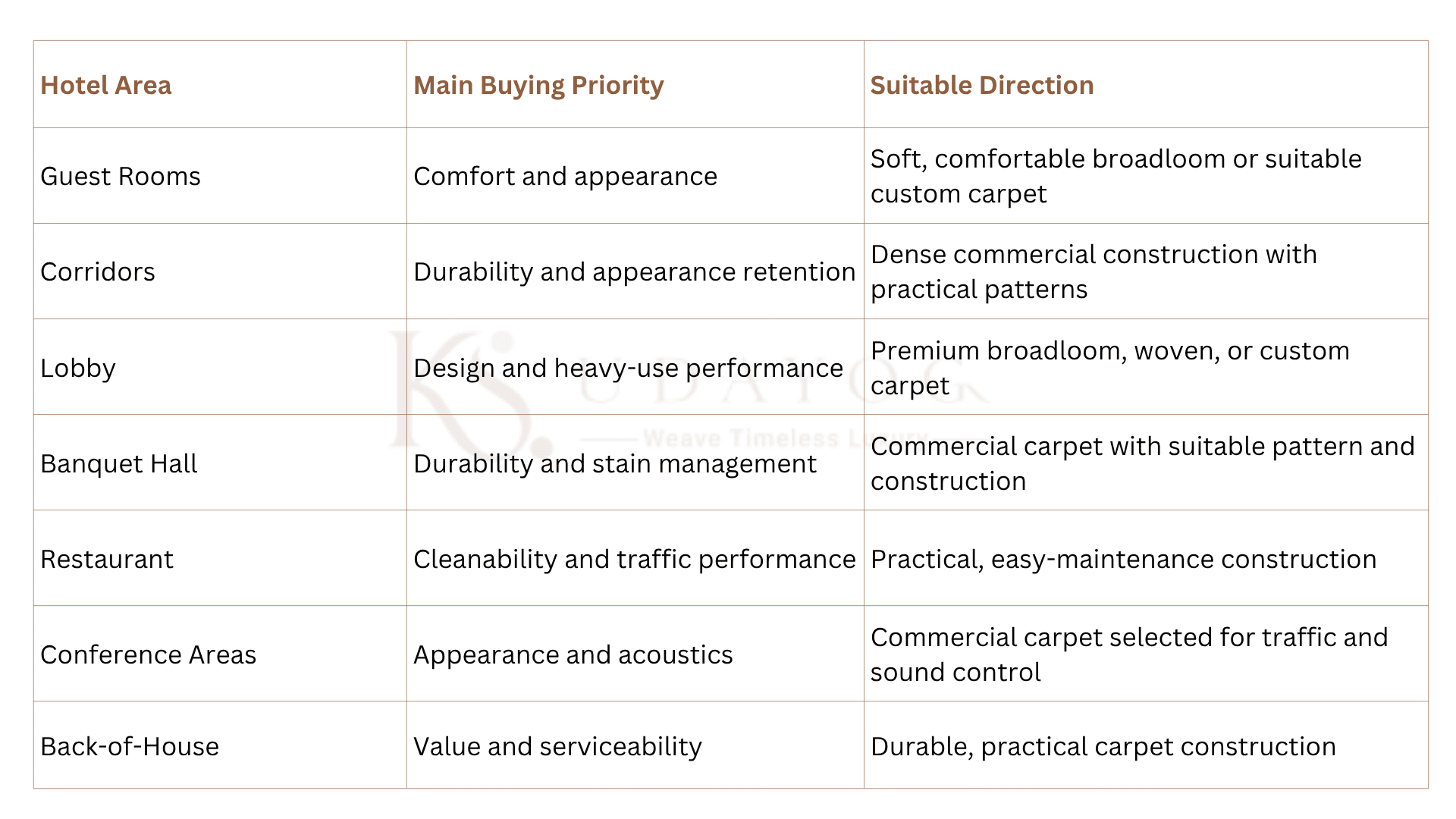
The same carpet specification does not necessarily make sense throughout the property. Zone-wise purchasing can help you balance premium finishes with practical performance.
2. Decide What Type of Hotel Carpet You Need
Hotel carpet can be purchased in different formats and constructions. The right choice depends on the design brief, area, installation method, maintenance plan, and replacement strategy.

1. Broadloom Carpet
Broadloom comes in wide rolls and creates a continuous wall-to-wall appearance. It is useful where visual continuity, flowing patterns, and a more finished hospitality appearance are important.
Before ordering, check roll width, pattern repeat, installation direction, seams, wastage, and whether the design can be matched across adjoining areas.
2. Carpet Tiles
Carpet tiles are modular pieces that can be replaced individually when localised damage occurs. They can be practical for selected commercial and high-use areas where maintenance access matters.
However, visible joints, pattern limitations, installation requirements, and replacement-stock planning should be considered before choosing tiles simply because they appear easier to maintain.
3. Custom Hotel Carpet
Custom carpet makes sense when the project requires a particular colour palette, pattern, logo-related design language, dimensions, or interior concept.
Customisation should be discussed early because design approval, sampling, production, colour matching, minimum quantities, and lead time can affect the project schedule.
3. Choose the Right Carpet Material
Fibre affects softness, resilience, appearance, stain behaviour, cleaning requirements, and cost. However, fibre alone should never be treated as the complete quality specification.
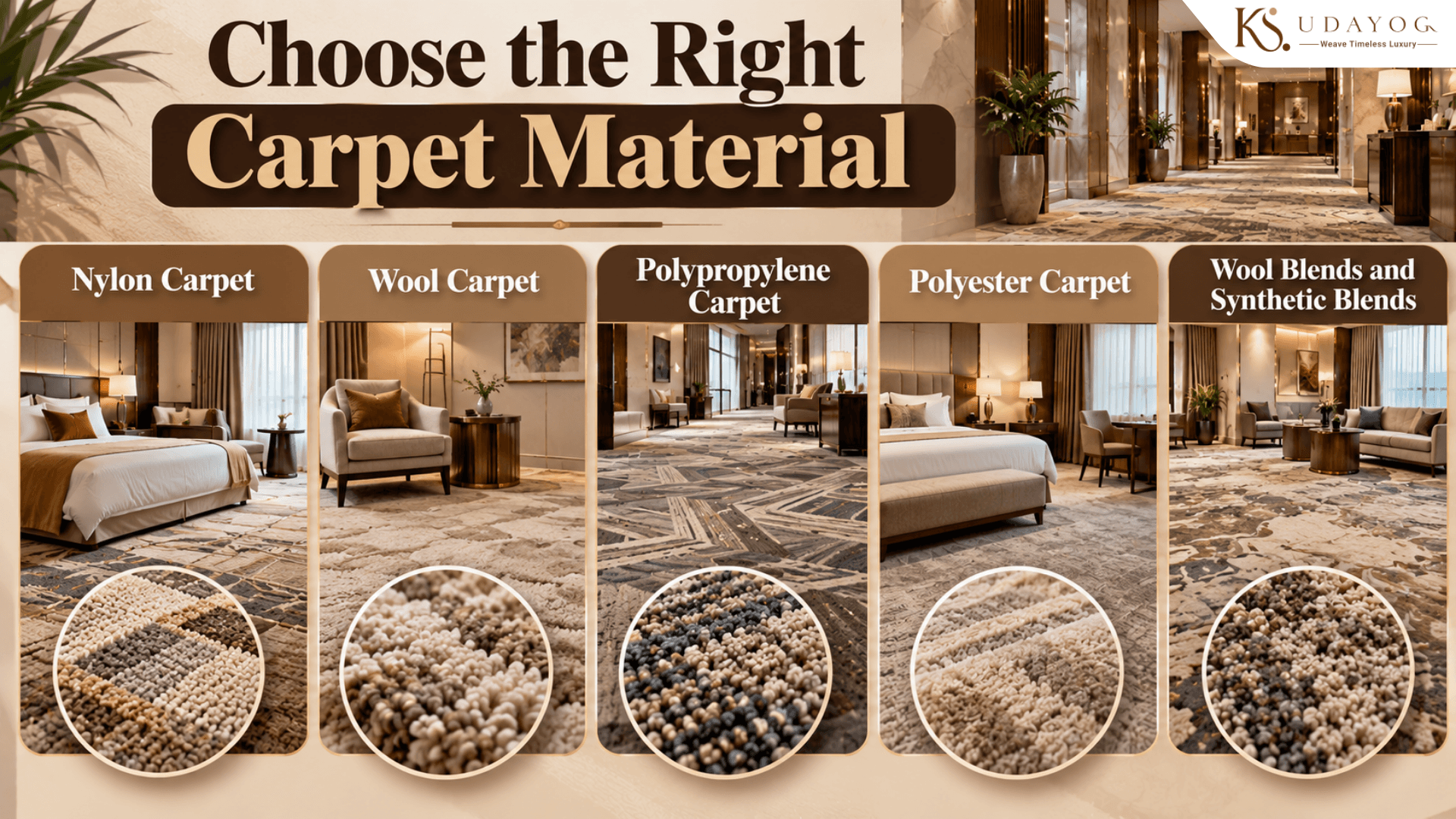
- Nylon Carpet
Nylon is widely considered for commercial and hospitality applications because of its combination of durability and resilience. It can be particularly suitable for corridors, lobbies, and other busy areas when the overall construction matches the intended use.
- Wool Carpet
Wool provides a premium natural appearance and soft underfoot feel. It can suit luxury guest rooms, suites, lounges, and feature areas where design and tactile experience carry significant weight.
Its purchase price and maintenance requirements can be higher, so the project should justify the additional investment.
- Polypropylene Carpet
Polypropylene can be considered when budget, stain behaviour, and the intended traffic level are important considerations. Its suitability depends on the complete carpet construction and the specific area where it will be installed.
- Polyester Carpet
Polyester is known for its softness and colour possibilities and can work for selected lower- or moderate-traffic applications. For demanding hotel areas, compare its resilience and appearance retention with alternative fibres before finalising.
- Wool Blends and Synthetic Blends
Blended constructions combine different fibre characteristics. They can be useful when a project needs a particular balance of appearance, comfort, durability, and cost.
Do not select a blend simply because it sounds premium. Ask the supplier to explain the purpose and proportion of each fibre.
4. Check the Carpet Construction Before Buying
Two carpets made from the same fibre can perform differently because their carpet construction is different.
Depending on the project, you may encounter cut pile, loop pile, cut and loop, tufted carpet, woven carpet, hand-tufted carpet, machine-made carpet, and carpet tiles.
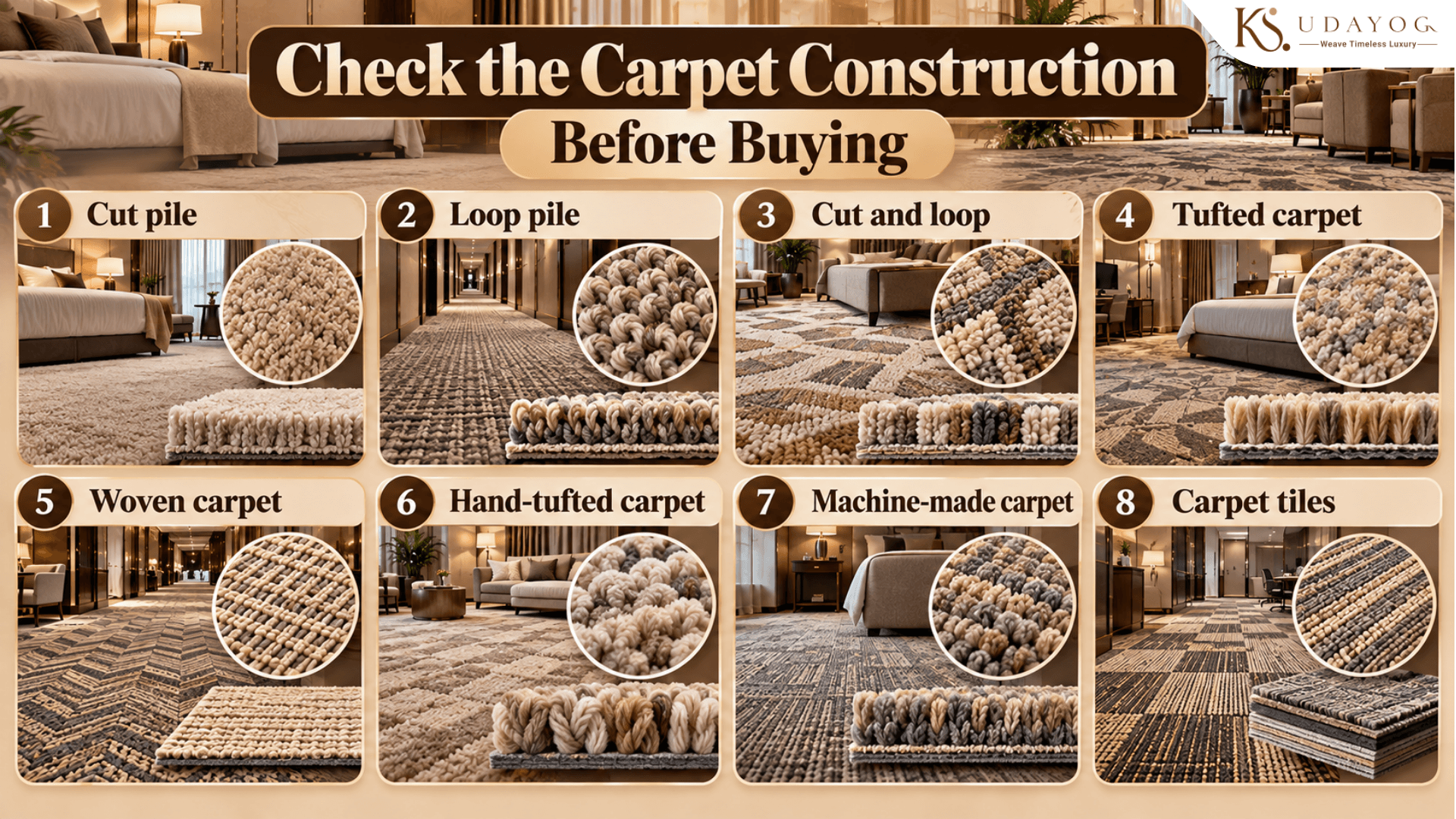
Construction influences texture, appearance, resilience, pattern possibilities, maintenance, and price.
For example, a plush surface may create a comfortable guest-room experience, while a more practical low-profile construction may be better suited to a corridor carrying luggage and housekeeping traffic.
Ask the supplier to provide the construction details in writing, rather than comparing samples only by appearance.
5. Do Not Judge Quality by GSM Alone
GSM or carpet weight can be useful when comparing specifications, but it should not be treated as a standalone quality score.
Carpet performance also depends on fibre, yarn characteristics, pile density, pile height, construction, backing, tufting or weaving quality, and finishing.
A heavier carpet is not automatically the right carpet for a particular hotel area.
When comparing two products, request their complete technical specifications and evaluate them against the actual application.
6. Consider Traffic Before Finalising the Carpet
Hotel traffic is not limited to walking. Corridors may experience:
- Continuous guest movement
- Suitcase wheels
- Housekeeping trolleys
- Service carts
- Furniture movement
- Repeated cleaning
Lobbies may combine high footfall with luggage, seating, reception activity, and entrance dirt.
Guest rooms generally have different traffic patterns, but they still need to tolerate repeated cleaning and furniture movement.
Think about how people and equipment move through the space, not merely how many people enter it each day.
7. Select the Carpet Backing Carefully
Backing is easy to overlook because it sits beneath the visible surface, but it contributes to dimensional stability, installation behaviour, and the overall carpet system.
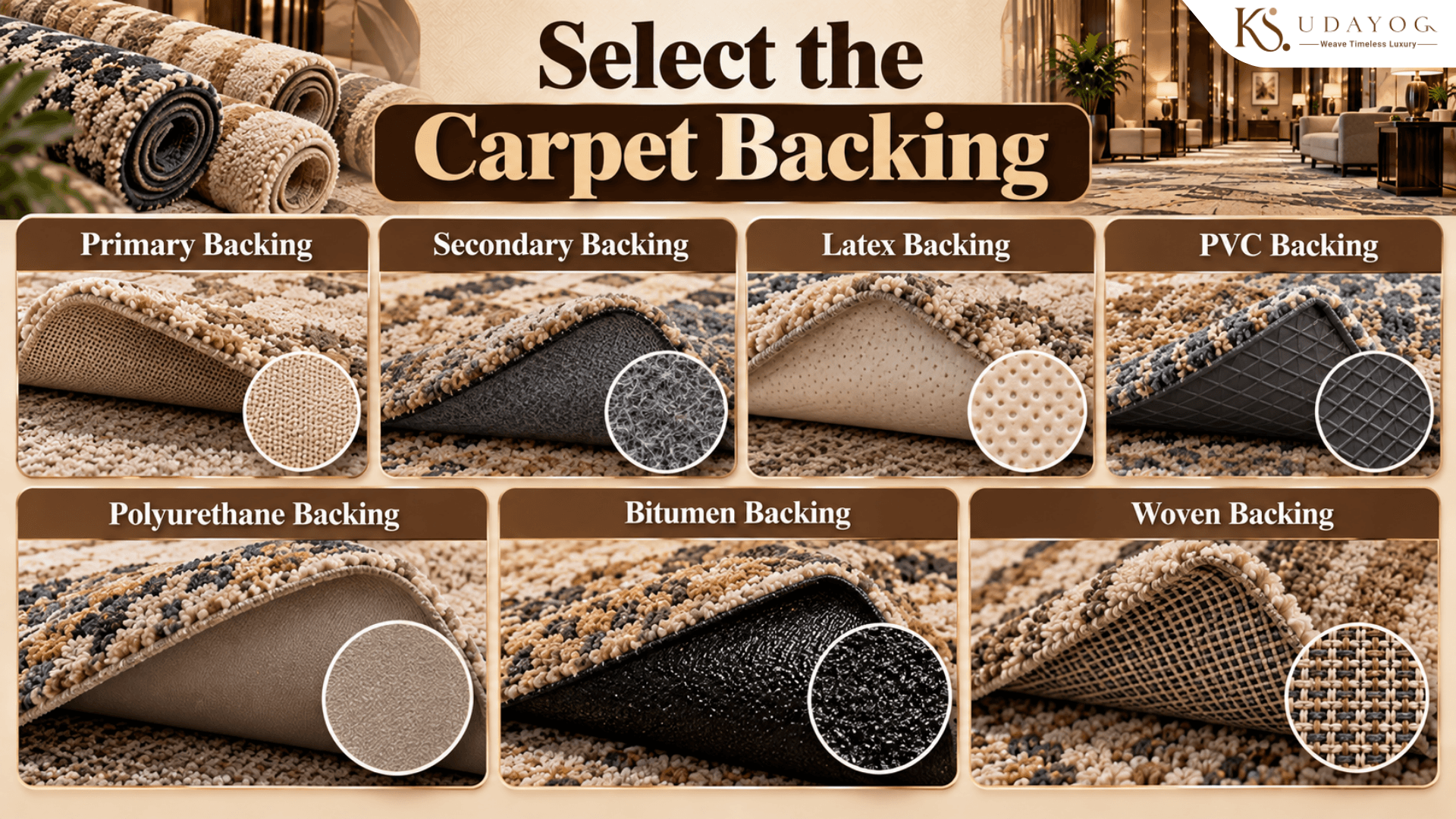
- Primary Backing: The layer through which carpet yarns are tufted, providing the foundation for the carpet construction.
- Secondary Backing: An additional layer added to improve dimensional stability, strength, and handling during installation.
- Latex Backing: A latex-coated backing that helps hold the tufted structure together and supports dimensional stability.
- PVC Backing: A firm backing option that can provide dimensional stability and is used in selected commercial carpet constructions.
- Polyurethane Backing: A backing material that can offer cushioning, dimensional stability, and support for certain carpet applications.
- Bitumen Backing: A heavier backing system commonly associated with carpet tiles, providing rigidity and dimensional stability.
- Woven Backing: A woven foundation integrated into the carpet structure, commonly associated with premium woven carpet constructions.
The backing specification should be evaluated alongside the carpet construction rather than as a separate afterthought.
8. Choose Colours and Patterns for Hotel Operations
Hotel carpet does more than cover the floor. It influences how guests perceive the space.
Very light, plain carpets can make a room appear clean and spacious, but they may show footprints, dust, spills, and stains more readily.
Extremely dark colours can also reveal lint, dust, and certain marks.
Mid-tone colours, subtle patterns, textured surfaces, and multi-colour designs can provide a practical balance between visual appeal and everyday maintenance.
Pattern scale matters too. Large, dramatic patterns may work in spacious lobbies but can feel overwhelming in smaller guest rooms. Smaller patterns or understated textures can create visual interest without dominating the interior.
For Indian hotels, colour selection can also be coordinated with regional design elements, local architecture, furniture finishes, and the property's brand identity.
9. Consider India's Climate and Location
Hotel carpet selection should reflect local operating conditions.
A coastal hotel may deal with humidity and sand, while a property in a region with strong monsoon conditions may face greater moisture-related cleaning challenges. Hotels in colder regions may place greater emphasis on warmth and comfort.
For Indian projects, also consider:
- Monsoon moisture
- Humidity
- Dust
- Coastal sand
- Air-conditioning
- Sun exposure
- Ventilation
- Cleaning and drying conditions
The right specification can therefore differ between a beach resort, an urban business hotel, and a mountain property.
10. Check Stain Resistance and Cleaning Requirements
Stain resistance matters because hotels deal with food, beverages, cosmetics, mud, dust, and other accidental spills.
However, stain resistance is not the same as stain proofing.
The carpet's fibre, dyeing method, finish, construction, and maintenance programme can all influence how easily a stain can be removed.
For restaurants, banquet halls, and corridors, consider materials and constructions that support practical spot cleaning. Also ask the supplier which cleaning chemicals and methods are recommended.
A carpet that requires specialised treatment for every small spill may become expensive to maintain, even if its initial purchase price looks attractive.
11. Think About Acoustics and Guest Comfort
Carpet can contribute to a quieter interior by reducing the hard-surface sound associated with footsteps and movement.
This can be particularly relevant in:
- Guest-room corridors
- Guest rooms
- Lounges
- Conference areas
- Hospitality floors
However, acoustic performance depends on the complete flooring assembly, including carpet construction and any underlay or backing system.
If noise control is an important project requirement, discuss the complete floor build-up with the supplier instead of relying on carpet alone.
12. Check Fire and Safety Requirements
Hotels are public-use buildings, so fire safety cannot be treated as an optional carpet feature.
Before procurement, confirm the applicable fire-safety requirements for the project, building, installation system, and local approvals. India's Bureau of Indian Standards maintains standards relating to fire safety in hotels, including IS 13716 for hotel fire safety.
The carpet itself should be evaluated as part of the complete flooring system rather than considered independently from adhesives, underlay where applicable, backing, and installation.
Ask suppliers for relevant test reports and documentation instead of relying only on phrases such as “fire retardant” in a product description.
13. Calculate How Much Hotel Carpet You Need
Do not order carpet based only on the floor's measured area. You should account for:
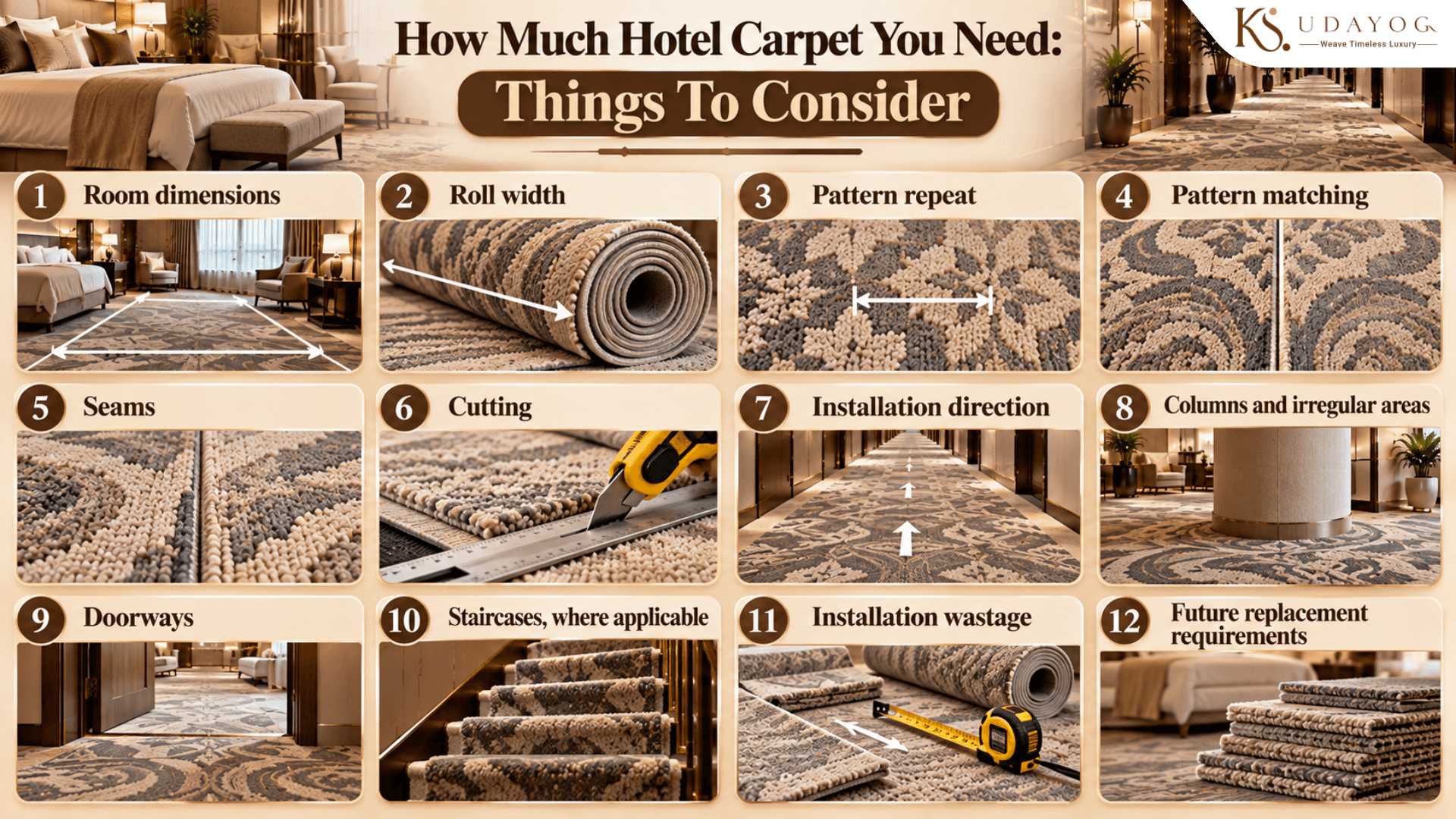
- Room dimensions
- Roll width
- Pattern repeat
- Pattern matching
- Seams
- Cutting
- Installation direction
- Columns and irregular areas
- Doorways
- Staircases, where applicable
- Installation wastage
- Future replacement requirements
For broadloom carpet, roll width and pattern repeat can significantly affect actual material consumption.
Ask the supplier or installer to prepare a cutting and quantity plan before the purchase order is finalised.
14. Compare Carpet Samples Properly
Never approve a hotel carpet from a small photograph alone.
Request physical samples and compare them for:
- Colour
- Texture
- Pile appearance
- Density
- Construction
- Backing
- Pattern repeat
- Edge finish
- Light reflection
- Cleaning response
Where possible, place samples under the same lighting conditions expected in the hotel.
For larger projects, a mock-up installation can reveal issues that are difficult to identify from a hand-sized sample.
Why Hotel & Resort Carpet Selection Needs More Attention
A residential carpet may only need to look good and feel comfortable. A hotel carpet has a much harder job.
Guest rooms experience regular foot traffic, while corridors receive continuous movement, luggage wheels, housekeeping carts, and repeated cleaning. Lobbies and banquet areas can face even greater traffic, furniture movement, food spills, and event-related wear.
That means the cheapest carpet at the time of purchase may not be the cheapest option over its useful life. A carpet that stains easily, shows wear quickly, loses its shape, or becomes difficult to maintain can create replacement and maintenance costs later.
For hotel projects, the better approach is to evaluate appearance, construction, durability, maintenance, comfort, safety, and lifecycle cost together.
Hotel Carpet Cost in India: What Determines the Price?
Hotel carpet prices can vary significantly, so comparing suppliers only by price per square metre can produce misleading results.
The final cost can be influenced by:
- Fibre composition
- Carpet construction
- GSM and pile density
- Pattern complexity
- Custom design
- Dyeing or printing method
- Backing
- Carpet width or tile dimensions
- Quantity ordered
- Installation requirements
- Transportation
- Custom sampling
- Packaging
- Maintenance requirements
A lower purchase price can become less economical if the carpet requires frequent replacement or difficult maintenance.
For commercial projects, calculate the total cost of ownership, not just the purchase price.
Custom Hotel Carpet vs Ready-Made Carpet: Key Differences
Custom hotel carpet offers greater control over design, dimensions, colours, and specifications, while ready-made carpet provides faster selection, simpler purchasing, and generally easier availability. The better fit depends on your hotel's design requirements, project timeline, order quantity, and budget.
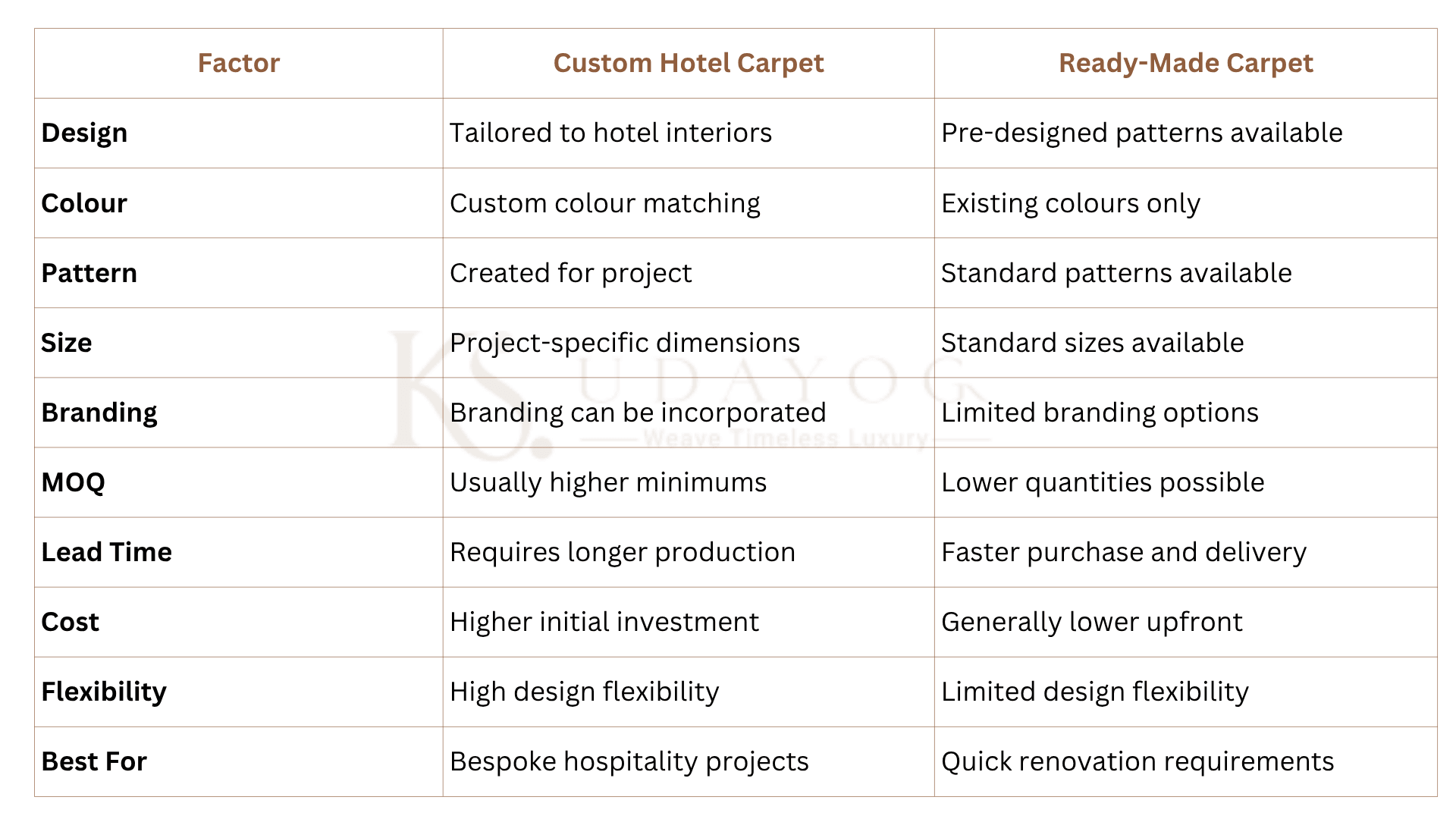
Custom carpet is worth considering when the hotel's interior requires a distinctive pattern, precise colour coordination, specific dimensions, or a branded visual identity. It can also be useful when standard collections cannot meet the project's technical or design requirements.
On the other hand, ready-made carpet can be practical when the project has a tight timeline, straightforward design requirements, or limited quantities. Existing collections also allow buyers to inspect available samples and move towards procurement without a lengthy development process.
Before deciding, compare design flexibility, specifications, MOQ, production time, sample approval, price, installation requirements, and future replacement needs. The cheapest or fastest option may not provide the right balance for the hotel's intended use.
Final Thoughts
Buying hotel carpet is ultimately a specification exercise, not simply a design purchase. The right decision comes from matching hotel area, traffic, fibre, construction, backing, appearance, maintenance, installation, and budget before comparing suppliers and quotations.
For Indian hotel projects, climate and operating conditions deserve the same attention as appearance. A well-prepared carpet brief also makes supplier comparisons easier because every manufacturer is responding to the same requirements.
If you are planning a hotel flooring project, connect with a reliable carpet manufacturer in India to develop carpet solutions around your property's design, traffic, performance, and procurement requirements.
Frequently Asked Questions (FAQs)
What Is The Best Carpet For A Hotel?
There is no single carpet suitable for every hotel area. Guest rooms, corridors, lobbies, restaurants, and banquet spaces can require different combinations of fibre, construction, backing, design, and durability.
How Do I Buy Hotel Carpet In India?
Start by identifying carpeted areas, traffic levels, dimensions, design requirements, and budget. Then compare fibre, construction, backing, samples, technical documentation, supplier capability, quantity, lead time, installation, and total project cost.
What Should I Check Before Buying Hotel Carpet?
Check fibre, construction, pile characteristics, backing, traffic suitability, colour, pattern repeat, cleaning requirements, safety documentation, installation requirements, supplier capability, lead time, and replacement planning.
Is Higher GSM Better For Hotel Carpet?
Not necessarily. GSM is only one specification. Fibre, construction, pile density, yarn characteristics, backing, and intended application also influence carpet performance.
How Much Hotel Carpet Should I Order?
Calculate the actual floor area while considering roll width, pattern repeat, seams, cutting, installation direction, irregular spaces, and expected wastage. A supplier or installer can prepare a project-specific quantity plan.
Can Hotel Carpet Be Customised?
Yes. Depending on the manufacturing method and supplier, hotel carpet can be customised for colours, patterns, dimensions, textures, and selected construction requirements.
Should I Buy The Same Carpet For Every Hotel Area?
Not always. Different areas experience different traffic, cleaning demands, design expectations, and maintenance conditions, so zone-specific specifications can be more practical.