A sample or a rug catalogue can tell you whether a rug looks right. It cannot tell you whether 2,000 pieces will arrive with the same dimensions, pile, colour, backing, edge finishing, and overall quality. That difference between a sample and a bulk rug shipment is where many first-time B2B buyers discover the real complexity of overseas rug sourcing.
India offers buyers access to a wide range of handmade and machine-made rugs, materials, designs, and manufacturing capabilities. The challenge is finding a trusted rug manufacturer and supplier that can translate your specifications into repeatable bulk production while meeting the agreed price, quantity, quality standards, packaging requirements, and delivery schedule.
A successful import order is therefore built through decisions made at every stage, not just through supplier selection. The detailed guide below covers the process from rug sourcing and sample approval to production, quality inspection, documentation, shipping, customs, and final delivery.
Why Import Rugs in Bulk From India?
India has a well-established carpet and rug manufacturing industry with capabilities spanning handmade and machine-made products. Buyers can source rugs in different materials, constructions, sizes, patterns, colors, and finishing options, making the country suitable for both commercial collections and more specialized requirements.
One major advantage of buying wholesale rugs from India is product flexibility. Depending on the manufacturer, buyers may be able to develop rugs according to specific dimensions, colors, patterns, materials, pile characteristics, backing, labeling, and packaging requirements.
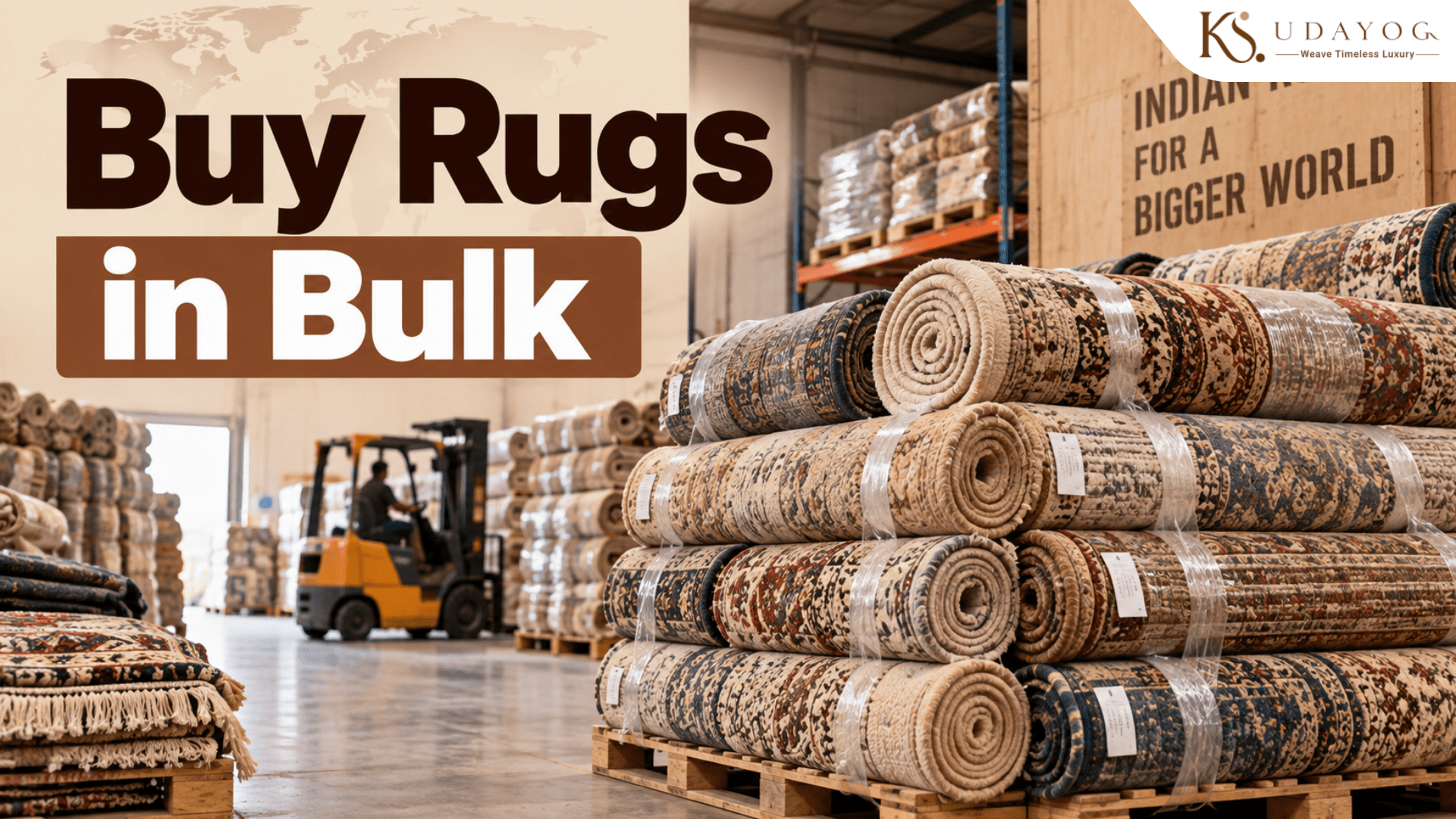
For buyers ordering in larger quantities, direct sourcing can also provide greater control over product development and communication. However, the right benefits depend on the manufacturer selected, the order volume, the specifications, and the destination market.
Step 1: Define What You Want To Import
Before contacting Indian rug suppliers, clearly define the products you want to purchase. A vague requirement such as “premium rugs” makes it difficult for rug manufacturers to provide accurate quotations or samples.
Prepare a basic product brief covering:
- Rug type
- Material or fiber
- Construction method
- Dimensions
- Shape
- Color palette
- Pattern or design
- Pile height
- Backing requirement
- Finishing requirements
- Expected quantity
- Packaging preferences
- Target price range
- Intended market
For example, instead of asking for “large decorative rugs,” you could specify that you need 5 × 8 feet rugs, a particular material, a medium pile, neutral colors, a specific backing, and an initial quantity of 500 pieces.
The more clearly you define the product, the easier it becomes to compare quotations from different manufacturers.
Step 2: Decide Which Type of Rug You Need
Your product category will influence the manufacturer you should approach.
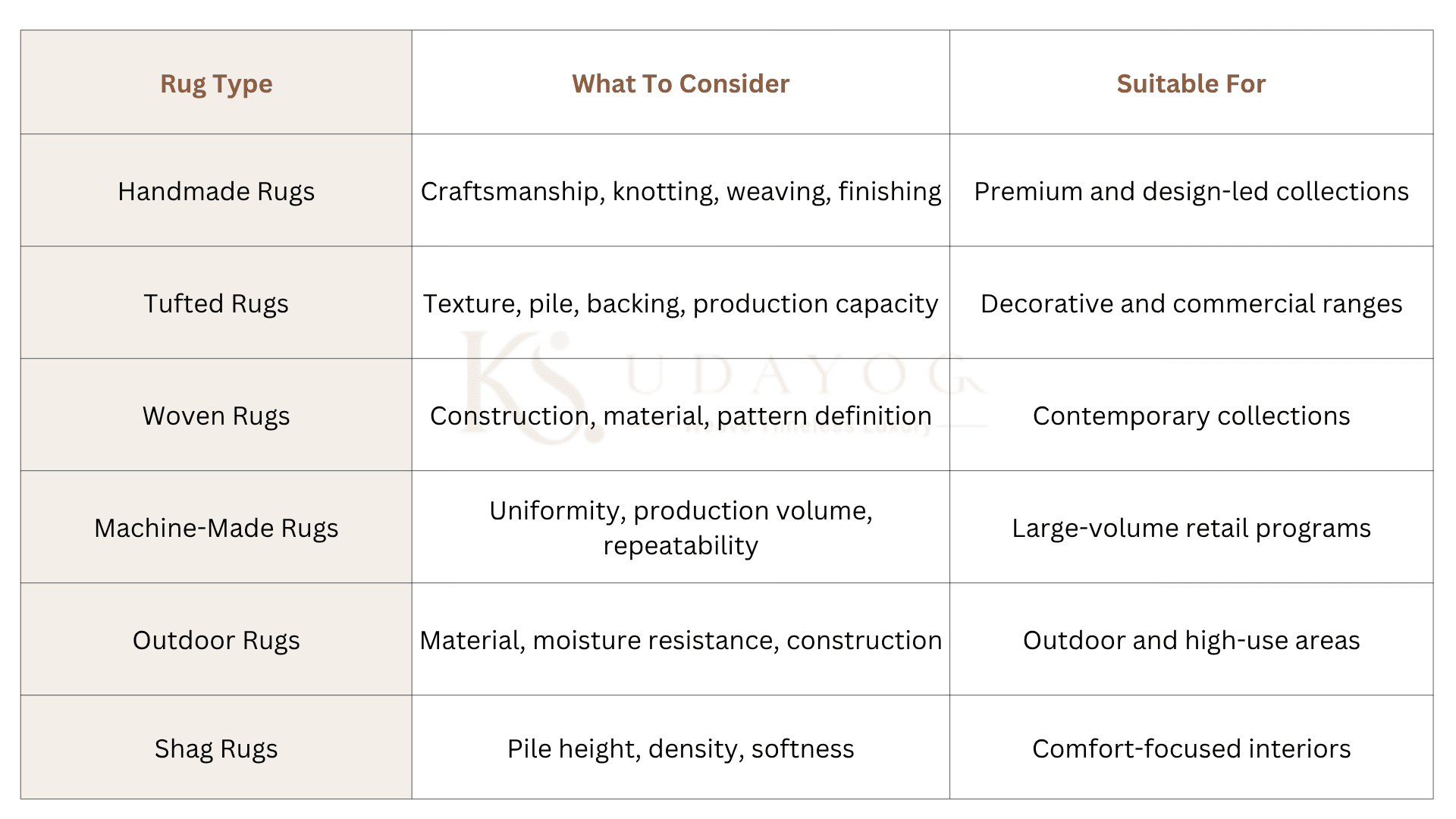
- Handmade Rugs: Choose handmade rugs when craftsmanship, individuality, and premium appeal matter more than identical pieces. They work especially well for buyers creating high-end collections where unique detailing can justify a higher selling price.
- Tufted Rugs: Tufted rugs are a practical choice when you want attractive designs, soft textures, and greater flexibility without the production requirements of hand-knotting. Buyers often choose them for decorative collections that need style variety at more accessible price points.
- Woven Rugs: Woven rugs suit buyers looking for structured patterns, distinctive textures, and a refined finish that works across different interiors. They can be a strong option for collections where visual design and everyday usability need to come together.
- Machine-Made Rugs: Machine-made rugs make sense when your priority is larger quantities, uniform sizing, and repeatable designs across an entire collection. They are particularly useful for retailers and wholesalers that need dependable products for wider distribution.
- Outdoor Rugs: Outdoor rugs are designed for spaces where the product may face moisture, dirt, sunlight, and frequent cleaning. Choose them when you need a rug collection suited to patios, balconies, outdoor seating areas, or other exposed spaces.
- Shag Rugs: Shag rugs are a natural choice when softness and a plush underfoot feel are central to the product's appeal. Their deeper pile can add warmth and visual depth, making them popular for comfort-focused residential collections.
Do not select a construction method only because it has a lower quoted price. Consider how the rug will be positioned, what customers expect from it, and how much variation is acceptable within your collection.
Step 3: Find Indian Rug Manufacturers And Suppliers
The next stage is wholesale rug sourcing from India. You can discover manufacturers through trade networks, industry directories, exhibitions, referrals, online research, and direct outreach.
However, finding a company that sells rugs is not the same as finding a manufacturer that can produce your required collection.
Ask potential suppliers:
- Do you manufacture the products directly?
- Which rug constructions do you produce?
- What materials can you work with?
- What sizes can you manufacture?
- What is your MOQ?
- Can you produce customized designs?
- Can you provide physical samples?
- Do you handle export orders?
- What markets do you currently supply?
- What is your normal production lead time?
Create a shortlist instead of choosing the first supplier that responds.
Step 4: Verify Rug Manufacturer Before Ordering
Rug supplier verification is one of the most important stages when you import rugs from India. A professional presentation or attractive catalog does not tell you everything about actual manufacturing capabilities.
Look at the following areas:
- Manufacturing Capability
Confirm that the supplier can actually manufacture the rug construction, sizes, materials, and finishing you require.
- Product Expertise
Check whether the manufacturer has experience producing the specific type of rugs you want to purchase rather than offering an unrelated product range.
- Customization
If you require private-label products or customized designs, confirm what the manufacturer can modify and what limitations apply.
- Production Capacity
A supplier capable of producing 100 pieces may not necessarily be prepared to handle several thousand pieces within your required timeline.
- Quality Procedures
Ask how products are inspected during and after production and whether rug quality standards can be documented before the order begins.
- Export Experience
If the manufacturer regularly handles international orders, ask how export documentation, packaging, freight coordination, and shipment preparation are managed.
- Repeat-Order Capability
If you plan to reorder successful products, confirm that the supplier can reproduce approved designs, colors, dimensions, and specifications.
Step 5: Request And Evaluate Samples
Never rely entirely on catalog photographs when planning a substantial import order. A physical sample gives you the opportunity to evaluate the product before committing to bulk production.
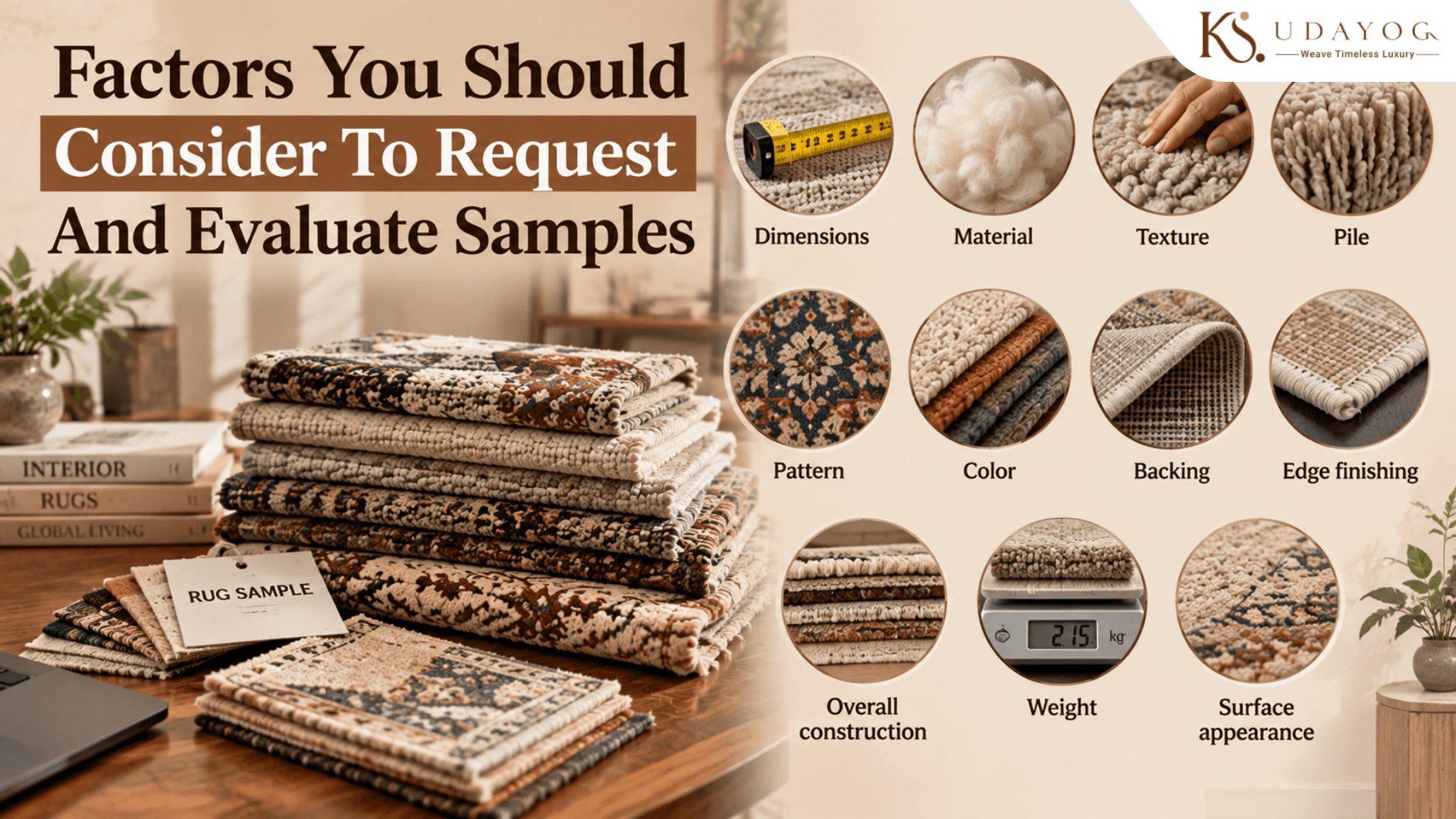
Compare the sample against your requirements for dimensions, material, texture, pile, pattern, color, backing, edge finishing, overall construction, weight, and surface appearance.
If the rug will be sold through a retail channel, also consider how it looks under normal lighting and how the actual material feels compared with how it appears in photographs.
Once a sample is approved, document exactly what was accepted. The approved sample can then serve as an important reference during bulk production.
Step 6: Finalize Rug Specifications
After approving the sample, create a written specification sheet.
It should include the details that could affect the final product:
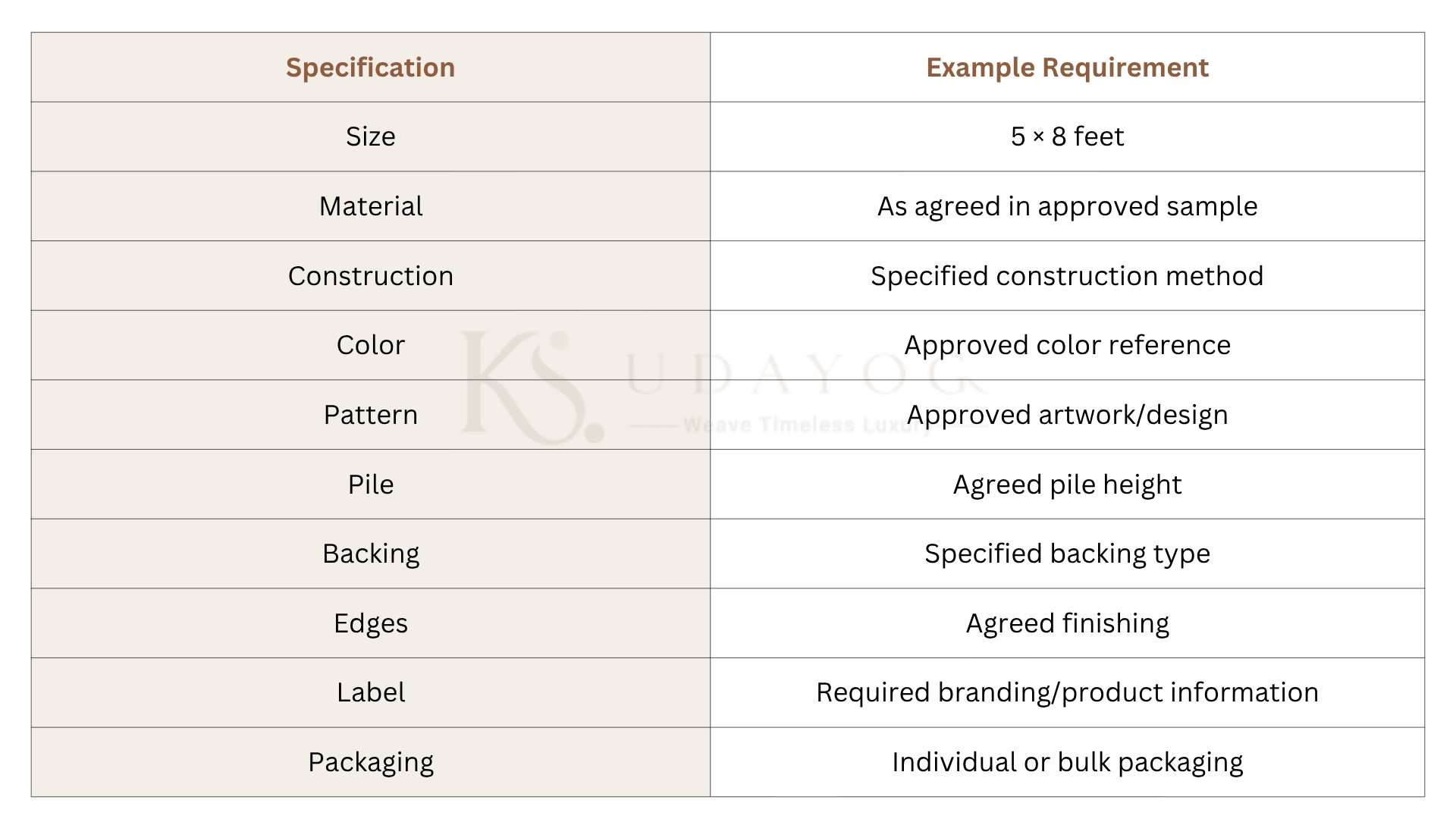
This step is particularly important when several suppliers or production teams are involved. Written specifications reduce the possibility of different interpretations.
Step 7: Discuss MOQ And Order Quantity
MOQ means Minimum Order Quantity. It is the smallest quantity a manufacturer is willing to produce or sell under specified terms.
MOQ can vary according to:
- Rug type
- Material
- Size
- Design
- Color
- Customization
- Production method
- Packaging
- Order value
A manufacturer may accept a smaller quantity for an existing design but require a higher quantity for a completely customized rug.
If you are testing a new market, ask whether the manufacturer offers a smaller initial order or sample production before committing to a larger program.
Step 8: Compare Wholesale Prices Correctly
When comparing rug manufacturers, do not compare unit prices alone.
Two suppliers could quote different prices because their products differ in material, construction, pile, backing, finishing, packaging, or customization.
Ask each supplier to quote against the same specification.
For example: Suppose you are sourcing 500 rugs with the same specifications from two Indian suppliers. Supplier A offers a lower rug price, but its customization and packaging charges are higher.
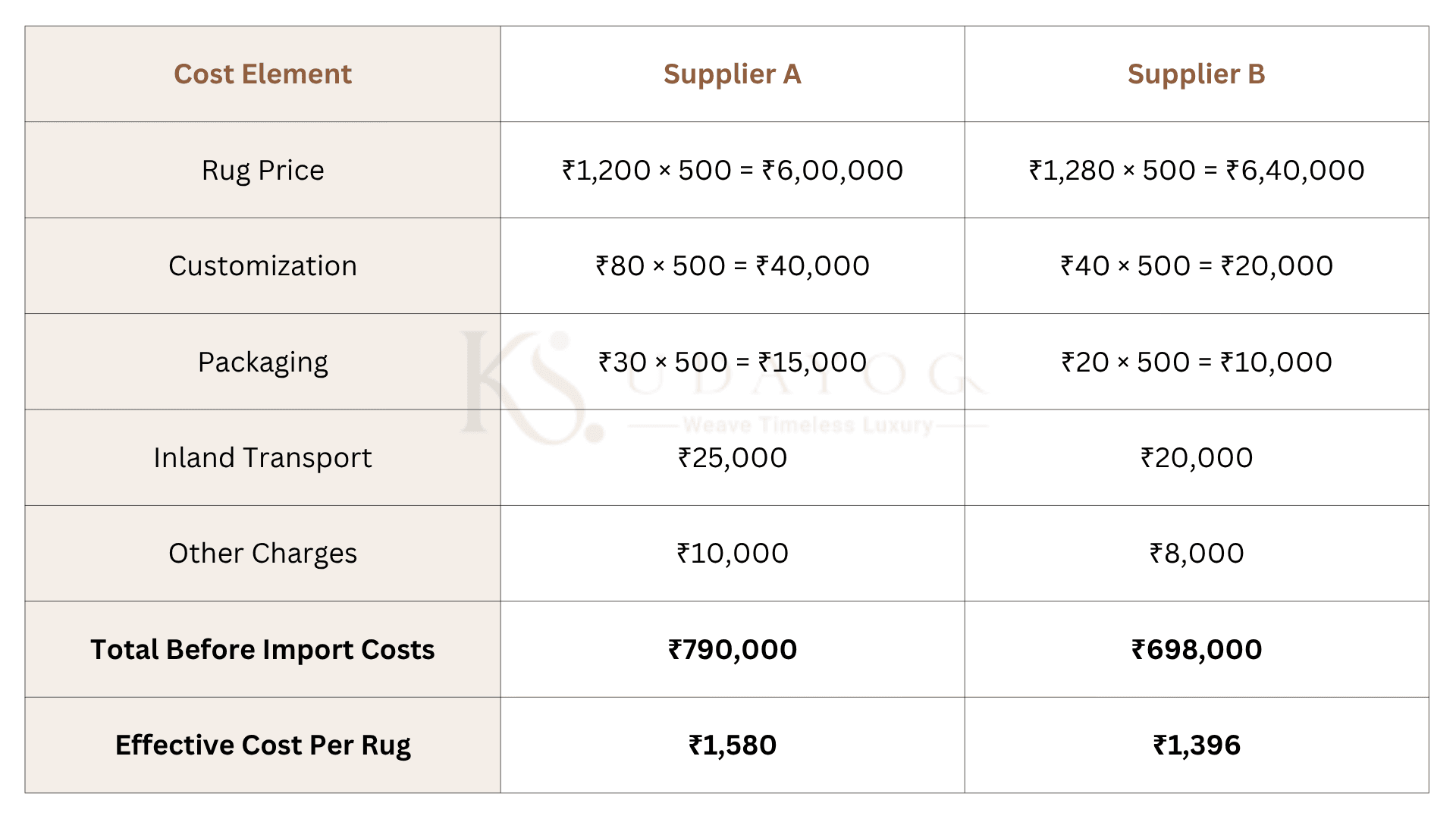
The objective is to determine which quotation provides the better overall value for the same product requirements.
Step 9: Calculate Your Landed Cost
The supplier's quoted rug price is only one part of your importing expense.
Your approximate landed cost may include:
Product Cost + Packaging + Inland Transport + Freight + Insurance + Customs/Duties + Port Charges + Clearance Fees + Final Delivery
For example, suppose your order contains 500 rugs at an agreed unit price of $30.
The product value would be:
500 × $30 = $15,000
You would then add applicable freight, insurance, customs-related charges, clearance costs, local transportation, and other expenses to determine the amount required to get the rugs to their final destination.
This calculation is important because a supplier with the lowest factory price may not produce the lowest overall landed cost.
Step 10: Discuss Customization And Private Label Requirements
If you want to import premium rugs under your own brand, discuss customization before production begins.
Depending on the manufacturer, requirements may include:
- Custom colors
- Custom dimensions
- Original patterns
- Brand labels
- Care labels
- Hang tags
- Packaging
- Barcodes
- Carton markings
- Special finishing
- Private-label presentation
Ask which elements require additional development charges or higher MOQs.
Also confirm who owns the final artwork, whether the manufacturer can reproduce it for future orders, and how design approvals will be documented.
Step 11: Confirm Packaging Requirements
Rugs need packaging that protects them during handling, transportation, storage, and delivery.
Discuss:
- Individual packaging
- Plastic or protective wrapping
- Carton requirements
- Moisture protection
- Palletization, where applicable
- Outer carton markings
- Product labels
- Quantity per carton
- Shipping marks
Your packaging requirements should be agreed before the final quotation because packaging can affect both cost and shipment volume.
Step 12: Understand Export And Import Documentation
International rug shipments require appropriate commercial and shipping documentation. The exact requirements depend on the shipment, origin, destination, product classification, and applicable regulations.
Common documents may include:
- Commercial invoice
- Packing list
- Bill of lading or air waybill
- Certificate of origin, where applicable
- Export documentation
- Customs documentation
- Product-specific certificates, where required
Do not assume that every shipment follows exactly the same documentation process. Confirm the requirements with your freight forwarder, customs professional, and relevant authorities in the destination market.
Step 13: Understand HS Classification And Import Duties
Rugs and carpets generally fall within HS Chapter 57, but the exact classification depends on the product's characteristics, including its construction and material.
This matters because the classification can affect applicable duties, taxes, documentation, and customs treatment.
Before placing a large order, confirm the appropriate tariff classification for your specific product in the destination country. Do not rely on a generic HS code found in an online article when calculating your actual import cost.
Step 14: Choose Suitable Rug Shipping Terms
Discuss the applicable Incoterm with your supplier and understand exactly which costs and responsibilities belong to each party.
Common terms buyers may encounter include:
- EXW: Buyer takes responsibility from the supplier's premises
- FOB: Seller handles specified origin responsibilities up to the agreed loading point
- CIF: Seller arranges cost, insurance, and freight to the named destination port
- DDP: Seller generally takes responsibility for delivery including applicable import formalities, subject to the agreed terms
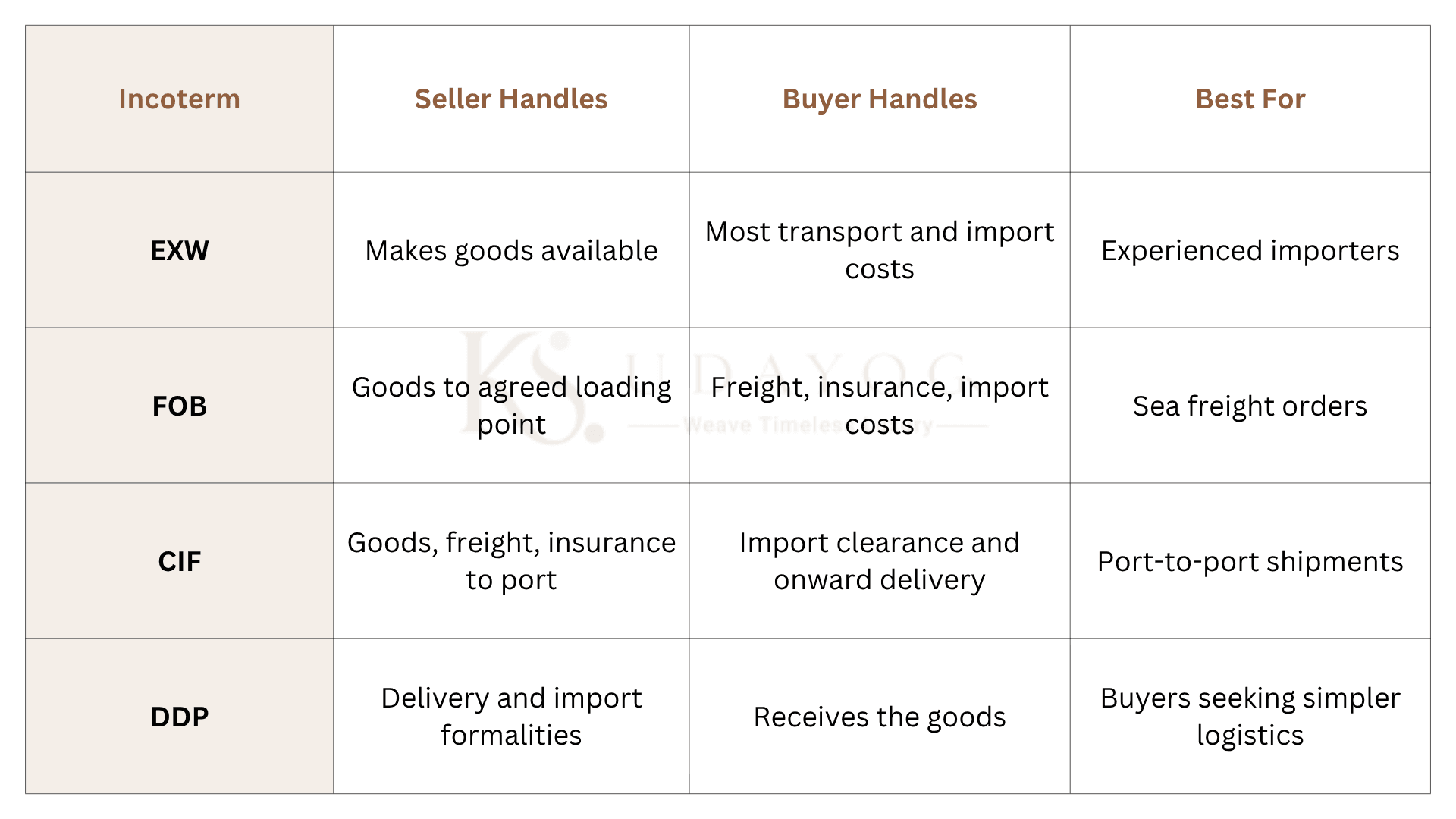
The exact obligations depend on the named place and contract. Make sure both parties understand who is responsible for transportation, insurance, customs clearance, duties, and final delivery.
Step 15: Select Sea Freight Or Air Freight
For larger rug orders, sea freight is often more practical because rugs can occupy substantial shipment volume. Air freight may make more sense when speed is more important than transportation cost or when the shipment is relatively small.
Consider:
- Order volume
- Shipment weight
- Shipment volume
- Required delivery date
- Freight rates
- Destination
- Product value
- Urgency
Ask your logistics provider to compare available options before finalizing the shipment.
Step 16: Approve Pre-Shipment Inspection
A pre-shipment inspection gives you an opportunity to identify problems before the goods leave India.
The inspection should compare the finished goods against the approved specifications and sample.
Check:
- Quantity
- Dimensions
- Color
- Pattern
- Material
- Construction
- Pile
- Backing
- Edge finishing
- Labels
- Packaging
- Visible defects
For a large order, checking only one rug is not enough. Inspect a suitable selection from the production batch according to an agreed inspection procedure.
Step 17: Arrange Shipment And Customs Clearance
Once production and inspection are complete, the shipment can move through the export and transportation process.
A simplified sequence is:
Final production → Quality inspection → Packaging → Export documentation → Freight booking → Export clearance → Shipment → Destination arrival → Customs clearance → Duties and taxes → Final delivery
Your freight forwarder or customs representative can help coordinate the relevant logistics and clearance requirements.
Make sure the commercial documents match the actual shipment. Differences between the invoice, packing list, product description, quantity, or shipment details can create unnecessary clearance issues.
Step 18: Inspect The Rugs After Arrival
Your rug quality check should not stop when the shipment leaves India.
After receiving the goods, inspect them before distributing them throughout your sales or retail network.
Compare the shipment against:
- Approved sample
- Purchase order
- Product specifications
- Quantity
- Packaging requirements
- Labeling requirements
Look for damaged packaging, moisture exposure, color differences, incorrect sizes, loose edges, surface defects, missing pieces, or other issues.
Photograph and document any discrepancies as soon as they are identified.
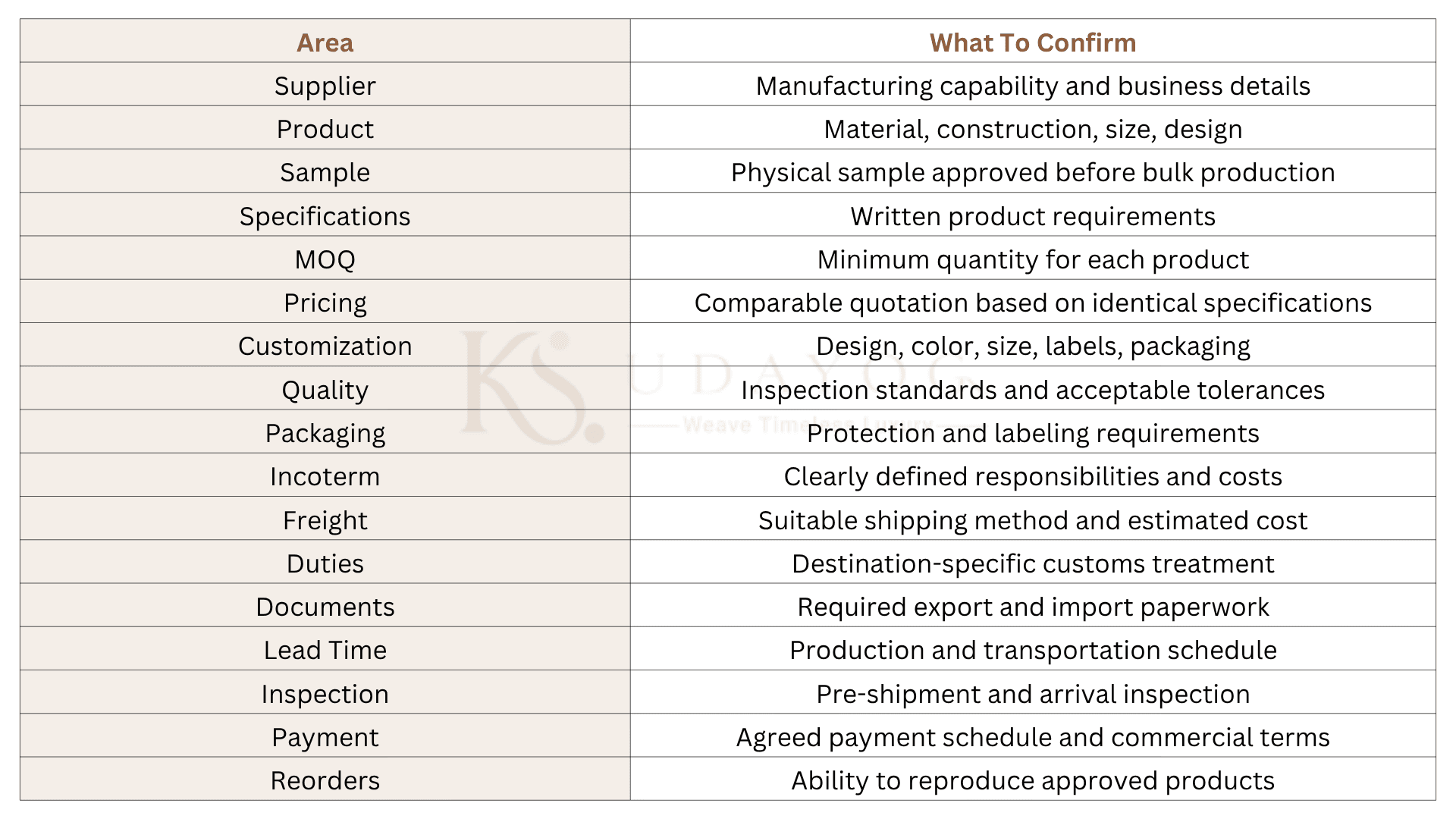
A Practical Checklist Before You Import Rugs From India
Use this checklist before approving your first large order.
Common Mistakes When Importing Rugs From India
An overseas rug order leaves little room for assumptions once production begins. Every promise made during sourcing eventually has to translate into the goods, paperwork, shipment, and final delivery you receive. The common mistakes that B2B buyers should avoid throughout this process are explained below.
1. Choosing A Supplier Based Only On Price
The cheapest quotation may not provide the best product, quality control, packaging, or service.
2. Skipping The Physical Sample
Photographs cannot fully communicate texture, pile, construction, color, or finishing.
3. Giving Vague Specifications
A supplier cannot reliably reproduce an unclear product requirement. Document the important details before production.
4. Ignoring Landed Cost
Factory price, freight, customs, clearance, and local delivery can significantly change the final cost.
5. Ordering Without Checking MOQ
A product may appear attractive until you discover that the required quantity is much higher than your planned inventory.
6. Assuming All Rug Manufacturers Offer The Same Capabilities
Manufacturers differ in materials, machinery, craftsmanship, capacity, customization, and construction methods.
7. Failing To Confirm Incoterms
Misunderstanding shipping responsibilities can lead to unexpected charges or delays.
8. Waiting Until Arrival To Check Quality
Problems are easier to address when identified before the shipment leaves the manufacturing facility.
9. Not Planning For Repeat Orders
If you are building a long-term collection, confirm whether the supplier can reproduce approved products with acceptable accuracy.
How To Choose The Right Indian Rug Manufacturer
The right rug manufacturer should match your required rug type, materials, construction, sizes, customization needs, and order quantity. A large catalog alone does not guarantee that the supplier can produce your specific requirements.
Manufacturing capabilities are important when evaluating a supplier. The reliable rug partner should have suitable production facilities, skilled workers, and experience with your required rug construction, along with the capacity to handle your expected order volume.
Quality standards should also be verified through physical samples and production checks. The sample should match your expectations for material, pile, dimensions, color, pattern, backing, edge finishing, and overall construction before bulk production begins.
Commercial terms deserve equal attention because the lowest unit price may not provide the best overall value. MOQ, customization charges, packaging, lead time, payment terms, production capacity, and repeat-order support should all fit your sourcing requirements and future demand.
Why Wholesale Buyers Source Rugs Directly From India?
Direct sourcing can give wholesale buyers greater involvement in product development and order planning.
Depending on the manufacturer and arrangement, buyers may benefit from:
- Direct communication with the production team
- Greater customization flexibility
- Better visibility into manufacturing requirements
- Bulk-order planning
- Product development support
- Easier coordination for repeat orders
- More control over specifications and packaging
However, direct sourcing also means the buyer needs to take greater responsibility for supplier verification, quality control, logistics, documentation, and import planning.
How To Make Wholesale Rug Sourcing From India Easier
A structured sourcing system can make future orders much easier to manage.
Start by creating a standard product specification template. Keep approved samples, color references, dimensions, packaging requirements, and quality standards documented.
For every new supplier, maintain a comparison sheet covering pricing, MOQ, samples, production capacity, customization, lead time, quality procedures, and export capabilities.
Once a product is approved, keep the final specification and sample reference for future production. This is particularly useful when you reorder the same design or expand your collection.
Most importantly, separate product approval from order approval. First make sure the rug is right; then make sure the commercial terms and logistics make sense.
Final Thoughts
Successful rug imports from India require a complete sourcing process rather than treating the transaction as a simple purchase. Define your product requirements, identify and verify suitable manufacturers, approve samples, document specifications, compare total costs, confirm shipping and import requirements, inspect production, and review the shipment upon arrival.
For buyers planning regular orders, the objective should extend beyond finding a supplier for a single shipment. A reliable sourcing process built around product quality, communication, pricing, production capacity, and repeat-order support can make future rug imports easier to manage and scale.
To source your next rug collection from India, partner with a reliable rug supplier that can support your product requirements, quality standards, and ongoing order volumes.
Frequently Asked Questions (FAQs)
Is India A Good Country To Source Rugs From?
India offers a broad rug manufacturing base, including handmade and machine-made products. Buyers can find varied materials, constructions, designs, sizes, and customization options for different market requirements.
What Types of Rugs Can I Import From India?
You can source handmade, tufted, woven, machine-made, decorative, outdoor, and other rug categories. Availability depends on the manufacturer's production capabilities, materials, equipment, and specialization.
How Do I Find A Reliable Rug Manufacturer In India?
Shortlist manufacturers based on product expertise, samples, customization, MOQ, quality procedures, capacity, lead time, export experience, and communication. Always verify capabilities before committing to bulk production.
What Is The MOQ For Wholesale Rugs From India?
MOQ varies by manufacturer, construction, material, design, size, customization, and packaging requirements. Ask each supplier for the MOQ applicable to your exact product specification rather than assuming one standard quantity.
How Much Does It Cost To Import Rugs From India?
The total cost depends on product pricing, quantity, packaging, freight, insurance, duties, customs clearance, handling, and final delivery. Calculate the complete landed cost rather than comparing factory prices alone.
What Documents Are Required To Import Rugs?
Common documents can include commercial invoices, packing lists, shipping documents, certificates of origin where applicable, and customs documentation. Exact requirements depend on the destination country and shipment.
How Long Does It Take To Import Rugs From India?
The timeline depends on product development, sample approval, production capacity, inspection, documentation, freight, customs clearance, and final delivery. Ask the manufacturer and logistics provider for a timeline specific to your order.
How Can I Reduce Risks When Importing Rugs From India?
Start with clear specifications, approve physical samples, verify the manufacturer, agree on quality standards, calculate landed costs, use appropriate inspections, and document discrepancies immediately after receiving the shipment.