A living room can look beautiful in a showroom, yet the wrong rug can make it feel ordinary at home. From family gatherings to everyday chai breaks, a premium rug must handle real life while keeping your space inviting.
With the festive season bringing Diwali celebrations, family visits, and get-togethers, many Indian households look for simple ways to refresh their interiors. A well-chosen rug can add warmth, complement festive décor, and make guests feel welcome.
The challenge is that not every attractive rug offers the same comfort, durability, or finish. Some lose their texture quickly, while others collect dust or become difficult to maintain, especially in busy households.
So, how do you recognise a rug worth buying? This practical checklist explains the key signs of high-quality rugs, helping Indian buyers choose the right material, weave, size, and finish for a beautiful home that stays inviting beyond the festive season.
What Does Rug Quality Really Mean?
Rug quality comes from the way materials, construction, design, and finishing work together. A premium-looking surface alone cannot guarantee that a rug will withstand regular foot traffic, maintain its shape, or retain its original appearance after cleaning.
The right quality standard also depends on where the rug will be used. A soft, decorative rug may suit a bedroom, while a busy entrance requires a construction that handles frequent footsteps and dirt. When buying wholesale rugs, you may have additional priorities, including batch uniformity, repeat-order availability, and clearly documented specifications.
The most useful approach is to evaluate a rug against its intended use rather than assume that every expensive or thick rug is automatically better.
10 Things to Check Before Buying a High-Quality Rug
A quality rug can make your living room feel warmer, your bedroom cosier, and your festive décor more inviting. But with so many designs, materials, and price ranges available, choosing the right one can be tricky. Here are 10 things to check before buying a high-quality rug that looks beautiful and lasts longer.
1. Material Quality and Fibre Composition
The fibre is one of the first details worth checking because it influences the rug’s feel, appearance, maintenance, and suitability for different spaces. Clear material information also helps you compare products that may look almost identical.
Here is how common rug materials differ:
- Wool Rug: A natural fibre valued for its warmth, resilience, and textured appearance. Wool rugs can suit living rooms and bedrooms, although shedding and care requirements vary by construction.
- Cotton Rug: A soft, versatile material used in flatweave rugs, lightweight decorative rugs, and other textile designs. Care requirements depend on the weave, dyes, and backing.
- Jute Rug: A plant-based fibre with a natural, textured appearance. Jute rugs can suit dry indoor areas, but moisture and intensive cleaning may be challenging.
- Polypropylene Rug: A synthetic fibre commonly used in practical, budget-conscious rugs. Its performance depends on yarn quality, construction, and finishing.
- Polyester Rug: A synthetic fibre often selected for its soft feel and colour possibilities. Pile construction and product specifications determine its suitability for different traffic levels.
- Viscose Rug: A fibre known for its silky sheen and smooth appearance. Viscose rugs generally need more careful handling because moisture and friction can affect their appearance.

Buyer’s check: Look for the exact fibre composition on the product label or specification sheet. Terms such as “luxury feel” and “premium finish” do not replace clear material information.
2. Rug Construction and Weaving Technique
The construction method explains how the rug is formed and offers useful clues about its expected performance. Hand-knotted, hand-tufted, handwoven, and machine-made rugs each have different structural characteristics.
- Hand-Knotted Rugs: Secure knots, clear pattern definition, and sound foundation construction
- Hand-Tufted Rugs: Even pile, secure backing, and well-finished edges
- Handwoven or Flatwoven Rugs: Uniform weave, secure yarns, and straight edges
- Machine-Made Rugs: Consistent pattern placement, even construction, and reliable finishing

Hand-made rugs can offer detailed craftsmanship and long service life, but their quality still depends on the fibre, knotting, foundation, and finishing. Similarly, a well-made machine-produced rug can provide dependable performance for everyday spaces.
Buyer’s check: Turn the rug over and examine its underside. The back should look appropriate for its construction, without unexplained gaps, loose sections, or signs of poor finishing. No single backing appearance is suitable for every rug type.
3. Rugs’ Pile Density and Surface Feel
Pile density refers to how closely the pile fibres or tufts are packed together. It can influence the surface feel, appearance, and ability to withstand compression, particularly in pile rugs.
A simple in-store check involves pressing your fingers gently into the pile. A well-constructed rug should feel appropriate for its stated design, without unexpectedly sparse areas or noticeable inconsistencies across the surface.

A fold-back check can also reveal how much of the foundation or backing shows between the fibres. However, the result needs to be interpreted according to the rug’s construction. A flatwoven rug has no raised pile to assess, and a hand-knotted rug has different structural characteristics from a tufted rug.
Buyer’s check: Compare the density across several areas instead of judging one small patch. For technical comparisons, request relevant measurements such as pile weight, construction density, or knot count where applicable.
4. Weight, Thickness, and Pile Height
A rug’s weight and thickness affect how it feels underfoot, how it sits beneath furniture, and how easily it can be moved or cleaned. However, greater weight does not automatically indicate superior quality.
A thick, high-pile rug may feel luxurious in a bedroom but prove less practical in a frequently used hallway. A thinner, tightly woven rug can be a better choice for an entrance or dining area where chairs move across the surface.

Rug weight should also be considered alongside fibre composition and dimensions. A heavier rug made from a less suitable material may not outperform a lighter rug designed for the same space.
Buyer’s check: Compare the specified dimensions, pile height, and weight per unit area where available. The intended room and expected foot traffic should guide your choice.
5. Backing Quality and Structural Support in Rugs
The backing helps support certain rug constructions and can affect their stability, flexibility, and durability. Its importance depends on how the rug is made.
A hand-tufted rug may have a secondary backing that secures the tufted structure, while some machine-made rugs use backing materials to improve stability. Flatwoven rugs may have no separate backing at all.

A well-finished backing should be appropriate for the construction, firmly attached where applicable, and free from visible cracking, peeling, or loose sections. An unusual chemical smell or brittle coating deserves further investigation rather than an automatic assumption about the product’s quality.
Non-slip performance is another separate consideration. A rug without a suitable grip layer can move on smooth flooring, even when its surface and construction are excellent.
Buyer’s check: Inspect the underside, ask about backing materials, and confirm whether a separate rug pad is recommended. For rugs with grip coatings, check compatibility with the floor type and the manufacturer’s care instructions.
6. Edge Finishing, Stitching, and Fringes
Edges receive repeated friction during vacuuming, movement, and everyday use. Weak binding or poorly secured stitching can allow a rug to fray even when the central surface remains in good condition.
The edge treatment should match the rug’s construction. Overlocking, binding, hemming, and woven fringes are different finishing approaches, and none should be judged by appearance alone.

Hand-knotted rugs may have fringes formed from the foundation’s warp threads. In other constructions, decorative fringes can be attached separately. An attached fringe is not automatically a defect; its security and suitability matter more.
Buyer’s check: Examine all four sides, especially the corners. Even stitching, secure bindings, tidy joins, and the absence of loose yarns are useful signs of careful finishing.
7. Colour Quality and Pattern Consistency of Rug
Colour quality involves more than choosing a shade that suits your interiors. Dye application, printing, yarn selection, and finishing all influence the final appearance and its ability to withstand everyday use.
A quality rug should match its approved design, allowing for any intentional variations associated with handmade production. Natural variations in yarn or dye can be part of a rug’s character, whereas unexpected patches, poorly aligned motifs, or uneven colour application may indicate a production issue.
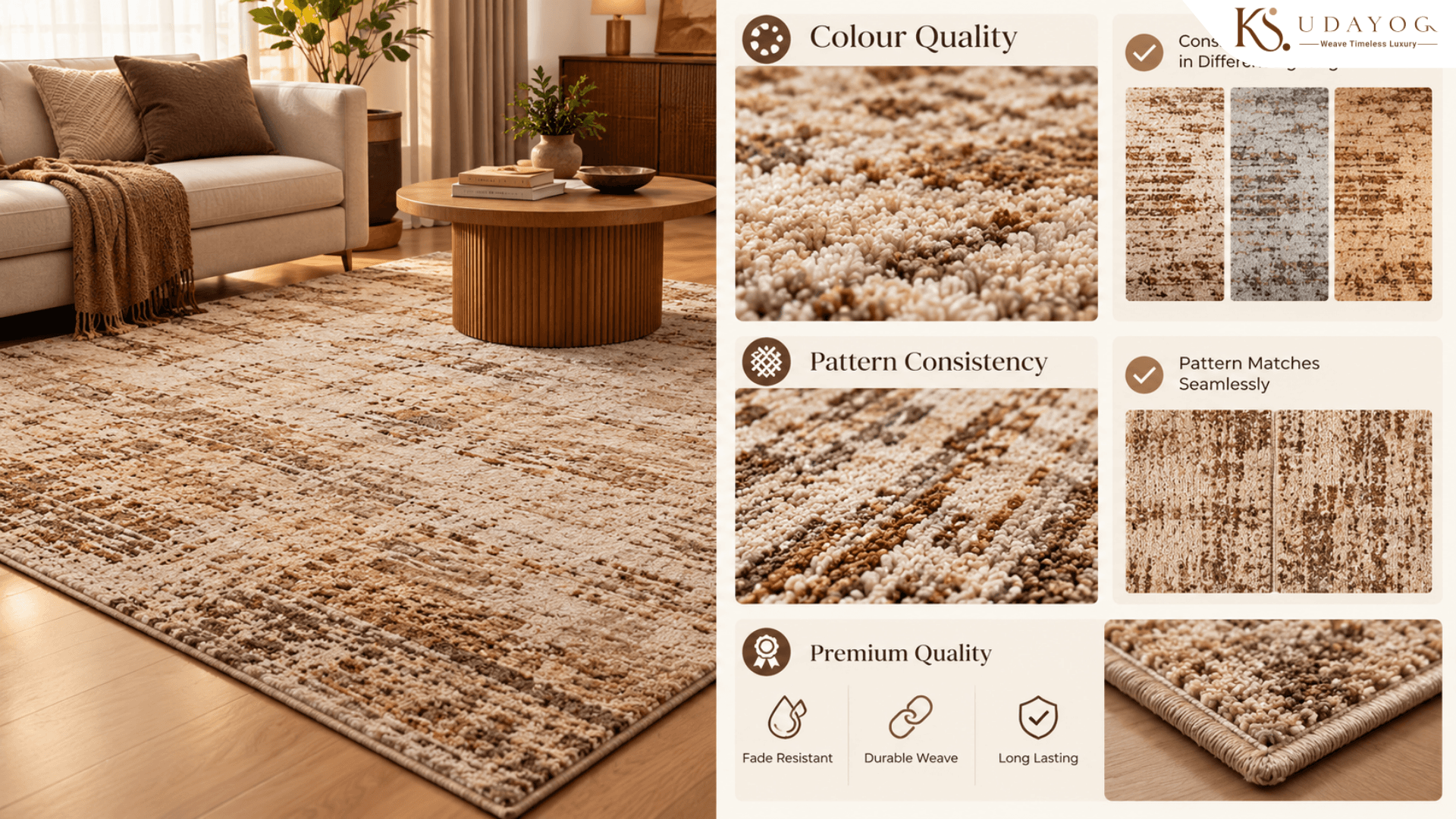
Colour fastness matters just as much. Some dyes can transfer during rubbing or washing if the product has not been processed or tested appropriately.
Buyer’s check: Compare the rug with its product description and inspect it under suitable lighting. For darker or strongly coloured rugs, ask about colour-fastness testing rather than relying only on visual inspection.
8. Durability and Everyday Performance
A high-quality rug should suit the conditions it will face. Daily footsteps, furniture pressure, pets, spills, sunlight, and cleaning routines can affect different fibres and constructions in different ways.
The most useful durability indicators include secure pile or yarns, sound edges, suitable backing, and construction appropriate for the intended traffic. A product designed for occasional decorative use may not be the best choice for a busy family living room.
Maintenance also forms part of long-term performance. Some wool rugs require specialised cleaning, while certain synthetic rugs may offer easier routine care. Washability should never be assumed from fibre content alone.
Buyer’s check: Review the care label, cleaning recommendations, and any available test information. For high-traffic areas, prioritise suitability and construction over softness or pile height alone.
9. Size, Shape, and Overall Finish
Even a well-made rug can disappoint when its dimensions or shape do not suit the room. Incorrect sizing may leave furniture awkwardly positioned, while uneven cutting or distorted edges can affect the rug’s appearance.
The finished product should match its stated measurements within the applicable manufacturing tolerance. Corners should have the intended shape, borders should look appropriately aligned, and the rug should lie reasonably flat after any temporary shipping creases have relaxed.

A handmade rug may display minor variations that reflect its production method. Such variations need to be distinguished from significant distortion or departures from the approved specification.
Buyer’s check: Measure the rug and compare its shape with the product listing. For online purchases, review the dimensions carefully and confirm whether the listed measurement refers to the finished rug or includes decorative fringes.
10. Product Information, Testing, and Supplier Reliability
Clear product information is an important part of quality assessment, particularly when you are buying online or placing a wholesale order. Reliable specifications make it easier to understand what you are purchasing and compare alternatives fairly.
Useful product information includes:
- Fibre composition and construction method.
- Finished dimensions and relevant weight details.
- Backing material and care instructions, where applicable.
- Country of manufacture and product identification.
- Available test reports or certifications, where relevant.
- Warranty, return conditions, and defect-handling procedures.
Testing and certification claims deserve careful attention. A certificate should identify the relevant product, material, or process and be verifiable with the issuing organisation. A general statement about quality is not proof of a particular certification.
Buyer’s check: Request the specification sheet and supporting documentation for any claim that materially affects your purchasing decision. For wholesale rugs, approved samples and written acceptance criteria are particularly useful.
A Quick Rug Quality Checklist for Buyers
The following rug quality checklist for B2B buyers and individuals can help you assess a rug during a showroom visit or when a delivery arrives.
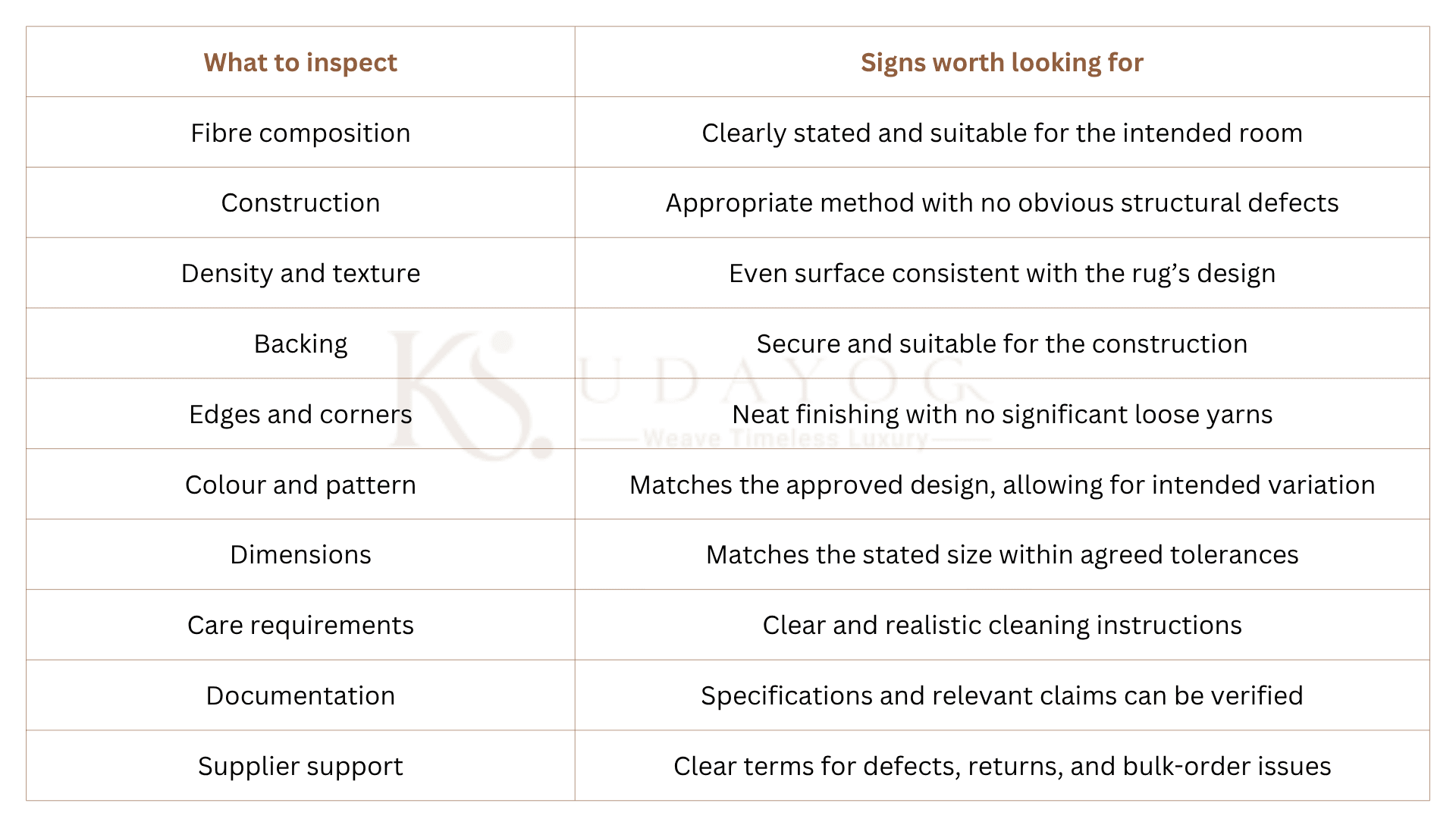
No single check determines the complete quality of a rug. The strongest assessment comes from considering the material, construction, finishing, and intended use together.
How to Choose Premium Rugs for Different Spaces
The right rug is not necessarily the most expensive option. A suitable choice balances appearance, practical performance, maintenance, and the conditions of the room.

- Rugs for Living Rooms
Living rooms often need rugs that handle regular foot traffic while complementing the furniture and décor. Wool, well-made synthetic fibres, and suitable flatwoven constructions can all work, depending on the household’s needs.
- Rugs for Bedrooms
Softness and comfort underfoot are common priorities in bedrooms. Pile texture, material feel, and cleaning requirements deserve attention, particularly when the rug will sit beside the bed.
- Rugs for Hallways and Entrances
These areas experience frequent movement and collect outdoor dirt. Durable construction, practical pile height, secure edges, and straightforward maintenance are useful selection criteria.
- Rugs for Dining Areas
A relatively low-pile or flatwoven rug can make chair movement and routine cleaning easier. The size should also allow chairs to remain on the rug when pulled away from the table.
- Rugs for Hospitality and Commercial Spaces
Hotels, offices, and other commercial settings may need rugs with clearly defined specifications, reliable repeat-order availability, and performance suited to the expected traffic. Cleaning procedures, replacement planning, and batch uniformity can matter as much as the initial purchase price.
What Wholesale Rug Buyers Should Check Before Placing Bulk Orders
Wholesale buyers face a different set of quality considerations from individual shoppers. A sample may look excellent, but the complete order must also match the approved specifications across the production batch.
- Sample approval: An approved sample establishes the expected material, texture, colours, construction, and finishing. Any agreed tolerances should be documented before production.
- Batch consistency: Colour, dimensions, pattern placement, and construction should remain within the buyer’s accepted limits. Handmade production may involve natural variations, which should be discussed in advance.
- Material transparency: Accurate fibre information helps wholesalers describe products correctly and set suitable customer expectations.
- Production capacity: The supplier should confirm realistic order quantities, lead times, and the ability to reproduce selected designs.
- Quality inspection: A defined inspection plan helps identify defects before dispatch. The sampling method and acceptable defect limits should be agreed upon rather than assumed.
- Packaging and labelling: Product labels, carton quantities, and shipping protection should match the order requirements and destination market.
- Commercial terms: Clear arrangements for payment, delivery, shortages, defects, and reorders reduce misunderstandings after the purchase.
For wholesale rugs, the best rug supplier is not simply the one offering the lowest quotation. Material transparency, reliable communication, documented specifications, and suitable quality controls all contribute to the long-term value of the order.
How KS Udayog Supports Rug Sourcing Requirements
For retailers, wholesalers, and brands exploring rug sourcing options, KS Udayog offers a relevant starting point for discussing product range and manufacturing requirements. Its website presents rugs, carpets, bath rugs, door mats, cushions, and other home textile categories, along with customisation and bulk-order options.
As a prominent rug manufacturer, we provide an in-house production facility and a multi-stage quality inspection approach. These details can help prospective buyers begin a supplier discussion, although specific capabilities and quality requirements should be confirmed directly before placing an order.
Final Remarks
High-quality rugs combine suitable materials, sound construction, careful finishing, and performance that matches their intended use. Fibre composition, density, backing, edges, colour fastness, and clear product information provide practical clues when comparing premium rugs.
For individual buyers, these checks help identify a rug that suits the room and maintenance routine. For wholesale buyers, documented specifications, sample approval, and batch inspections provide a stronger basis for purchasing decisions.
Looking for rugs for your home, retail collection, or wholesale business? Explore suitable rug options and discuss your requirements with a trusted rug manufacturer before making your next purchase.
Frequently Asked Questions (FAQs)
What Is The Most Important Factor In Rug Quality?
Material and construction are two of the most important factors, but neither works in isolation. A rug’s quality also depends on its density, backing where applicable, finishing, and suitability for the intended room. The best assessment considers all these elements together.
Are Expensive Rugs Always Better Quality?
No, a higher price does not guarantee better construction or durability. Price can reflect fibre type, manufacturing method, craftsmanship, design, and brand positioning. A well-made rug at a moderate price may offer better value than an expensive product that does not suit your needs.
How Can I Check Rug Quality Before Buying Online?
A detailed product listing should specify the fibre composition, dimensions, construction, backing where applicable, and care requirements. Close-up photographs of the front, underside, and edges can help with visual assessment. Supplier answers, verified documentation, and a clear return policy provide additional reassurance.
Does A Thicker Rug Mean Better Quality?
Not necessarily. Thickness affects the feel and appearance, but it does not independently establish durability. A dense, low-pile rug may perform better in a busy hallway than a thick rug with a less suitable construction.
What Is The Difference Between Premium Rugs And Ordinary Rugs?
The difference depends on the materials, construction, finishing, design, and performance specifications. Premium rugs may feature carefully selected fibres or more labour-intensive craftsmanship, but buyers should verify the actual product details instead of relying only on marketing terms.
What Should Wholesale Buyers Check When Sourcing Rugs?
Wholesale buyers should confirm fibre composition, construction, dimensions, sample approval, production capacity, batch tolerances, inspection procedures, and delivery terms. Written specifications and agreed defect limits help maintain expectations across larger orders.
How Can I Tell If A Rug Will Last Longer?
No visual check can predict an exact lifespan. However, suitable fibres, sound construction, secure edges, appropriate backing, and clear care instructions can indicate whether a rug is suited to its intended use. Available wear, colour-fastness, and dimensional-stability test results can provide further evidence.